Drone Warfare in Ukraine: Myths and Reality
•February 10, 2026
0
Why It Matters
Ukraine’s drone experience reshapes procurement priorities for NATO and European defense firms, highlighting the strategic value of rapid, scalable unmanned solutions over expensive, singular platforms.
Key Takeaways
- •Ukraine turned civilian drones into mass strike platforms.
- •Expendable drones outlast expensive, high‑value systems.
- •Adaptation cycles now measured in weeks, not years.
- •Drone production depends on fragile civilian supply chains.
- •Battlefield feedback accelerates R&D, prevents costly errors.
Pulse Analysis
The Ukrainian conflict has become a live laboratory for unmanned aerial systems, illustrating how necessity can accelerate technology adoption. Early in the war, hobby‑grade quadcopters provided spotter data for artillery, but the lack of doctrine forced soldiers to improvise. By 2023, dedicated FPV strike drones emerged, supported by ad‑hoc logistics, repair bays, and training pipelines. This rapid evolution demonstrates that modern militaries can field effective drone swarms without waiting for multi‑year development cycles, a lesson that reverberates across NATO’s procurement strategies.
Economic realities drive the shift toward expendable platforms. A trained infantryman represents years of investment, whereas a low‑cost drone can be produced, lost, and replaced within days. In a theater where manpower is constrained and industrial capacity limited, such as Europe’s defense ecosystem, the ability to sustain high‑tempo operations hinges on resilient, civilian‑sourced supply chains. The episode underscores that reliance on fragile component sources can bottleneck scale, making supply‑chain resilience a critical factor in future drone programs.
The broader implication for defense R&D is clear: speed and adaptability trump perfection. Ukrainian operators provide immediate combat feedback, exposing flaws and prompting iterative upgrades faster than traditional acquisition cycles allow. This feedback loop fuels a culture of continuous improvement, where simple, modular designs can be fielded and refined in weeks. As the initiative pivots to maritime drone warfare, the same principles—rapid iteration, low cost, and supply‑chain agility—will likely dictate how navies confront emerging threats in the Black Sea, Baltic, and beyond.
Drone Warfare in Ukraine: Myths and Reality
The European Programme of the Irregular Warfare Initiative is proud to present another episode of the Notes from the Eastern Front: Lessons from the Russo-Ukrainian War series. The discussion is hosted by Ukraine Hub Lead, Armenak Ohanesian, and Dr Olga R. Chiriac, Europe Programme Director. Our guest is Ivan Grys, Sergeant First Class in the Ukrainian Armed Forces and co-founder of Resist Labs.
The Ukraine Hub of the IWI Europe Program brings forth discussions grounded in battlefield reality., exchanges with operators and practitioners of IW in Ukraine, it explores what separates ideas that survive combat from those that collapse under pressure.
This episode explores how drone warfare has evolved under real combat pressure and why Ukraine’s experience is reshaping modern military thinking. Rather than focusing on theory or future concepts, the discussion is grounded in what has worked, what has failed, and what has survived on an active battlefield since 2022.
We begin with a brief look at how drones entered the war in Ukraine. In the early phase, they were mostly civilian tools used for reconnaissance and artillery correction. There was no doctrine, no standards, and little protection against losses. By 2023, FPV drones had become strike weapons, dedicated drone units appeared, and logistics, training, and repair became part of military planning. Today, drones are used at massive scale, with constant upgrades driven by enemy countermeasures. Adaptation cycles are measured in weeks, not years.
The conversation then turns to war economics. Drones are not valuable because they are advanced, but because they are replaceable. A trained soldier takes years to prepare and cannot be quickly replaced. Drones reduce exposure, take on high-risk missions, and help compensate for limited manpower. This matters especially for Europe, where resources and industrial depth are finite. In wars against countries like Russia, outcomes are shaped by what can be produced, lost, and replaced every day.
A central theme of the episode is why the idea of a “perfect drone” is misleading. In a contested environment filled with electronic warfare and air defenses, large and expensive platforms quickly become high-value targets. Their survivability does not scale with price. Instead, simple and expendable systems prove more resilient when they can be updated quickly and deployed in large numbers. The evolution of the Shahed drone illustrates this logic: not as a sophisticated weapon, but as a basic platform that is constantly modified, tested, and improved in combat. Its danger lies in how fast it evolves, not in technical perfection.
The episode also addresses the strategic risk of production dependence. Modern drone warfare relies heavily on fragile supply chains and civilian technologies. Without control over key components and manufacturing, scale and endurance are impossible.
Finally, the discussion highlights why Ukrainian battlefield experience is essential for any serious research and development effort. Real combat feedback exposes failures immediately, prevents costly mistakes, and keeps systems aligned with reality.
The key conclusion is simple: modern war is not about perfect weapons. It is about speed, scale, and the ability to learn faster than the enemy.
In our upcoming segment we address drone and robotics warfare in the maritime environment. Specifically, how a nation without an active Navy has taken the battlefield away from the Russian Black Sea fleet. We will look at current developments for subsea warfare and draw conclusions for the Baltic Sea, Arctic, and South Chinese Sea.
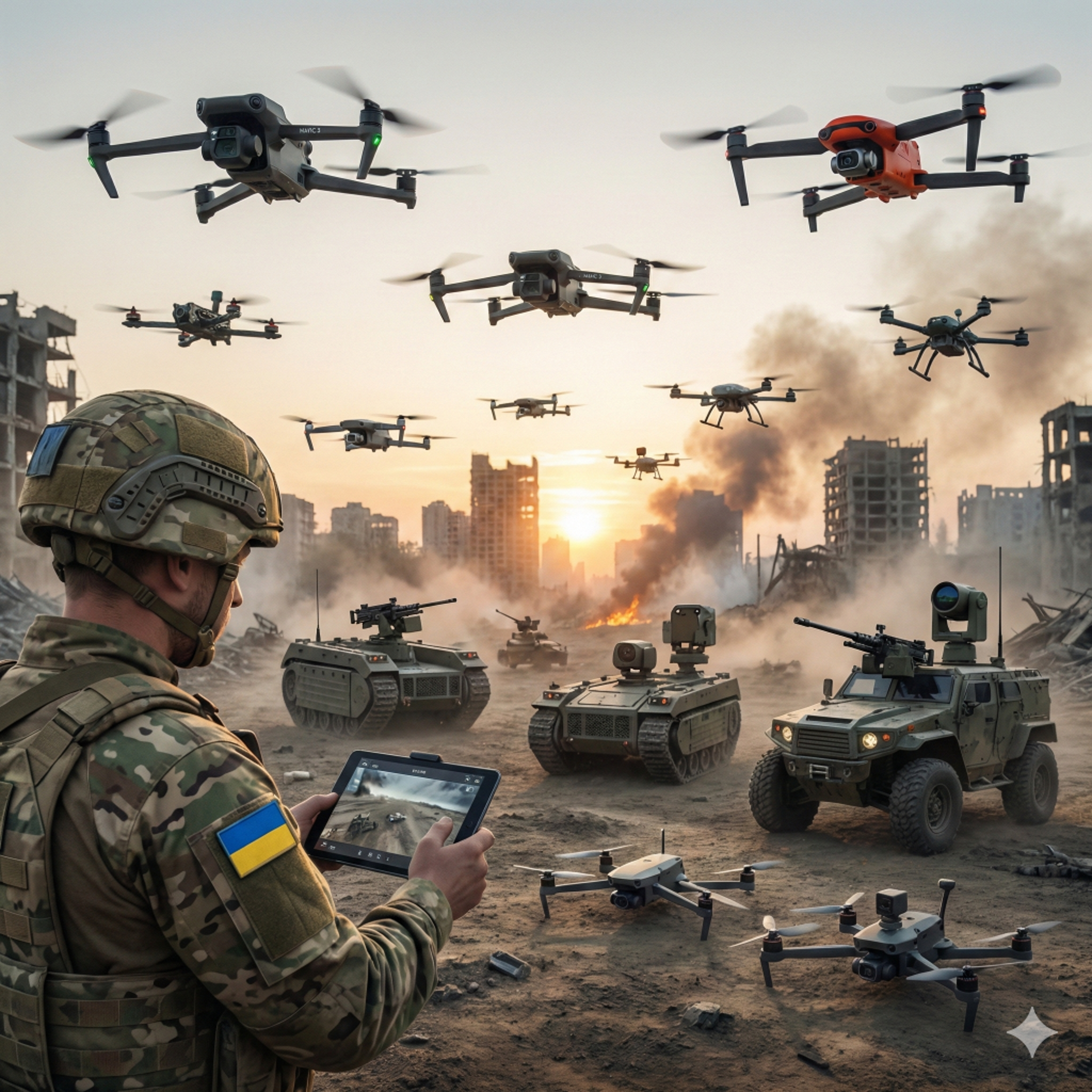
Main image: Generated by Gemini Pro on February 9th, 2026, 11:30 (UTC +2).
If you value reading the Irregular Warfare Initiative, please consider supporting our work. And for the best gear, check out the IWI store for mugs, coasters, apparel, and other items.

0
Comments
Want to join the conversation?
Loading comments...