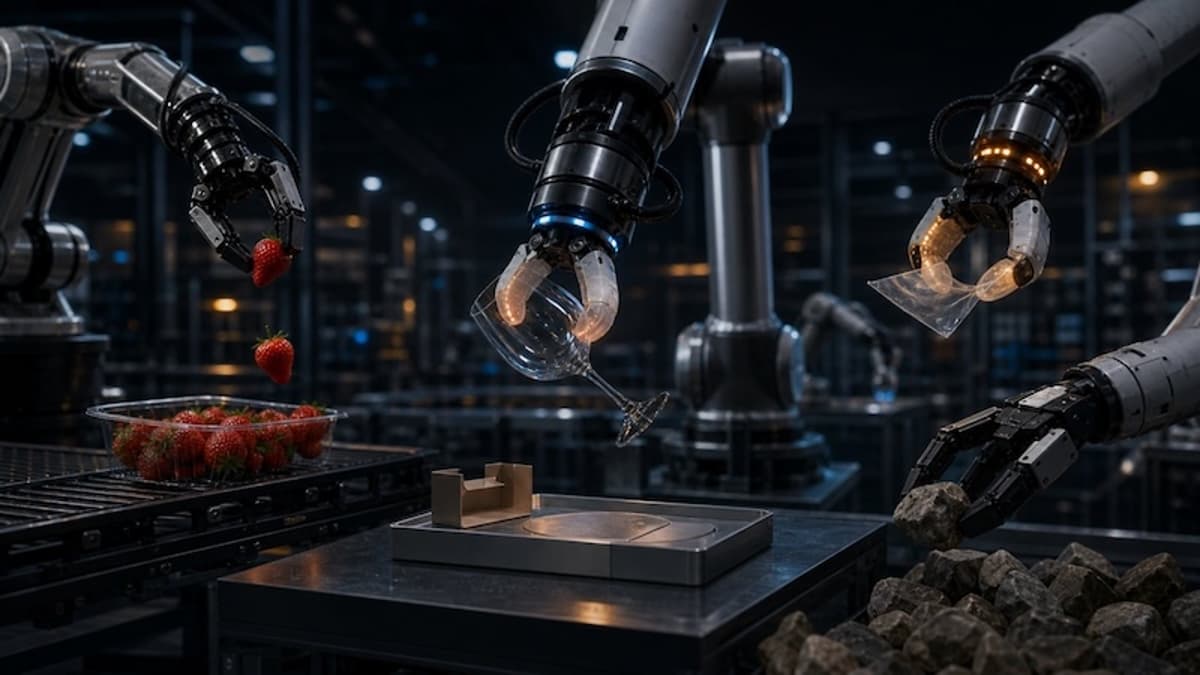
Kirisense Wins Funding to Develop Robotic Fingertips that Can Sense Touch and Slip
Why It Matters
Tactile sensing will let robots grasp and manipulate objects reliably, unlocking new applications beyond structured factories and driving growth in logistics, healthcare and consumer robotics.
Key Takeaways
- •Henry Royce Institute funds Kirisense's shear‑sensing fingertip prototype
- •Project targets real‑time detection of force, slip, and shear
- •Optical tactile sensor offers compact hardware versus camera‑based systems
- •Enables reliable grasping for logistics, food handling, healthcare robots
- •Launches July 2026, partnership with University of Sheffield
Pulse Analysis
The robotics sector has spent the last decade perfecting visual perception, yet the ability to physically interact with objects remains a bottleneck. Tactile feedback—information about pressure, texture, and slip—mirrors the human sense of touch and is essential for tasks that require delicate handling or rapid adjustments. As AI and machine vision continue to mature, manufacturers are turning to haptic technologies to bridge the manipulation gap, a shift that could redefine automation across multiple industries.
Kirisense’s approach diverges from many academic projects that rely on high‑resolution cameras and intensive image processing. By embedding a compact optical sensor directly into a fingertip, the startup promises millisecond‑scale force and slip detection with a simpler hardware stack. This architecture reduces system complexity, power consumption, and cost, making it more attractive for commercial deployment. The collaboration with the University of Sheffield adds rigorous research backing, while the Henry Royce Institute’s funding underscores the strategic importance of tactile sensing for the UK’s advanced manufacturing agenda.
If successful, the technology could accelerate robot adoption in sectors where precision handling is critical. In logistics, robots could sort fragile parcels without damage; in food processing, they could manipulate delicate produce without bruising; in healthcare, assistive robots could handle surgical tools or patient‑care items safely. By delivering a reliable sense of touch, Kirisense positions itself at the forefront of the next automation wave, potentially reshaping supply‑chain dynamics and expanding the market for intelligent, dexterous robots. The project's outcomes will likely influence standards and spur further investment in haptic solutions.
Kirisense wins funding to develop robotic fingertips that can sense touch and slip
Comments
Want to join the conversation?
Loading comments...