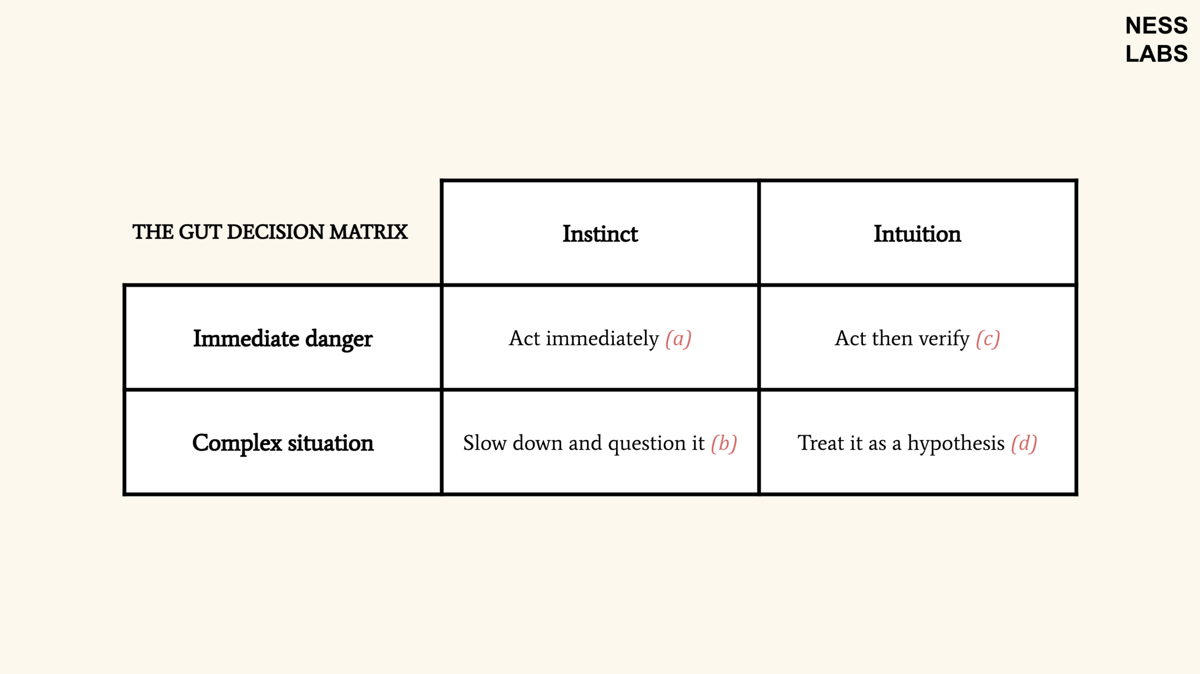
The Gut Decision Matrix: When to Trust Instinct and Intuition
•March 11, 2026
0
Key Takeaways
- •Instinct is evolutionarily hardwired, triggers fast survival responses
- •Intuition derives from learned pattern recognition, built through expertise
- •Matrix matches response type to context for better decisions
- •Misapplied instincts can hinder modern complex problem solving
- •Treat intuition as hypothesis in slow, complex scenarios
Summary
The article distinguishes instinct and intuition as two separate sources of “gut feelings.” Instinct is an evolutionary, fast‑acting response to immediate threats, while intuition is learned pattern recognition honed by experience. The author proposes a Gut Decision Matrix that asks whether a reaction is instinct or intuition and whether the situation is urgent or complex, guiding when to act quickly or pause. Applying this framework can improve judgment in both personal and professional decisions.
Pulse Analysis
Instinct is a hard‑wired survival system that evolved to prioritize speed over accuracy. Neuroscience links these rapid reactions to the amygdala and brainstem, which fire within milliseconds when a threat is perceived. In a corporate setting, this translates to snap judgments about market volatility, competitor moves, or safety concerns. While such reflexes can protect an organization from immediate danger—such as a cyber‑attack or supply‑chain disruption—they are calibrated for primitive environments and may misfire when the stimulus is abstract or financially nuanced. Understanding this biological basis prevents overreliance on gut‑level fear in strategic planning.
Intuition, by contrast, emerges from accumulated experience and domain‑specific pattern recognition. Experts like firefighters, surgeons, or seasoned investors develop an unconscious ability to match current cues with thousands of prior cases, a phenomenon documented by psychologist Gary Klein’s recognition‑primed decision model. This learned gut feeling allows rapid, accurate assessments without deliberate analysis, giving leaders a competitive edge in fast‑moving markets. However, intuition is not infallible; it reflects the quality and breadth of the underlying data set. Companies that invest in deep expertise and continuous learning can therefore amplify the reliability of intuitive insights.
The Gut Decision Matrix offers a simple, two‑step filter to separate instinct from intuition and match each to the appropriate context. By first asking whether a reaction is a primal instinct or an experience‑based intuition, and then evaluating if the situation is urgent or complex, decision‑makers can decide when to act immediately or pause for analysis. Implementing this framework in meetings, risk assessments, or product launches helps teams avoid costly overreactions while still capitalizing on genuine expertise. In practice, the matrix turns vague “gut feelings” into actionable intelligence, improving both speed and accuracy of business decisions.
Comments
Want to join the conversation?