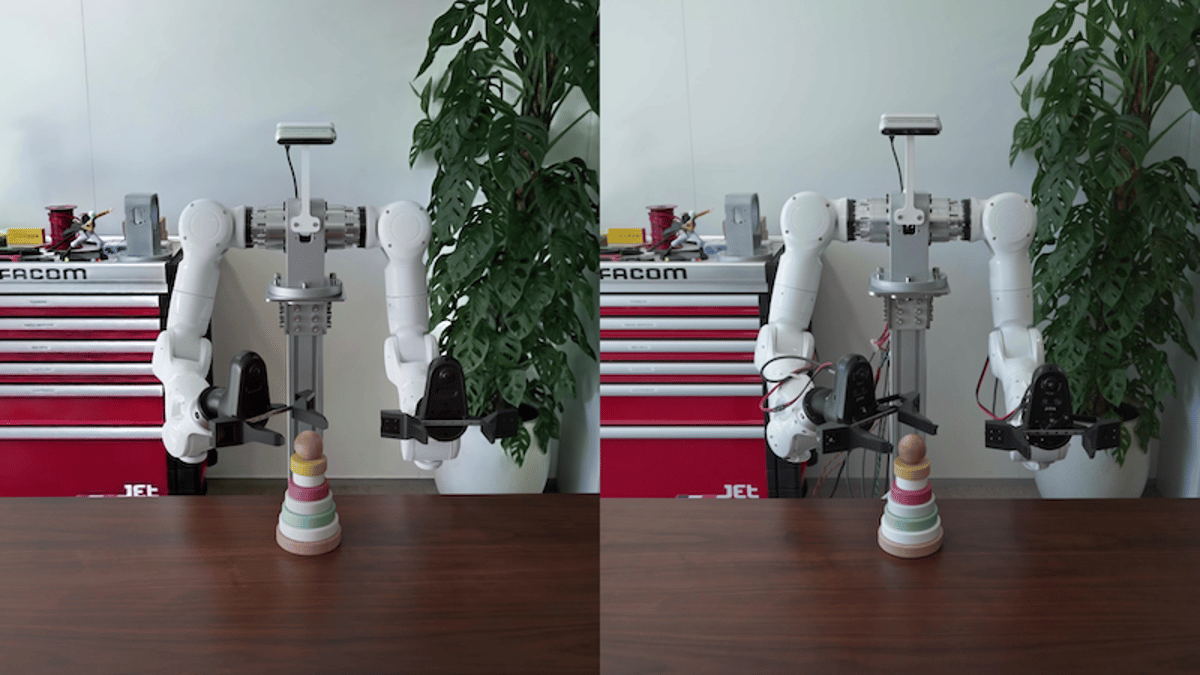
Genesis AI Launches Simulation Platform to Accelerate Robotics Development
Companies Mentioned
Why It Matters
By turning weeks of physical testing into minutes, Genesis World 1.0 accelerates robot innovation, reduces hardware costs, and speeds time‑to‑market for AI‑driven automation solutions.
Key Takeaways
- •Genesis World 1.0 cuts evaluation from a week to 30 minutes.
- •Simulation runs 40,000 object-handling attempts in 30 minutes vs 166 hours.
- •89% correlation between simulated and real-world robot performance.
- •Nyx rendering and Quadrants compiler deliver photorealistic physics at scale.
- •Digital twins created via photogrammetry enable varied lighting and layout tests.
Pulse Analysis
Robotics development has long been bottlenecked by the need for extensive physical testing, which consumes time, lab space, and expensive hardware. Genesis AI’s Genesis World 1.0 reshapes this paradigm by offering a cloud‑based simulation environment that can execute thousands of test scenarios in parallel. The platform’s ability to shrink a typical week‑long evaluation to just half an hour not only speeds product cycles but also democratizes access to high‑fidelity testing for startups and research labs lacking large robot fleets.
At the core of Genesis World 1.0 are three proprietary technologies: Nyx, a photorealistic rendering engine tuned for robotic perception; a robust physics layer that handles rigid bodies, deformable materials, and fluid dynamics; and Quadrants, a GPU‑accelerated compiler that distributes workloads across diverse hardware. By investing a year in realism, Genesis achieved an 89% alignment between simulated and real‑world outcomes, dramatically reducing the sim‑to‑real gap that has historically limited trust in virtual testing. The platform also supports digital‑twin creation through photogrammetry, allowing users to replicate real workspaces and vary lighting, object placement, and camera angles at scale.
Looking ahead, the implications extend beyond evaluation. As reinforcement learning and foundation models mature, realistic simulation will become the primary training ground for autonomous robots, enabling continuous improvement before any physical deployment. Companies that adopt such virtual pipelines can expect lower R&D expenditures, faster iteration, and a competitive edge in sectors ranging from warehouse automation to healthcare robotics. Genesis World 1.0 positions itself as essential infrastructure for the next wave of AI‑powered robots, signaling a shift toward simulation‑first development in the broader robotics ecosystem.
Genesis AI launches simulation platform to accelerate robotics development
Comments
Want to join the conversation?
Loading comments...