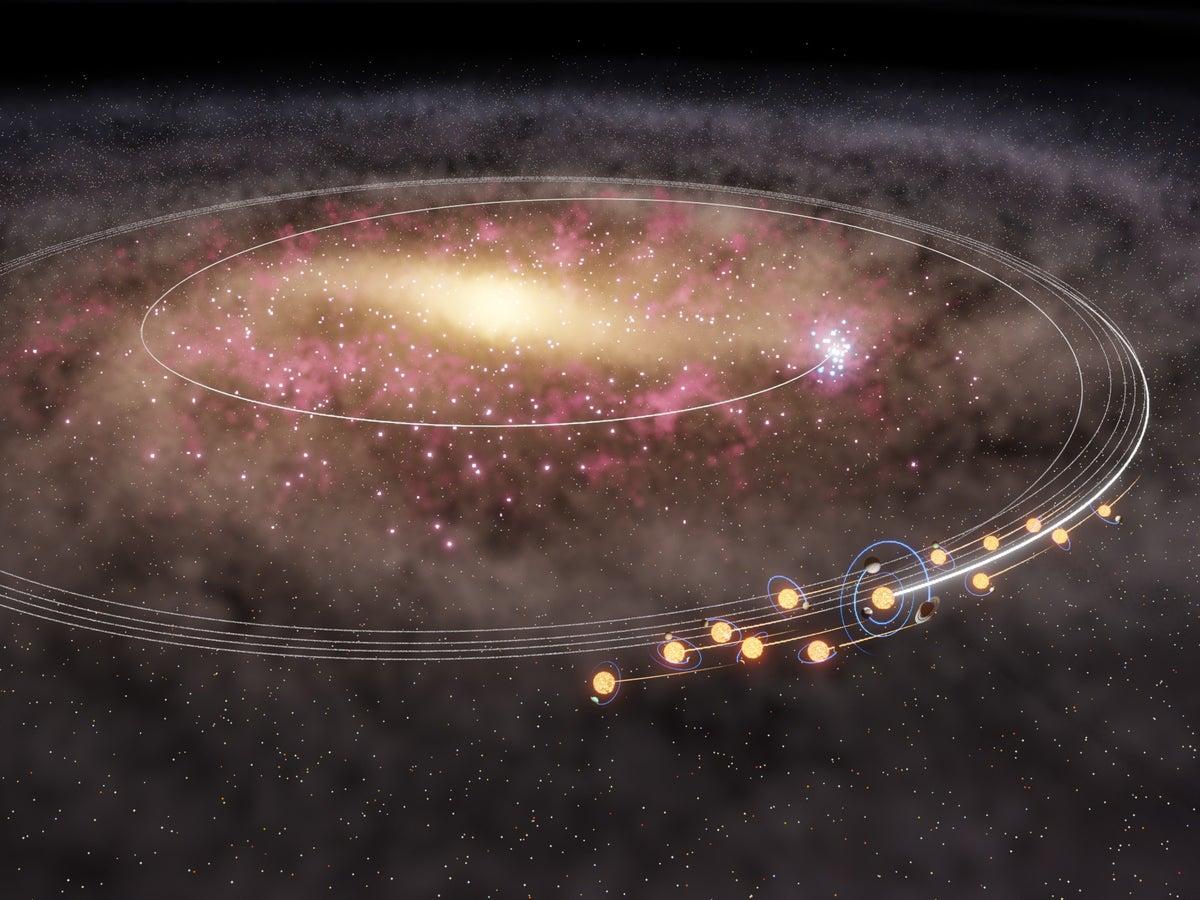
The Sun and Thousands of Its Twins Migrated Across the Milky Way Just in Time
•March 12, 2026
0
Why It Matters
Understanding the Sun’s migration informs models of galactic evolution and the distribution of habitable zones, impacting predictions of planetary system formation across the Milky Way.
Key Takeaways
- •Sun migrated ~10,000 light‑years outward from galactic center
- •Thousands of solar twins share same migration path
- •Gaia data identified 6,594 solar twins within 1,000 ly
- •Corotation barrier likely incomplete, allowing mass migration
- •Bar formation and Sagittarius dwarf interactions drove migration
Pulse Analysis
The Milky Way is not a static backdrop; its inner regions constantly reshape the orbits of billions of stars. Recent research highlights how the galaxy’s rotating bar—a dense, elongated concentration of stars and gas—can destabilize the corotation barrier that normally confines inner‑disk stars. When the bar was still forming, its gravitational torque, combined with perturbations from the Sagittarius dwarf galaxy, created a window for massive outward migration, allowing groups of chemically similar stars to leap tens of thousands of light‑years.
Leveraging the European Space Agency’s Gaia mission, astronomers compiled a catalog of 6,594 solar‑twin stars within a 1,000‑light‑year sphere around Earth. By cross‑matching stellar ages, metallicities, and orbital parameters, they uncovered two distinct age peaks, the broader one aligning with the Sun’s 4.6‑billion‑year timeline. This pattern suggests a coordinated migration event rather than random scattering. The study also addressed potential sampling bias, confirming that orbital eccentricity does not skew the age distribution, thereby strengthening the case for a genuine migratory cohort.
If the Sun’s journey was part of a larger wave, it reshapes how we view the Galactic habitable zone and the likelihood of Earth‑like planets elsewhere. Stellar migration can redistribute heavy elements essential for planet formation, influencing where life‑supporting worlds may arise. Future surveys and refined dynamical models will test the timing of bar formation and dwarf‑galaxy encounters, offering deeper insight into the Milky Way’s evolving architecture and its impact on planetary system diversity.
The sun and thousands of its twins migrated across the Milky Way just in time
0
Comments
Want to join the conversation?
Loading comments...