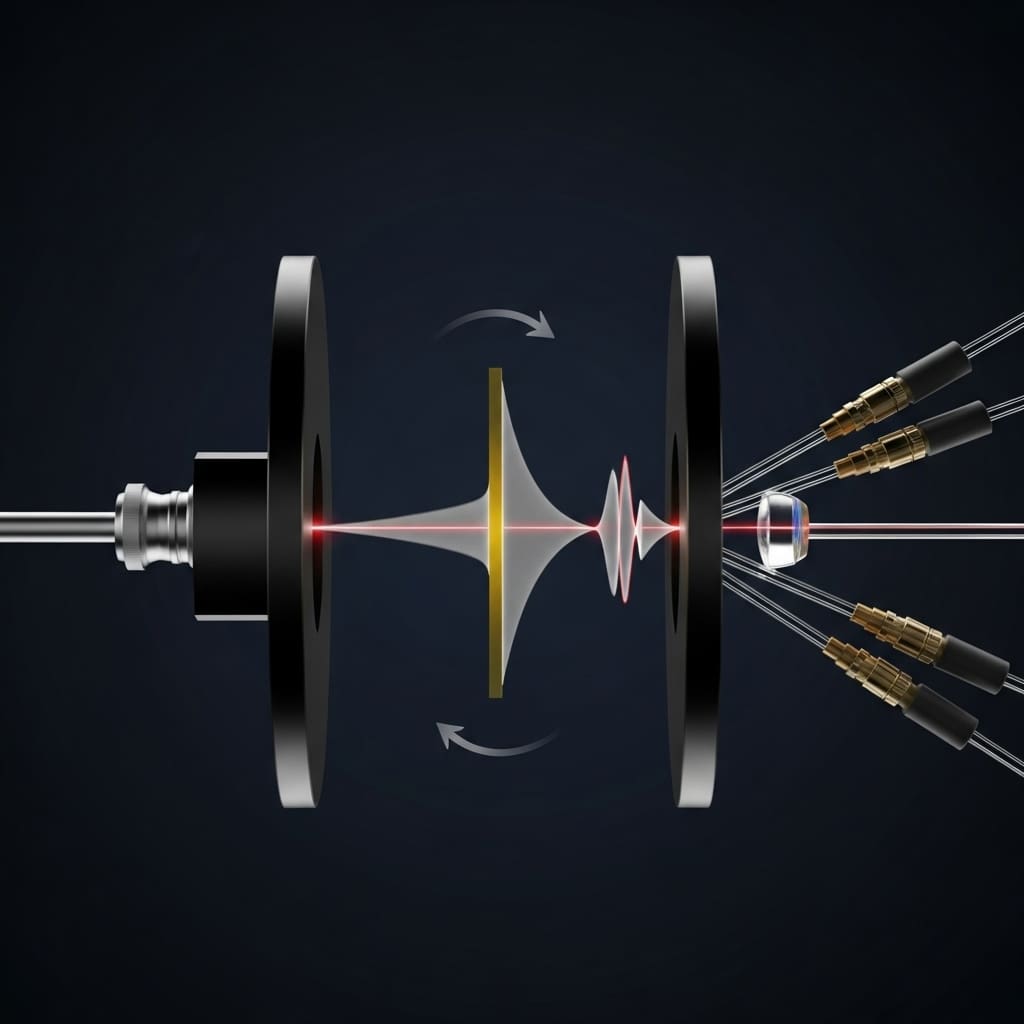
Db Signal Boost Achieved by Mitigating Nonlinear Transduction Noise in Cavity Optomechanics

Why It Matters
Eliminating TIN unlocks quantum‑limited sensing at ambient conditions, accelerating practical optomechanical technologies.
Db Signal Boost Achieved by Mitigating Nonlinear Transduction Noise in Cavity Optomechanics
Daniel Allepuz‑Requena, Zohran Ali, Dennis Høj, Yingxuan Chen, Luiz Couto Correa Pinto Filho, Alexander Huck, et al.
Technical University of Denmark
Precise displacement measurements are fundamental to numerous scientific fields, yet achieving accuracy at the standard quantum limit remains a significant challenge. The authors have demonstrated a novel technique to overcome limitations imposed by nonlinear transduction noise in cavity optomechanical systems. Their research addresses thermal intermodulation noise (TIN), which typically degrades measurement precision as optomechanical coupling strength increases. By applying a nonlinear transform to data from a high‑cooperativity microcavity, the team eliminated all orders of this noise, achieving a nearly 10 dB improvement in signal‑to‑noise ratio and paving the way for more sensitive and accurate measurements in future experiments. This advancement is particularly relevant for room‑temperature systems where such noise is expected to be a dominant factor.
1. Overview of the Breakthrough
The breakthrough was achieved by directly addressing and mitigating TIN, a critical limitation in high‑cooperativity optomechanical systems. The work centers on a membrane‑in‑the‑middle microcavity engineered to exhibit cooperativity exceeding the thermal occupation. A novel nonlinear transform was applied to the recorded output, effectively eliminating all orders of TIN and yielding a ~10 dB improvement in the mechanical signal‑to‑noise ratio.
2. Nonlinear Transduction and Thermal Intermodulation Noise
In the strong‑coupling regime, standard linearized analysis fails because thermomechanical motion nonlinearly mixes with the cavity response, creating imprecision beyond the standard quantum limit. Previously, cancellation of this noise was limited to second‑order nonlinearity via operation at a specific “magic detuning”. The present technique removes TIN across all orders by:
-
Performing detailed spectral analysis and correlation measurements to trace narrow features in the transmission spectrum to specific triple‑mode mixing processes.
-
Implementing a nonlinear position‑reconstruction protocol that inverts the full cavity response, thereby restoring linear position readout.
3. First Experimental Identification of Third‑Order TIN
The study reports the first experimental observation of third‑order TIN within a cavity optomechanical system—a noise source expected to dominate in high‑cooperativity, room‑temperature setups. By applying the nonlinear transform, the authors removed this noise, revealing a clean mechanical spectrum that had previously been obscured by nonlinear mixing.
4. Position‑Reconstruction Protocol
The protocol proceeds as follows:
-
Direct‑Detection Scheme – The reflected field from the microcavity is measured to infer intracavity field fluctuations and, consequently, mechanical displacement.
-
Full‑Cavity Response Inversion – Equations relating cavity detuning to intracavity photon number and phase are inverted without linear approximations, eliminating the contribution of TIN at all orders.
-
Signal‑to‑Noise Enhancement – The resulting mechanical signal‑to‑noise ratio improves by nearly 10 dB, and the mechanical spectrum becomes sharply defined.
5. Microcavity Architecture
The microcavity consists of:
-
A silicon chip holder.
-
A density‑phononic membrane.
-
A bottom mirror etched along crystalline planes (100) and (101).
-
A concave micromirror integrated into the top substrate.
The relationship between mechanical displacement (x(t)) and cavity detuning (\nu(t)) is expressed as
[
\nu(t) = \nu_0 - 2G\kappa,x(t),
]
where (G) is the optomechanical coupling strength and (\kappa) the cavity linewidth. Direct inversion of this relation yields immunity to all orders of TIN.
6. Implications for Quantum‑Limited Measurements
By removing TIN, the technique enables access to the quantum back‑action‑dominated regime at room temperature, where performance limits are set by higher‑order classical forces rather than thermal noise. This opens pathways for:
-
Ground‑state preparation of massive mechanical resonators.
-
Ponderomotive squeezing without the constraints of nonlinear transduction noise.
-
More practical and scalable quantum technologies based on room‑temperature optomechanical platforms.
7. Broader Applicability
The digital implementation of the nonlinear transform (e.g., on a field‑programmable gate array) is versatile and can be applied to any system exhibiting a Lorentzian response, such as mechanically coupled nitrogen‑vacancy centres or quantum dots.
The authors note that extraneous noise—potentially arising from intrinsic cavity frequency fluctuations—currently limits full access to the quantum back‑action regime. Future work will focus on mitigating these additional noise sources.
Reference
Mitigating nonlinear transduction noise in high‑cooperativity cavity optomechanics, arXiv:2601.10689.
Comments
Want to join the conversation?
Loading comments...