The Hidden Risk of Single-Developer Dependency in SaaS Companies
SaaS

The Hidden Risk of Single-Developer Dependency in SaaS Companies

SaasRise
SaasRiseJan 14, 2026

Why It Matters

When all technical insight resides in one person, any disruption can stall product delivery, erode investor confidence, and lower company valuation, making the risk a strategic priority for SaaS leaders.

The Hidden Risk of Single-Developer Dependency in SaaS Companies

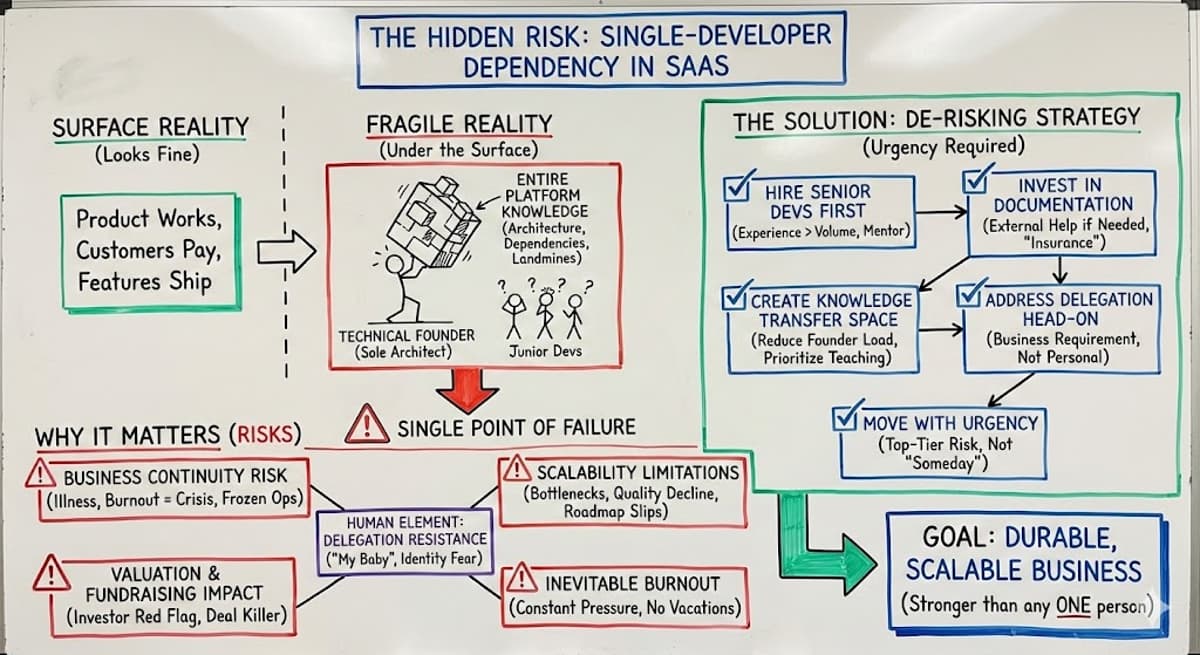
The product works. Customers are paying. Features are shipping. The technical co‑founder is productive, committed, and deeply knowledgeable. From the outside, it can even look like a strength: “We’ve got an incredible technical founder who built the whole thing.”

But under the surface, there’s often a fragile reality:

Too much of the company’s technical knowledge lives in one person’s head.

And that creates a serious, often underestimated business risk.


The Situation: When One Person Builds the Whole Machine

The scenario usually looks something like this.

A SaaS company has built a complex platform—often one that integrates multiple tools, workflows, or data sources into a single solution. It’s not trivial software; it has real architectural depth.

The platform was built almost entirely by a technical co‑founder.

There may be one or two additional developers, but they’re junior, recent hires, or working on narrow areas of the codebase. They don’t fully understand how everything fits together and rely heavily on the technical founder for guidance.

The result is a massive concentration of knowledge:

  • Architecture decisions

  • System dependencies

  • Why things were built a certain way

  • Where the landmines are

  • What not to touch

All of that lives primarily in one person’s brain.

As long as that person is healthy, engaged, and available, things keep moving. From a business standpoint, however, this is not a stable or scalable position to be in.


The Dilemma: Speed vs. Safety

In a recent SaaS leadership discussion, a company found itself staring directly at this issue.

The technical co‑founder recognized the risk and wanted to address it quickly—but proposed hiring a large number of developers all at once to scale fast. The CEO was hesitant.

Their instincts were understandable:

  • Rapid hiring can create chaos

  • Onboarding many developers at once is risky

  • Code quality can suffer

  • Culture dilution is real

But the tension is clear: moving too fast can be dangerous, and moving too slowly can be equally dangerous when you have a single point of failure. This isn’t just a hiring debate; it’s a business continuity problem.


Why This Matters More Than Most Founders Realize

When founders think about risk, they often focus on:

  • Customer churn

  • Competition

  • Fundraising

  • Market timing

Single‑developer dependency rarely makes the top of the list—it should.

1. Business Continuity Risk

When critical systems knowledge exists in one person’s head, you are one unexpected event away from a crisis. That event doesn’t have to be dramatic; it could be illness, burnout, a family emergency, a shift in motivation, or a disagreement between founders. Even a short‑term absence can slow development to a crawl if no one else knows how things actually work, and in a worst‑case scenario the business can become operationally frozen.

2. Scalability Limitations

Small, knowledge‑concentrated teams don’t scale well. As customer count grows, so does bug volume, feature requests, infrastructure complexity, and support needs. When everything routes through one person, that person becomes the bottleneck—even if they’re incredibly capable. The result: slipped roadmaps, increased stress, declining quality, and mounting frustration.

3. Valuation and Fundraising Impact

Investors and acquirers actively look for single points of failure. During diligence, if they discover that:

  • One person understands the system

  • Documentation is weak

  • Knowledge isn’t distributed

  • Processes aren’t institutionalized

they see red flags. At best, this complicates the deal; at worst, it kills it outright. A business that cannot survive the loss of one individual is inherently risky—no matter how good the product is.

4. Burnout Is Inevitable

Even a heroic, committed technical founder cannot sustainably be the sole keeper of the system. Constant on‑call duty, endless context switching, and the emotional weight of being “the only one” lead to burnout, which often manifests as quiet disengagement, frustration, or resistance to change.


The Human Side: Delegation and Identity

Technical founders often view the system as “their baby,” having internalized every decision. Letting go can feel risky, and teaching takes time they don’t feel they have. A deeper identity question may arise: “If others can do this, what’s my unique value?” This isn’t malicious—it’s human. Left unaddressed, it becomes a structural weakness.


The Recommended Approach: How to Actually De‑Risk This

Solving single‑developer dependency requires urgency—but not recklessness.

1. Hire Senior Developers First (Not a Swarm of Juniors)

Experience, not volume, reduces knowledge concentration fastest. Senior engineers can:

  • Understand complex systems quickly

  • Ask the right questions

  • Recognize architectural patterns

  • Push back when something doesn’t make sense

  • Mentor others effectively

One strong senior engineer who truly understands the system is worth far more than five junior developers who don’t.

2. Invest Explicitly in Documentation

Documentation is often skipped, but it’s essential insurance. If the system is under‑documented, consider external consultants whose sole job is to:

  • Document architecture

  • Map data flows

  • Capture deployment processes

  • Identify dependencies

  • Create onboarding materials

3. Create Space for Knowledge Transfer

Technical founders can’t delegate effectively while drowning in delivery work. Make knowledge transfer an explicit priority by:

  • Reducing their sprint load

  • Blocking time for walkthroughs

  • Pairing senior hires with them directly

  • Rewarding teaching, not just output

Shipping one less feature this quarter is worth it if it removes existential risk.

4. Address Delegation Resistance Head‑On

If a technical leader is reluctant to share knowledge, address it directly and respectfully—not as a personal failing, but as a business requirement. Frame the conversation around:

  • Company resilience

  • Long‑term success

  • Reducing pressure on them

  • Creating optionality for the future

It’s not about replacing them; it’s about ensuring the company doesn’t depend on any single individual—including the CEO.

5. Move With Urgency, Not “Someday”

Every month without action increases risk. This doesn’t mean panic hiring; it means clear prioritization, focused investment, and executive attention. If your SaaS platform cannot function without one person, that is a top‑tier risk—not a side project.


The Bottom Line

Single‑developer dependency is one of the most common—and most dangerous—hidden risks in SaaS companies. It affects daily operations, team morale, customer confidence, fundraising outcomes, and exit potential.

Addressing it requires:

  • Investing in senior technical talent

  • Documenting what already exists

  • Supporting knowledge transfer

  • Having honest conversations about delegation

  • Acting with urgency

The goal isn’t to diminish the technical founder’s importance; it’s to make the company stronger than any one person—including its founders. That’s how real, durable SaaS businesses are built.

Comments

Want to join the conversation?

Loading comments...