Crop Monitoring Tools for Corn: What Is Now Commercially Available in 2026
Key Takeaways
- •AI tools deliver weekly field‑level yield forecasts within 1 % of USDA estimate.
- •Drone weed mapping costs $20‑$50 per acre, delivering GPS‑precise ragweed locations.
- •Accurate early intel cuts costly nitrogen misapplications at $1,126 per ton.
- •Data‑rich farms can monetize carbon‑intensity scores under the Clean Fuel Credit.
- •Early adoption builds cumulative data assets, improving financing and contract terms.
Pulse Analysis
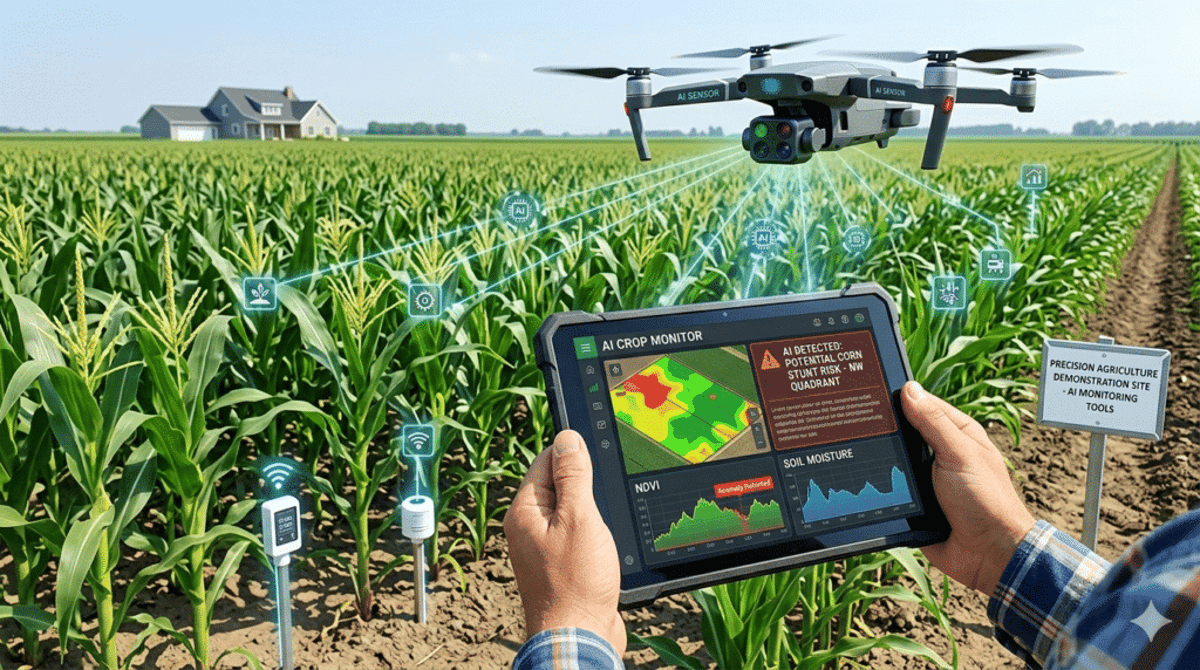
The arrival of AI‑driven yield modeling marks a turning point for U.S. corn production. Platforms like Treefera ingest satellite, weather, and sensor data to generate weekly probabilistic forecasts that have consistently landed within 1 % of the USDA’s final yield numbers. For growers, this forward‑looking intelligence replaces the traditional end‑of‑season performance report, allowing marketing desks to hedge futures, adjust grain contracts, and time fertilizer applications with a confidence previously reserved for large agribusiness analysts. The granularity of field‑level predictions also supports precision budgeting, a critical advantage in a market where margins are squeezed.
Complementing yield forecasts, TerraClear’s drone‑based ragweed detection service delivers GPS‑accurate weed maps for as little as $20 per acre. The imagery is processed in real time, feeding variable‑rate sprayers that target giant ragweed before it competes for nutrients, thereby reducing herbicide usage and labor costs associated with manual scouting. In a cost environment where anhydrous ammonia commands $1,126 per ton, avoiding even a single misapplied nitrogen event can preserve thousands of dollars per hundred acres. The technology thus turns what was once a reactive, expense‑heavy process into a proactive, cost‑efficient operation.
Beyond agronomic gains, the data layer created by these tools is becoming a tradable asset. Under the U.S. Clean Fuel Production Credit, growers who can substantiate low‑carbon intensity through verified field data are eligible for premium contracts in the emerging renewable‑fuel market. This convergence of precision agriculture and carbon accounting incentivizes investment in digital infrastructure, which in turn strengthens a farm’s credit profile and access to financing. As the gap widens between data‑rich and data‑poor operations, early adopters are poised to capture both higher yields and new revenue streams, setting a new competitive baseline for the corn industry.
Crop Monitoring Tools for Corn: What Is Now Commercially Available in 2026
Comments
Want to join the conversation?