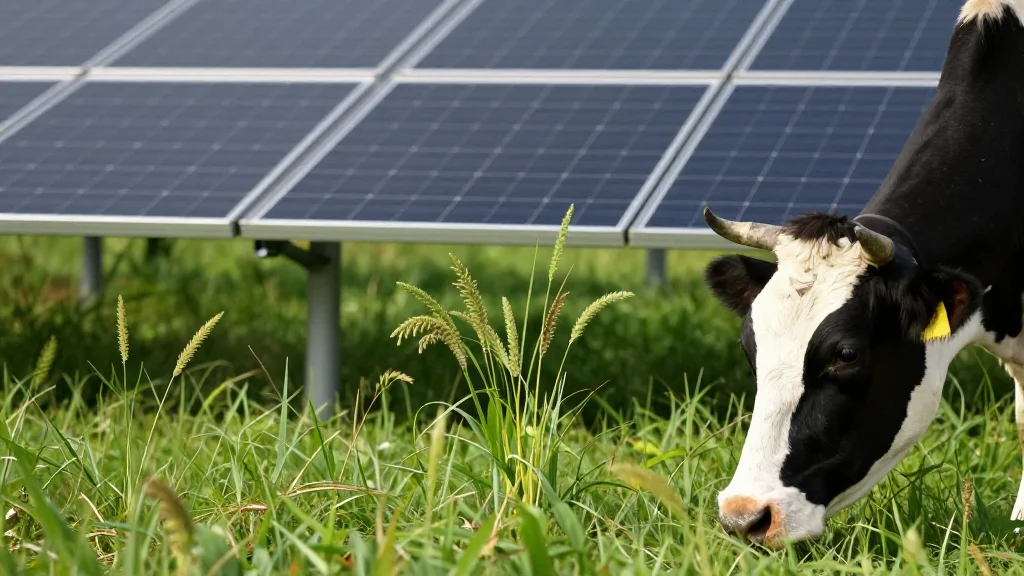
Agrivoltaics Maintain or Enhance Forage Quality, Study Finds
Why It Matters
The findings demonstrate that agrivoltaic installations can support dairy forage production without sacrificing, and sometimes improving, feed quality, opening a revenue‑generating pathway for farmers and solar developers. This dual‑use model could accelerate renewable energy adoption on agricultural land while preserving livestock productivity.
Key Takeaways
- •50 kW site yielded 3,223 kg/ha, lower biomass but higher protein
- •Forage protein reached 23.8% DM at 50 kW, surpassing control
- •Orchardgrass and meadow fescue thrived under solar panels
- •Researchers will test vertical bifacial panels to assess economics
- •Study offers guidance on optimal forage crops for agrivoltaics
Pulse Analysis
Agrivoltaics—co‑locating solar panels with crops—has emerged as a promising strategy to reconcile renewable energy expansion with agricultural land use. For dairy operations, pasture quality directly influences milk production and herd health, making any reduction in forage yield or nutrition a critical concern. By integrating solar arrays into grazing systems, producers can capture additional revenue from electricity while potentially shielding crops from extreme heat, a benefit that aligns with climate‑resilient farming practices.
The University of Minnesota study provides the first quantitative comparison of forage performance under differing solar configurations. While the larger 50 kW array reduced total biomass to roughly one‑third of the control, it boosted crude protein to 23.8% of dry matter and raised total‑tract neutral detergent fiber digestibility to 54.4%, both key indicators of feed efficiency. Notably, orchardgrass and meadow fescue maintained robust growth beneath the panels, suggesting that shade‑tolerant species can thrive in these microclimates. These results challenge the assumption that solar shading inevitably harms pasture productivity and instead point to a nuanced trade‑off between quantity and quality.
For farmers and solar developers, the implications are twofold. First, selecting high‑protein, shade‑tolerant forages can offset lower yields, preserving milk output and farm profitability. Second, the upcoming research on vertical bifacial panels promises to refine the economic calculus by optimizing land use intensity and energy capture. As policy incentives increasingly favor renewable integration on farms, data‑driven guidance like this study will be essential for designing agrivoltaic systems that deliver both clean power and high‑quality livestock feed.
Agrivoltaics maintain or enhance forage quality, study finds
Comments
Want to join the conversation?
Loading comments...