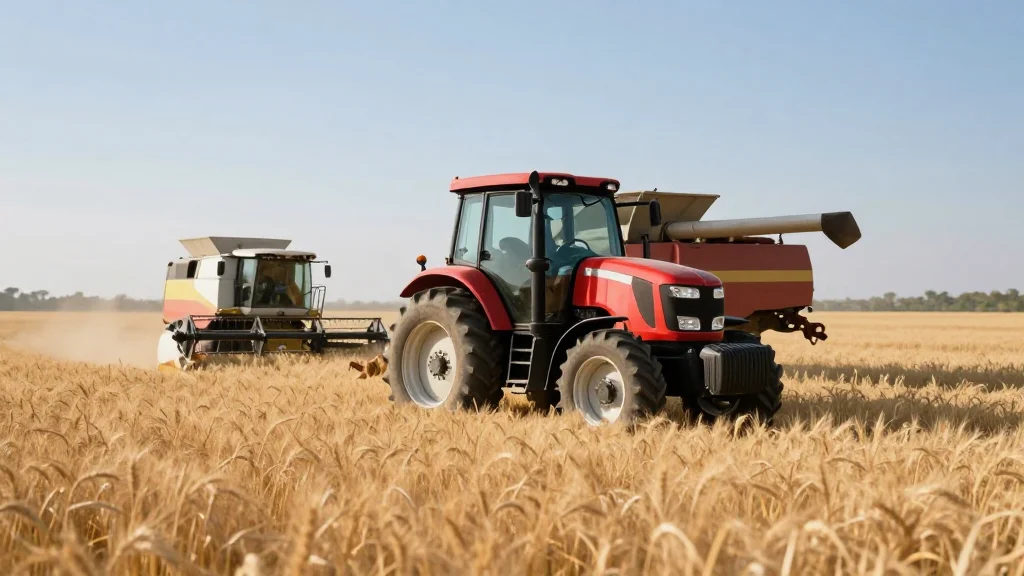
Mechanization Enhances Wheat Yield and Technical Efficiency: Evidence From Smallholder Farmers in the Arsi Zone, Oromia Region, Ethiopia
Why It Matters
Mechanization offers a proven pathway to lift smallholder wheat yields, directly strengthening Ethiopia’s food‑security agenda and rural incomes. Policymakers can leverage these insights to design targeted credit and service programs that accelerate adoption.
Key Takeaways
- •Study covers 409 wheat farms in Ethiopia’s Arsi Zone
- •Tractor‑and‑combine users achieve 0.95 technical efficiency
- •Fertilizer (DAP, urea) raises output across all farms
- •Mechanization adoption significantly lifts wheat yields
- •Policy focus needed on service access and extension support
Pulse Analysis
Wheat remains Ethiopia’s staple, feeding a rapidly growing population and accounting for a sizable share of the nation’s agricultural output. Over the past decade, the government has pursued ambitious wheat‑production targets, encouraging the diffusion of tractors, combine harvesters, and improved seed varieties. Yet adoption among smallholders has lagged, constrained by limited credit, fragmented service markets, and insufficient technical knowledge. Understanding how mechanization translates into productivity gains is therefore critical for aligning policy with on‑the‑ground realities.
The Arsi Zone study applies rigorous econometric tools—Stochastic Frontier Modeling with selection correction and Multinomial Endogenous Switching Regression—to isolate the causal effect of machinery on farm performance. Results reveal stark efficiency differentials: households employing both tractors and combines operate at a 0.95 efficiency frontier, far outpacing manual or single‑machine users. Fertilizer inputs, particularly DAP and urea, consistently lift output regardless of mechanization status, highlighting complementary input needs. These findings validate mechanization as a lever for closing the yield gap that has persisted despite Ethiopia’s favorable agro‑ecology.
For stakeholders, the implications are clear. Expanding access to affordable mechanization services—through cooperatives, rental schemes, or public‑private partnerships—can catalyze widespread efficiency gains. Extension agents must integrate machinery training with fertilizer best‑practice guidance to maximize returns. Moreover, financing mechanisms tailored to smallholder cash flows, such as micro‑leasing or input‑linked credit, can lower adoption barriers. As Ethiopia strives to achieve self‑sufficiency in wheat, scaling these interventions could deliver measurable boosts to national food security and rural livelihoods.
Mechanization Enhances Wheat Yield and Technical Efficiency: Evidence from Smallholder Farmers in the Arsi Zone, Oromia Region, Ethiopia
Comments
Want to join the conversation?
Loading comments...