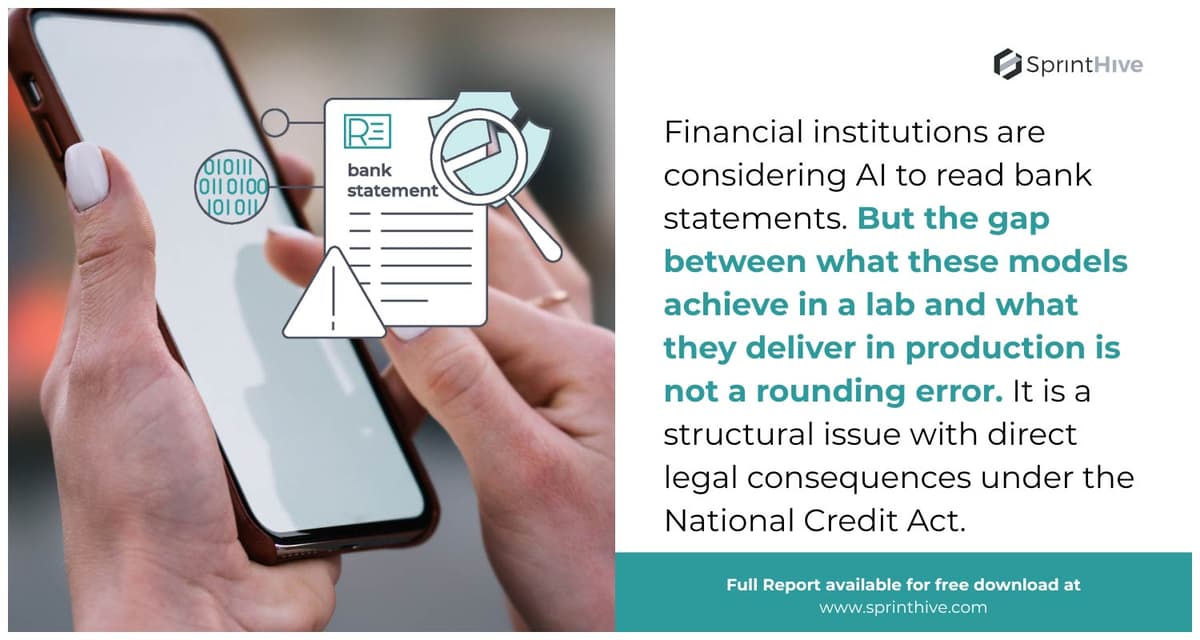
What Happens when Your Onboarding AI Gets It Wrong?
Companies Mentioned

Why It Matters
Mis‑read onboarding data feeds corrupted signals to fraud systems, inflating loss and regulatory risk; a robust validation framework protects both bottom line and compliance.
Key Takeaways
- •AI hallucination causes confident misclassifications on degraded statements
- •Frontier models cost $1.5‑$11.5 per extraction, 8.5 min each
- •Monthly processing of 65k statements can exceed $100k in AI fees
- •Custom models reduce latency but still need validation layers
- •Regulatory audit demands error‑based cost metrics, not per‑page pricing
Pulse Analysis
The rush to embed artificial intelligence in digital onboarding has created a false sense of security for many South African financial institutions. While AI can parse bank statements faster than humans, transformer models inherently hallucinate, producing plausible yet incorrect transaction categories when faced with low‑quality images or unfamiliar layouts. This structural flaw means that fraud‑detection engines may be acting on fabricated data, turning a protective signal into a liability. Companies must therefore treat AI as a data‑generation layer that requires independent verification before feeding downstream risk models.
Cost considerations amplify the risk. SprintHive’s analysis shows frontier models averaging 8.5 minutes per statement and charging between $1.5 and $11.5 per extraction. At a volume of 65,000 statements per month, the AI‑only expense tops $100,000, not counting human review or compliance overhead. Even custom‑trained vision‑language models, while cheaper and faster, cannot eradicate hallucination. The financial impact is two‑fold: higher operational spend and amplified fraud exposure when erroneous outputs bypass detection thresholds.
The solution lies in architecture, not model choice. A hybrid pipeline that cross‑checks AI‑derived figures against deterministic rules—such as verifying that opening balance + credits – debits = closing balance—captures errors that any single model will miss. This approach satisfies the South African National Credit Act’s audit requirements, shifting the performance metric from cost per page to cost per error. For heads of fraud and CTOs, the decisive question is no longer "does the vendor use AI?" but "how does the system detect and remediate AI mistakes in real time."
What happens when your onboarding AI gets it wrong?
Comments
Want to join the conversation?
Loading comments...