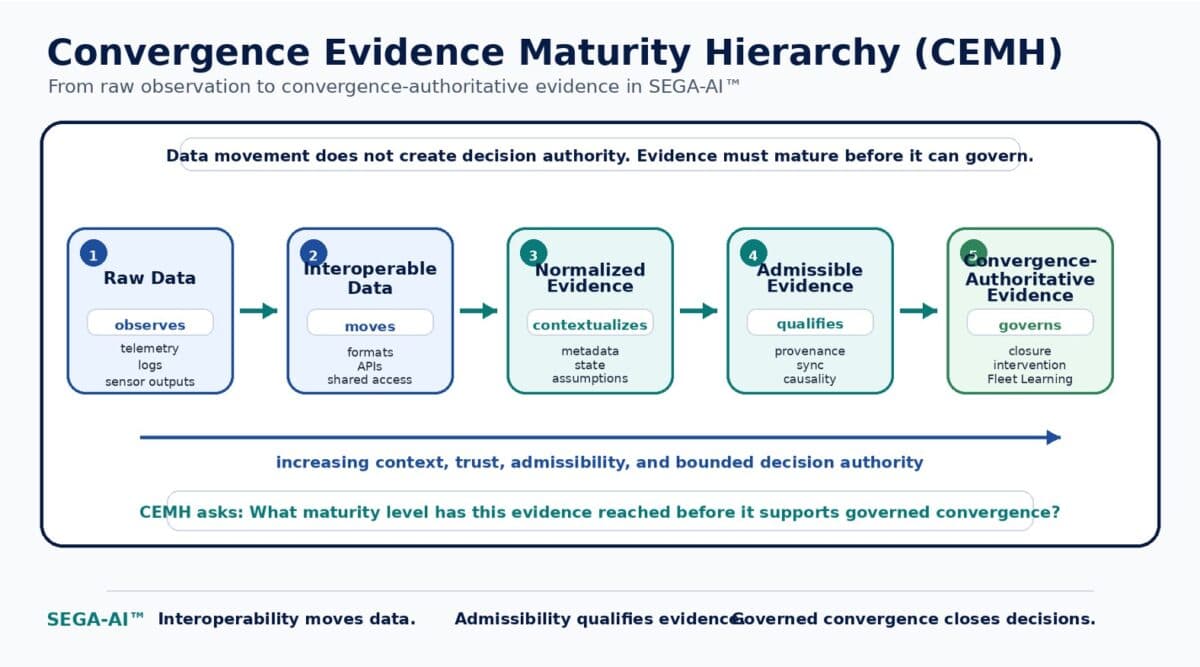
Convergence Evidence Maturity Hierarchy: From Raw Data to Convergence-Authoritative Evidence
Key Takeaways
- •Semiconductor firms need evidence maturity to govern AI-driven decisions
- •CEMH defines five levels from raw data to authoritative evidence
- •Only admissible evidence can trigger fleet‑learning adjustments or gate closures
- •Governance frameworks GFL and TCG rely on CEMH for trust
- •Mature evidence prevents costly redesigns in AI, chiplet, and HBM systems
Pulse Analysis
The semiconductor industry now generates petabytes of telemetry, simulation logs, and field‑return data each day. While modern data pipelines can move this information across tools and teams, the sheer volume does not automatically translate into actionable insight. The Convergence Evidence Maturity Hierarchy (CEMH) addresses this gap by codifying how raw observations evolve into decision‑grade evidence, a prerequisite for any AI‑driven governance system such as SEGA‑AI™. By insisting on contextual enrichment, provenance tracking, and synchronization checks, CEMH transforms a chaotic data lake into a structured evidence stream that can be audited and trusted.
At its core, CEMH outlines five progressive stages. Raw data provides visibility but lacks authority; interoperable data adds transportability without guaranteeing relevance. Normalized evidence injects critical metadata—model versions, timestamps, and workload states—creating a shared decision context. Admissible evidence then satisfies bounded governance criteria, ensuring continuity of custody and causal relevance. Finally, convergence‑authoritative evidence meets the stringent standards required to close design gates, trigger runtime interventions, or feed fleet‑learning algorithms. This tiered approach dovetails with the Governance for Lifecycle (GFL) and Trusted Convergence Governance (TCG) frameworks, which respectively ask whether a system can stay converged over its life and whether incoming evidence is trustworthy enough to influence convergence decisions.
For businesses, adopting CEMH means turning data into a strategic asset rather than a compliance burden. Mature evidence reduces the risk of erroneous design changes, shortens time‑to‑market for AI‑optimized chips, and safeguards investments in advanced packaging technologies like chiplets and HBM. Companies that embed CEMH into their toolchains can demonstrate higher confidence to customers and regulators, unlocking new revenue streams tied to guaranteed performance and reliability. As AI continues to steer semiconductor innovation, the ability to prove that every decision rests on vetted, authoritative evidence will become a competitive differentiator.
Convergence Evidence Maturity Hierarchy: From Raw Data to Convergence-Authoritative Evidence
Comments
Want to join the conversation?