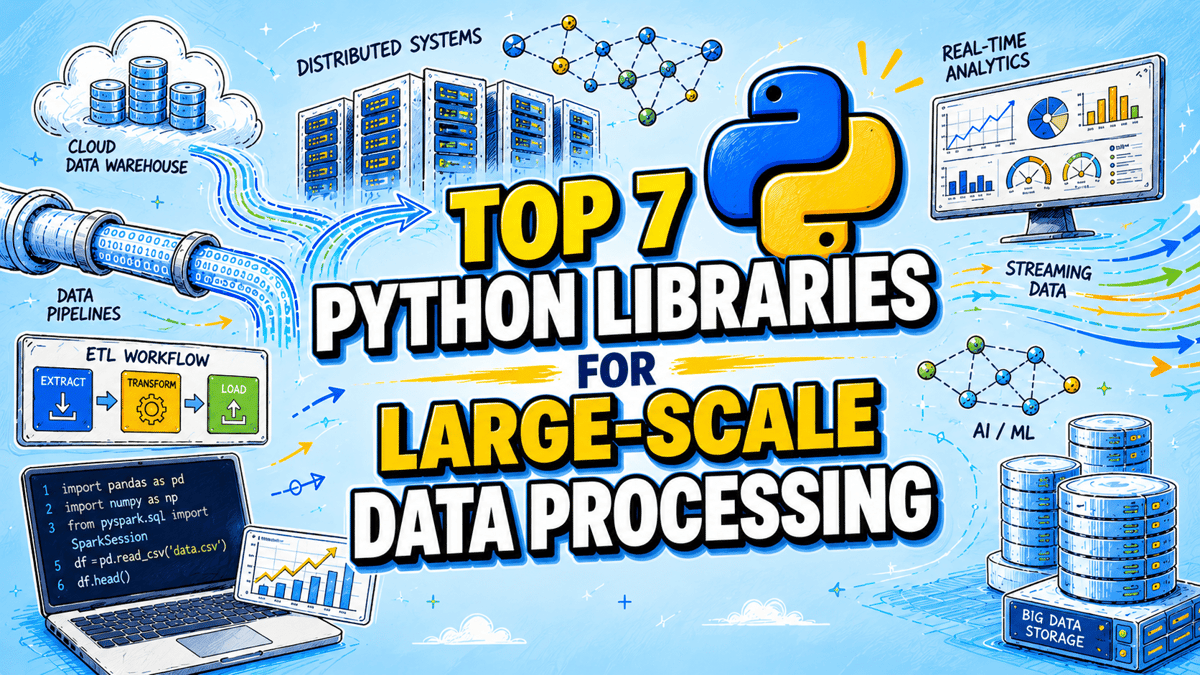
Key Takeaways
- •PySpark enables petabyte‑scale batch and streaming jobs on clusters
- •Dask mirrors pandas/NumPy APIs, scaling workloads from laptops to clusters
- •Polars leverages Rust and Arrow for faster, parallel DataFrame operations
- •Ray simplifies distributed Python tasks, integrating with major ML frameworks
- •DuckDB runs SQL analytics on local files without loading data into memory
Pulse Analysis
Data volumes are exploding, and traditional pandas workflows quickly hit memory limits. Python remains the lingua franca for data science, but scaling beyond a single machine requires specialized libraries. PySpark and Ray provide cluster‑wide processing for batch and streaming workloads, while Dask offers a familiar pandas‑like interface that can expand from a laptop to a distributed environment. Meanwhile, newer tools such as Polars and Vaex deliver high‑performance, out‑of‑core DataFrames on a single node, and DuckDB brings SQL analytics to local files without the overhead of loading data into memory.
Each library targets a distinct niche. PySpark is the go‑to for petabyte‑scale ETL and machine‑learning pipelines, leveraging Spark’s mature ecosystem. Dask excels when teams want to parallelize existing pandas or NumPy code with minimal changes. Polars, built on Rust and Apache Arrow, often outpaces pandas in speed and memory efficiency, making it ideal for rapid data transformation. Ray’s task‑and‑actor model abstracts away cluster management, allowing data scientists to parallelize any Python function and integrate seamlessly with PyTorch or TensorFlow. For real‑time event streams, Kafka’s high‑throughput messaging pairs well with Spark Structured Streaming or Flink, while Vaex enables billion‑row exploration on a single workstation through lazy, memory‑mapped operations.
Looking ahead, the convergence of these tools will shape the next wave of data engineering. Hybrid pipelines that combine Spark’s scalability, Polars’ speed, and DuckDB’s zero‑copy SQL are emerging as best‑practice patterns for cost‑effective analytics. Professionals should evaluate workloads based on latency, resource constraints, and skill‑set, then adopt the library that aligns with those criteria. Continuous learning—through the provided tutorials and community resources—will ensure teams stay competitive as the data landscape evolves.
Top 7 Python Libraries for Large-Scale Data Processing
Comments
Want to join the conversation?