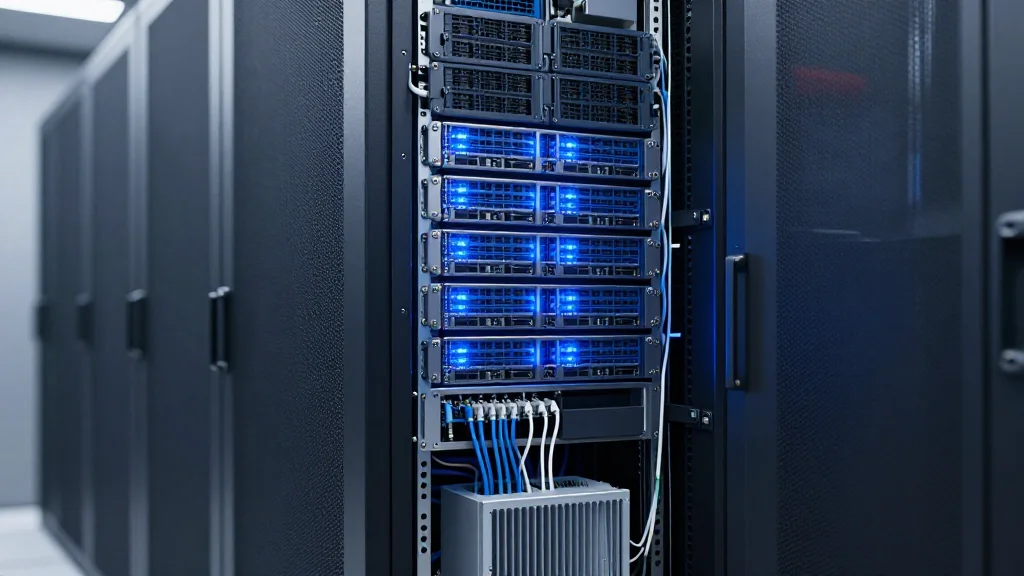
AI Boom Triggers $1.1 Trillion Power Push and $5 B High‑Density Rack Market Surge

Companies Mentioned

Why It Matters
The convergence of massive power‑infrastructure spending and ultra‑dense compute hardware signals a structural shift in how big‑data workloads will be hosted. Enterprises that rely on AI‑enhanced analytics, real‑time streaming, and large‑scale model training will need reliable, low‑cost electricity to keep operating margins viable. A failure to secure sufficient power could throttle AI adoption, slowing innovation across sectors from finance to healthcare. At the same time, the high‑density rack market’s rapid expansion creates a new competitive frontier for hardware vendors, cooling specialists, and data‑center operators. Companies that master the integration of high‑power racks with sustainable energy sources will capture a premium in a market that is expected to generate $3.4 billion in new revenue over the next decade. This dynamic will also influence capital allocation decisions for investors seeking exposure to the AI infrastructure value chain.
Key Takeaways
- •Utilities pledge $1.1 trillion in power‑infrastructure investment over five years to support AI data centers
- •Data‑center electricity use expected to become the world’s fifth‑largest consumer, between Japan and Russia
- •High‑density AI rack market projected to grow from $1.6 billion in 2026 to $5 billion by 2036 (CAGR 12.2%)
- •Fusion‑energy startup Commonwealth Fusion Systems aims to deliver power enough for 280,000 homes per plant
- •Nordic regions highlighted as prime locations for low‑cost, green AI‑focused data‑center builds
Pulse Analysis
The AI‑driven data‑center boom is more than a supply‑chain story; it is a macro‑economic pivot point. Historically, big‑data infrastructure grew in step with incremental improvements in server efficiency and modest power cost increases. Today, the scale of generative AI models—often requiring hundreds of petaflops of compute—has broken that incremental model, forcing a leap in both power capacity and rack density. The $1.1 trillion utility commitment reflects a recognition that traditional grid upgrades alone cannot meet the latency‑sensitive, 24/7 demand of AI workloads.
From an investment perspective, the high‑density rack market’s projected $5 billion size creates a clear niche for specialized vendors. Companies that can bundle liquid‑cooling, AI‑optimized power distribution, and modular rack designs will likely enjoy higher margins than legacy server manufacturers stuck in the commodity space. Moreover, the geographic shift toward the Nordics and other low‑carbon regions could re‑balance the global data‑center landscape, reducing the dominance of traditional hubs like Northern Virginia and Singapore.
Looking ahead, the biggest uncertainty remains the timeline for breakthrough power technologies such as fusion. If commercial fusion plants materialize within the next decade, they could dramatically lower the cost of AI compute, unlocking new use cases and further accelerating data‑center construction. Until then, the industry will have to navigate volatile electricity markets, regulatory hurdles, and the environmental scrutiny that comes with building megawatt‑scale facilities. Stakeholders that align their strategies with both power reliability and sustainable cooling will be best positioned to capture the upside of the AI‑powered big‑data era.
AI Boom Triggers $1.1 Trillion Power Push and $5 B High‑Density Rack Market Surge
Comments
Want to join the conversation?
Loading comments...