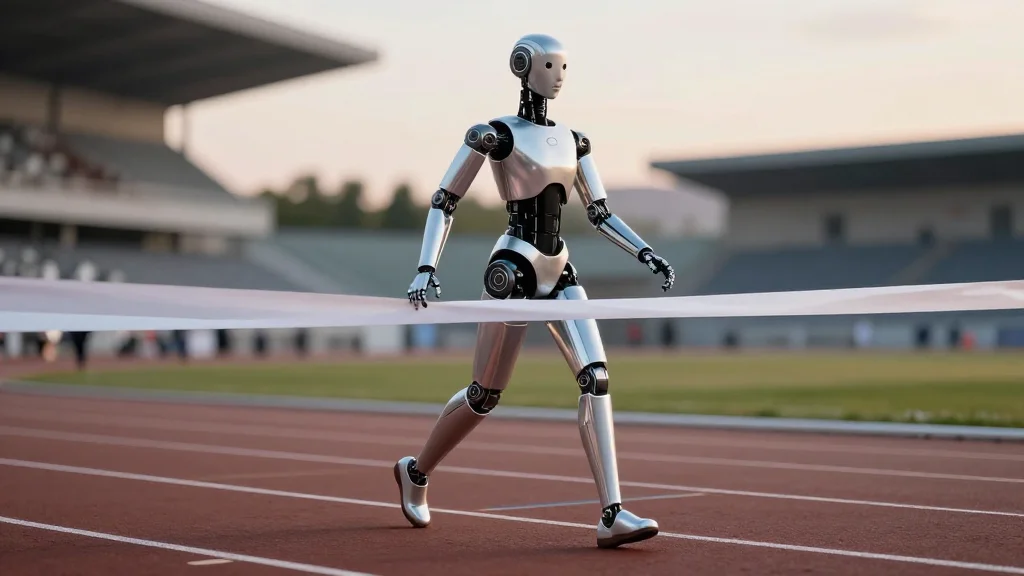
China's 'Flash' Robot Wins Half‑Marathon, Showcasing AI‑Powered Industrial Automation

Why It Matters
The Flash victory demonstrates that AI, edge computing and real‑time data analytics are no longer confined to pilot projects; they are becoming integral to large‑scale industrial automation. By turning a public half‑marathon into a high‑stakes data laboratory, China accelerates the feedback loop between algorithm development and manufacturing deployment, shortening the time to market for intelligent robots. Globally, the surge in humanoid robot shipments signals a shift toward more versatile, adaptable automation solutions. Companies that can harness the massive data streams generated by such robots will gain a competitive edge in predictive maintenance, quality control and flexible production, reshaping supply chains across sectors from automotive to consumer electronics.
Key Takeaways
- •Flash robot finished the 2026 Beijing E‑Town half‑marathon in 50:26, beating the human record of 57:20.
- •IDC forecasts >510,000 humanoid robot shipments by 2030, a ~95% CAGR.
- •China's industrial robot output rose 33.2% YoY in Q1 2026.
- •Shao Yuanxin (Robstride Dynamics) highlighted competition‑driven AI optimization.
- •Li Yechuan (Beijing Municipal Bureau) linked the event to the 15th Five‑Year Plan's robotics push.
Pulse Analysis
China’s use of high‑visibility competitions to stress‑test AI‑driven robotics is a strategic masterstroke. By converting a public sporting event into a data‑rich validation platform, Chinese firms generate terabytes of telemetry that can be immediately fed back into manufacturing AI models. This approach compresses the traditional R&D cycle, which in the West often spans years of isolated lab work before field trials. The result is a rapid escalation in robot capability, as evidenced by the leap from a 2‑hour‑plus finish last year to sub‑hour performance today.
The broader market implication is a looming inflection point for industrial automation. As humanoid robots become faster, more reliable and capable of handling unstructured tasks, they will erode the value proposition of traditional fixed‑axis robots. Companies that invest early in the data pipelines, edge infrastructure and AI talent required to support such systems will capture a disproportionate share of the upcoming $200 billion global robotics market. Conversely, firms that remain wedded to legacy automation may find themselves outpaced by competitors leveraging the same data‑driven insights that powered Flash’s victory.
Looking forward, the next wave will likely involve hybrid human‑robot teams operating in live factories, where real‑time analytics guide collaborative tasks. The success of Flash suggests that China is not only building the hardware but also the data ecosystem needed to sustain a new era of intelligent manufacturing. Western players should watch these developments closely, as the competitive advantage may shift from pure hardware engineering to the ability to harvest, process and act on massive streams of sensor data in real time.
China's 'Flash' Robot Wins Half‑Marathon, Showcasing AI‑Powered Industrial Automation
Comments
Want to join the conversation?
Loading comments...