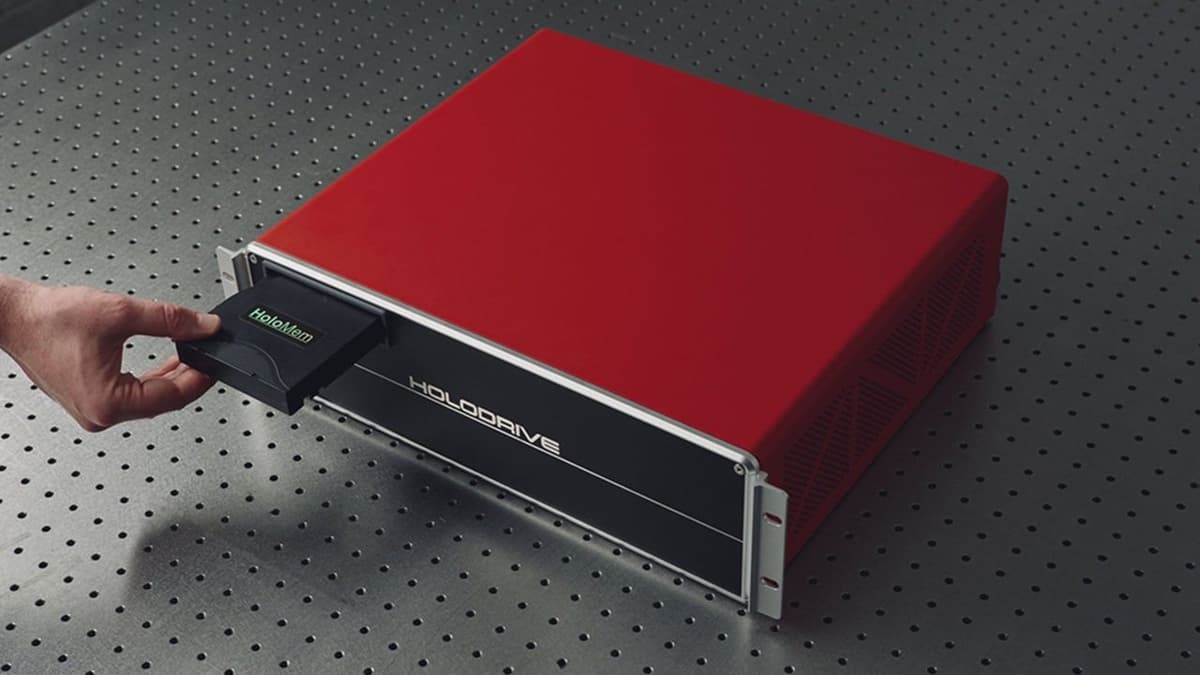
Integrating holographic tape into legacy tape libraries accelerates adoption of ultra‑high‑density cold storage, offering a scalable path for enterprises facing exponential data growth. Its compatibility reduces capital expense and simplifies compliance‑driven archival strategies.
The holographic tape breakthrough arrives at a time when enterprises grapple with exploding cold‑data volumes and the high cost of scaling traditional disk arrays. By leveraging polymer‑ribbon media and layered holographic recording, HoloMem can pack 200 TB into a form factor identical to LTO tapes, delivering a dramatic density jump without demanding new robotic infrastructure. This compatibility lowers the barrier to entry, allowing organizations to augment existing tape libraries with a high‑capacity tier that meets stringent write‑once‑read‑many compliance requirements.
From a technical standpoint, the system’s reliance on inexpensive laser components and a WORM architecture addresses two longstanding challenges: cost per gigabyte and data integrity over decades. While laboratory tests have shown impressive raw density, the real value lies in the successful dry run within a production‑grade LTO library, where software and hardware interoperability were validated. Such integration mitigates the risk of vendor lock‑in and eases certification processes, making holographic tape a viable candidate for regulated industries that need immutable, long‑term storage.
Looking ahead, HoloMem’s roadmap targets mass production by 2027, positioning the technology ahead of competing silica and ceramic archival media that still require bespoke handling systems. If the commercial hardware matches the trial’s performance, the market could see a shift toward holographic tape as the preferred cold‑storage tier, especially for organizations seeking to defer data center expansion costs. Analysts will watch pilot deployments through 2026 closely, as real‑world reliability and cost metrics will ultimately determine whether holographic tape reshapes the archival storage landscape.
By Efosa Udinmwen · published 5 hours ago
Mixed LTO and holographic operation functioned within the same library environment

Image credit: HoloMem
A UK startup has tested a holographic tape storage system inside a working LTO tape library, showing that it can run within existing data‑center setups. The test by HoloMem involved real software writing data to the system and reading it back through normal tape‑library operations.
Both traditional LTO drives and holographic drives ran side by side in the same library, which is important because many storage ideas fail outside controlled test environments.
The system uses polymer‑ribbon cartridges that match the size and shape of standard LTO tapes—because of this, the tape‑library’s robotic arm can move and load them without any physical changes. The holographic drives fit into the library as shelf units, allowing the robot to choose between LTO tapes and holographic cartridges based on the request it receives. From the software side, everything appears as one unified system rather than separate platforms.
Each cartridge is designed to hold up to 200 TB of data in a write‑once, read‑many (WORM) format, meaning the data can be stored permanently and accessed repeatedly. The storage method relies on layered holographic recording using relatively inexpensive laser components. Its capacity figure is a design target for production hardware rather than a lab maximum, and the WORM characteristic aligns with compliance‑driven archival requirements. Longevity claims extend beyond 50 years, although the deployment focused on functional operation rather than accelerated aging validation.
The value of the trial lies less in raw density and more in demonstrated compatibility, as many alternative archival media platforms require new library designs, new handling systems, or new software layers, which slows procurement and certification. In this case, the holographic drive was added to an existing tape library without replacing hardware or rewriting software.
HoloMem says this result supports its plans to move toward commercial readiness, with more pilot deployments planned while technical work continues through 2026.
“This is a major step forward for the commercial viability of future‑fit cold data storage, and the results are very exciting,” said Charlie Gale, founder and CEO of HoloMem.
“New technological solutions have to integrate with legacy infrastructure in order to fulfill their potential, and we’re pleased to have successfully proven HoloDrive’s deployability within BDT’s library.”
Mass production of the drive hardware is planned for 2027, which places this system closer to everyday use than silica or ceramic storage technologies that remain difficult to integrate into data centres.
“What HoloMem has achieved is so impressive. By developing a plug‑and‑play holographic solution compatible with our tape libraries, the HoloDrive enables so many use cases to many in the industry,” said Marc Steinhilber, CEO of BDT Media Automation GmbH.
The test does not prove long‑term reliability or cost‑effectiveness at scale, but it shows that holographic tape can be added as another storage layer without disrupting current systems. Based on what has been demonstrated so far, its credibility depends on whether production hardware performs the same way as it did in this live deployment.
Via Blocks & Files
About the author

Efosa Udinmwen – Freelance Journalist
Efosa has been writing about technology for over 7 years, initially driven by curiosity but now fueled by a strong passion for the field. He holds both a Master's and a PhD in sciences, which provided him with a solid foundation in analytical thinking.
Comments
Want to join the conversation?
Loading comments...