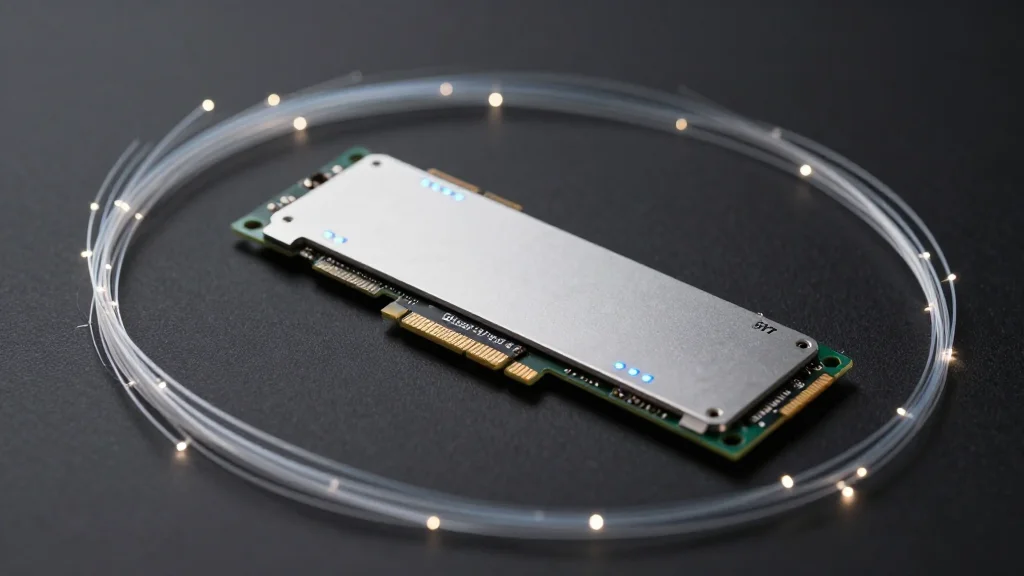
Nvidia Launches BlueField‑4 STX DPU, Promising 5x Token Throughput and 4x Energy Efficiency

Companies Mentioned
Why It Matters
The BlueField‑4 STX DPU targets the storage bottleneck that has limited the scalability of large‑language‑model inference, potentially unlocking new use cases that require massive context windows. By shifting storage processing from CPUs to purpose‑built silicon, Nvidia aims to lower both latency and power consumption, two critical factors for hyperscale data centers. If the architecture lives up to its claims, it could accelerate the shift toward autonomous AI infrastructure, prompting cloud providers and enterprises to re‑evaluate their hardware roadmaps. Moreover, the integration of in‑silicon security addresses growing concerns about data leakage and compliance in AI pipelines. Embedding protection at the hardware level reduces attack surfaces and may become a prerequisite for regulated industries that handle sensitive data, such as finance and healthcare.
Key Takeaways
- •BlueField‑4 STX DPU promises up to 5× token throughput and 4× energy efficiency for AI inference
- •Supermicro announced compatible storage servers one day after Nvidia's GTC reveal
- •Eight cloud and AI providers have committed to early deployments of the new architecture
- •Nvidia reported Q1 FY2027 revenue of $81.6 billion, an 85 % YoY increase
- •In‑silicon security is built into the DPU to reduce latency and attack surface
Pulse Analysis
Nvidia’s move to embed a full storage stack within a DPU reflects a broader industry trend of offloading specialized workloads from general‑purpose CPUs. The BlueField‑4 STX’s claimed performance gains suggest that storage bandwidth, not compute, is becoming the primary limiter for next‑generation AI services that rely on long‑context reasoning. Historically, Nvidia has leveraged its GPU dominance to expand into adjacent markets—first with NVLink for inter‑GPU communication, then with the BlueField‑3 petascale JBOF arrays. The BlueField‑4 STX represents the next logical step: a tightly integrated, security‑first storage engine that can keep GPUs fed with data at line rate.
From a competitive standpoint, the announcement forces rivals like Intel to accelerate their own AI‑centric storage solutions, which have so far leaned on software optimizations rather than dedicated silicon. Nvidia’s partnership strategy—bringing together server OEMs, storage vendors and cloud providers—creates a de‑facto ecosystem that could lock in customers early, especially as the eight unnamed cloud partners begin pilot programs. The real test will be whether the performance metrics hold up under real‑world workloads, a factor that will determine if data‑center operators re‑architect their stacks around DPUs.
Looking forward, the success of the BlueField‑4 STX could set a new baseline for AI infrastructure economics. A 4× improvement in energy efficiency directly translates into lower operational expenditures, a critical metric as hyperscale operators grapple with rising power costs and sustainability mandates. If Nvidia can deliver on its promises, the DPU could become as indispensable to AI workloads as GPUs are today, reshaping procurement cycles and influencing the next wave of AI‑driven services.
Nvidia launches BlueField‑4 STX DPU, promising 5x token throughput and 4x energy efficiency
Comments
Want to join the conversation?
Loading comments...