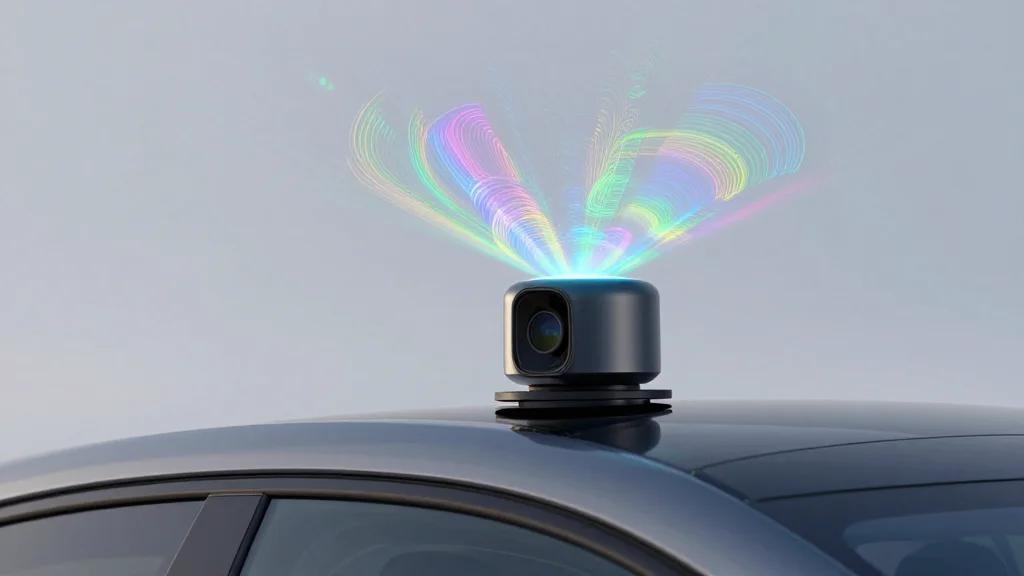
Ouster's Rev8 Color Lidar Boosts Stock 3% as It Merges Vision and Depth

Companies Mentioned
Why It Matters
The Rev8’s ability to deliver a pre‑fused 3‑D color point cloud reshapes the data architecture of autonomous systems. By collapsing two sensor streams into one, developers can cut latency, reduce bandwidth, and simplify calibration pipelines—critical factors for safety‑critical applications. Moreover, the richer data set enables more nuanced AI perception, potentially improving object classification and scene understanding in complex environments. If Ouster’s approach proves scalable, it could set a new industry standard, prompting rivals to adopt similar fused‑sensor designs. This shift would accelerate the consolidation of perception hardware and software, driving down costs and hastening the rollout of robotaxis, autonomous trucks, and advanced robotics across logistics and manufacturing.
Key Takeaways
- •Ouster unveiled Rev8 sensors with native color lidar, combining depth and 48‑bit color data.
- •Shares rose 3.19% to $27.30, with 2,753,155 shares traded on the announcement day.
- •Rev8’s OS1 Max model reaches 500 m range while remaining smaller than competing long‑range lidars.
- •Sensors use SPAD detectors to capture color and depth on a single custom chip, delivering 116 dB dynamic range.
- •Field trials slated for Q3 2026 will test the Rev8’s data pipeline for autonomous‑vehicle and robotics applications.
Pulse Analysis
Ouster’s Rev8 launch is more than a product refresh; it signals a strategic pivot toward data consolidation in the autonomous‑sensor market. Historically, lidar and camera systems have evolved in parallel, forcing developers to build complex sensor‑fusion stacks that consume compute cycles and introduce calibration drift. By delivering a pre‑fused 3‑D color point cloud, Ouster is effectively redefining the perception stack’s first layer, shifting the engineering burden downstream to software teams that can now focus on higher‑level reasoning rather than raw sensor alignment.
The timing aligns with a broader industry inflection point. After years of skepticism about lidar’s cost‑benefit ratio, robotaxi operators have begun to scale fleets, proving that high‑resolution depth data remains essential for safety. Simultaneously, the robotics sector is witnessing a surge in investment, with firms seeking sensors that can handle both navigation and visual inspection tasks. Rev8’s dual‑mode output directly addresses these converging needs, offering a single hardware solution that can be repurposed across domains.
However, the market’s response will hinge on execution. The sensor’s performance in rain, fog, and low‑light conditions—scenarios where traditional cameras excel but lidar struggles—will be scrutinized. Moreover, the promise of reduced system complexity must translate into measurable cost savings for OEMs. If Ouster can demonstrate that the Rev8 cuts total bill‑of‑materials and integration time without sacrificing reliability, it could force competitors like Velodyne and Luminar to accelerate their own fused‑sensor roadmaps, potentially sparking a new wave of M&A activity focused on data‑fusion capabilities. In the short term, Ouster’s stock rally reflects investor confidence, but the real test will be whether the Rev8 becomes the de‑facto standard for next‑generation autonomous perception.
Ouster's Rev8 Color Lidar Boosts Stock 3% as It Merges Vision and Depth
Comments
Want to join the conversation?
Loading comments...