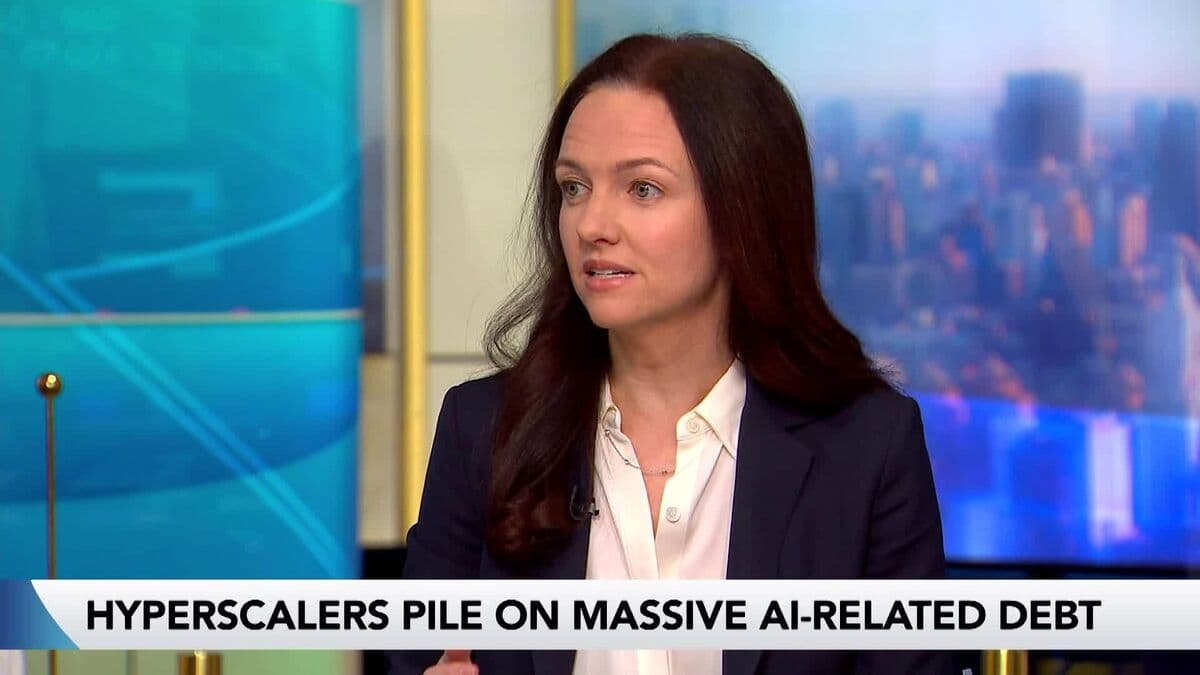
The forecast signals a major reallocation of capital in credit markets, raising financing costs for the biggest tech firms and reshaping risk‑return dynamics for investors.
The surge in hyperscaler debt reflects a fundamental transition from the traditionally asset‑light tech model to one that increasingly resembles capital‑intensive industries such as telecom and automotive. AI‑driven cloud expansion, which some firms are reporting at 40% growth, is fueling a 16% rise in capex expectations. To fund this build‑out, companies like Alphabet and Oracle are turning to the bond market at an unprecedented scale, pushing issuance forecasts to $250 billion by 2026. This influx of supply is poised to test investor appetite and could force spreads to widen as the market digests the added risk.
Investors are responding with a mix of conventional and unconventional instruments. The recent 100‑year corporate bond, issued in sterling, illustrates how managers with long‑duration liabilities are seeking to lock in yields despite the inherent interest‑rate and credit uncertainties. Such ultra‑long tenors are rare for corporates, traditionally reserved for sovereigns or universities, yet the abundant cash in the system and the desire for yield have created a niche demand. While demand remains robust, analysts caution that the sheer volume of hyperscaler debt may eventually outpace the sector’s ability to monetize its investments, prompting a gradual spread widening.
For portfolio managers, the implications are clear: exposure to hyperscaler credit now carries heightened risk, prompting a strategic tilt toward more credit‑stable sectors like utilities, which are also financing AI‑related infrastructure but with more predictable cash flows. Smaller technology firms, lacking the scale of the hyperscalers, could encounter tighter financing conditions as capital chases the larger players. Consequently, investors should reassess duration exposure, monitor spread trajectories, and consider diversifying into sectors that combine stable earnings with attractive yield potential.
Meghan Robson, head of US credit strategy at BNP Paribas · February 10 2026
MEGHAN: That’s a great question. One, we are seeing these numbers increase so quickly. It brings up the sustainability question – if they are continuing capex at this rate, tech has been a very asset‑light sector. They are transitioning to building these hard assets. You look at telecom, autos, more hard‑asset‑type sectors; this transition into a business model moving in that direction.
JONATHAN: So many of these companies like Alphabet come from these operations. It begs the question how much bigger could this site be and how long will it go on for?
MEGHAN: To date we have seen capex expectations increased 16 %. That drives our expectation that it could continue to go up in terms of the capex. Our high‑conviction view is we do think spreads have to continue to get wider for hyperscalers. There will be a penalty. We haven’t seen it quite yet, but we think there will be a penalty as issuance continues.
LISA: The 100‑year bond issue sort of sounds the warning bell, as sort of what we have seen in the past. How do you view something like that with a big company that doesn’t necessarily need the cash but is really beneficial financing conditions? Going all in on the century bond?
MEGHAN: It is still an outlier but the massive demand across the space. The risk you have to think about is whether these companies will monetize the investment that they are making here.
Looking at earnings last week we saw cloud growth as high as 40 %. There is potential to monetize it. Growth for some of these names is 20 % revenue – that is a huge number. There are some of these concerns that are extremely high.
LISA: We are seeing truly unbelievable demand for a lot of this debt. How much money is just sitting on the sidelines? How much money is waiting to be poured into this by investors, or are they selling treasuries? Are they selling some asset to go into some of this debt that they know will be issued this year?
MEGHAN: We haven’t seen signs that there is a selling‑in rotation. Some of these issues have been three, four, five times. They are more worried about being left behind, left out of deals, then having too much exposure at this point. The hyperscalers in the past have had small debt stacks. The over‑capacity issue from an investor standpoint of having too much exposure is not quite there yet.
ANNMARIE: Does it make it harder for a smaller tech company?
MEGHAN: It could. We are seeing markets generally open across the board when conditions are easy. Hyperscalers have this advantage of scale across the various software sector that is seen as an advantage and investors do seem to have a preference for scale in terms of capitalizing on AI.
JONATHAN: Do you find it odd we are seeing push‑back in equity and not in debt?
MEGHAN: In the IG space we haven’t seen much push‑back on debt. It has pushed over to software with smaller names. If you look at leveraged loans we have seen real under‑performance as a result of the sell‑off in software, software equity down almost 20 %. A lot of the smaller names value their companies and leverage based on value metrics where they automatically have higher leverage based on some of the weakness we have seen.
JONATHAN: Equity pushes back even though it should be the beneficiary and the debt market is sucking it up. Is that a curious dynamic at the moment?
MEGHAN: Bond investors have tons of cash, are just looking for return and looking at the absolute return and not looking for the potential growth factor. The other argument is that something has to give. It might not be so dramatic; it might be that slight spread widening or that push‑back with smaller deals.
JONATHAN: Based on the moves we have seen from Oracle, Alphabet, for this to grow and go on longer – which is what Wells Fargo was telling us yesterday – could we talk about a 100‑year debt? What is that about? Why would someone buy that issue? Typically we would associate that with governments, universities, institutions that are around for centuries, not with a tech firm. Which is why we go back to the 1997 Motorola issue. I have no idea where Alphabet is. I don’t see how anyone could have any degree of confidence where they will be in the next century. Why would someone in your market want to buy a 100‑year corporate debt issue?
MEGHAN: It is definitely a unique tenor and not only brings credit risk that you are talking about but interest‑rate market risk, having that extreme long duration. The 100‑year bond was sold in a different currency; it was sold in sterling, adding a more specific element. There are managers that have certain liability‑matching needs; it could play into the average duration goal. It is potentially one tool they could use to do so.
JONATHAN: This often doesn’t work out for sovereigns, let alone companies.
LISA: Marvin said the Argentine 100‑year bond didn’t make it to the second coupon payment. It is a scattershot in terms of what you could get. This really speaks to the dynamic of people having a lot of cash and the liquidity of the system. For all the people looking for some sort of blow‑out, good luck if you have this kind of liquidity. This kind of determination to keep that liquidity.
MEGHAN: $250 billion is our forecast for this year. We are recommending investors overweight the utility sector versus hyperscalers, both borrowing more to fund this AI‑capex build‑out and also using what is called hybrid structures to get a little bit of a pickup in yield. It is more credit‑friendly and we think that is a better way to position.
JONATHAN: Management teams are used to running companies with intensity this high?
MEGHAN: There is less of a transition for the business model; that is a great point as well.
Comments
Want to join the conversation?
Loading comments...