The Game on the Field Has Changed
•February 27, 2026
0
Why It Matters
The shift shows investors and CEOs demanding far higher productivity, reshaping hiring, compensation and valuation models across the tech sector.
Key Takeaways
- •Block cuts 40% workforce, shares rise 24%
- •Tech layoffs projected 153k annually in 2026
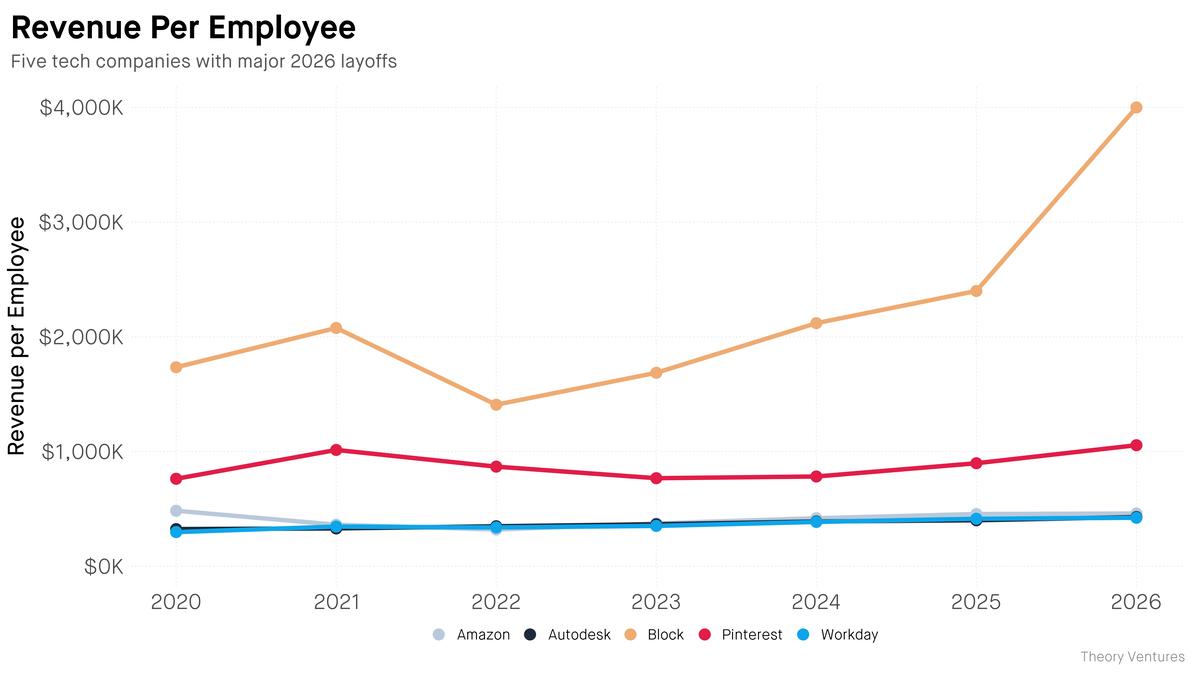
- •Revenue per employee climbs to $4M at Block
- •AI-native firms achieve $2‑4M ARR per employee
- •Investors now demand double productivity benchmarks
Pulse Analysis
The recent wave of headcount reductions, highlighted by Jack Dorsey’s Block announcement, marks a strategic pivot rather than a distress signal. While traditional layoff cycles are often tied to revenue shortfalls, the current trend involves growing tech firms voluntarily shedding staff to unlock efficiency gains. This proactive approach has already moved the market, with Block’s shares jumping 24% after the memo, and analysts projecting a 153,000‑employee annualized layoff figure for 2026—well above last year’s peak.
At the heart of this movement is a dramatic rise in revenue per employee. Block’s expected jump from $2.4 million to $4 million per headcount illustrates how leaner organizations can extract more value from each worker, especially when augmented by AI tools. Comparable AI‑native companies like Cursor and Gamma are already reporting $2‑4 million ARR per employee, setting a new benchmark that dwarfs the $100 k ARR per employee norm of five years ago. The data suggest that productivity gains are no longer incremental; they are exponential, driven by automation, machine‑learning‑enhanced workflows, and a cultural shift toward high‑impact, low‑overhead operations.
For investors and management teams, the implications are profound. Valuation models must now factor in higher per‑employee revenue expectations, and compensation structures will likely evolve to reward output over tenure. Companies that fail to adopt AI‑driven efficiency risk falling behind, as capital markets increasingly favor firms that can do more with fewer people. Consequently, the "game on the field" has changed: productivity, not just growth, has become the primary metric for success in the evolving tech landscape.
The Game on the Field Has Changed
0
Comments
Want to join the conversation?
Loading comments...