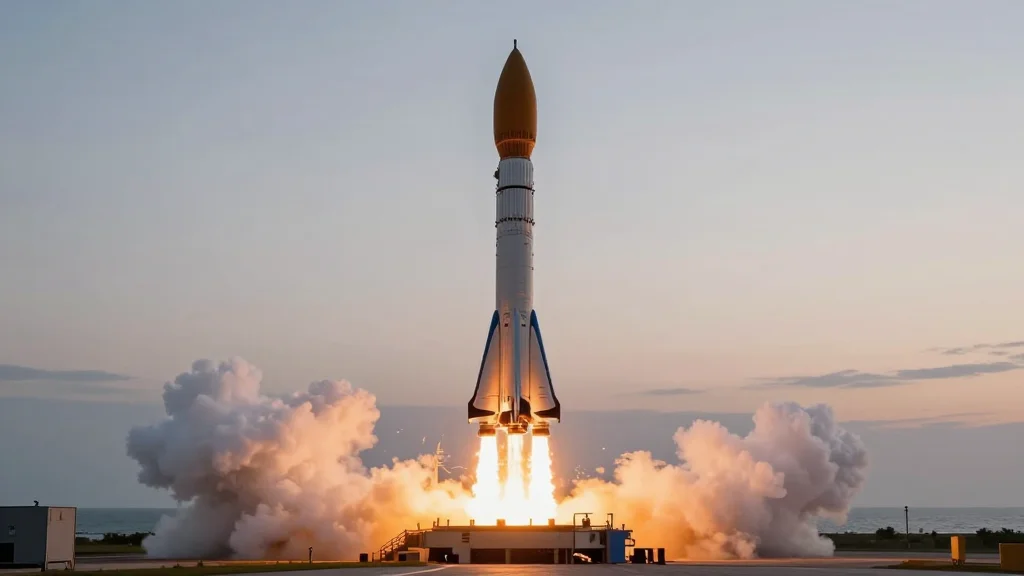
Blue Origin’s New Glenn Test Ends in Explosion, Bezos Promises Rebuild

Companies Mentioned


Why It Matters
The New Glenn explosion strikes at the heart of the U.S. government’s plan to return humans to the Moon under the Artemis program. Blue Origin’s heavy‑lift capability was a cornerstone of NASA’s diversified launch strategy, intended to reduce reliance on a single provider. A prolonged delay could force NASA to re‑allocate contracts, accelerate SpaceX’s Starship development, and shift the balance of commercial space power. For investors and CEOs in the aerospace sector, the incident highlights the high‑risk nature of developing next‑generation launch vehicles. It also underscores the importance of regulatory oversight, as the FAA’s forthcoming investigation will set precedents for safety standards that affect all U.S. commercial launch firms.
Key Takeaways
- •New Glenn, a 98‑metre heavy‑lift rocket, exploded during a static‑fire test at Cape Canaveral on May 29, 2026.
- •Jeff Bezos said the cause is “too early to know” but pledged to rebuild the vehicle.
- •Elon Musk called the accident “most unfortunate,” noting the inherent difficulty of rockets.
- •NASA Administrator Jared Isaacman warned the incident could impact Artemis lunar‑lander timelines.
- •FAA now requires a detailed post‑incident analysis before Blue Origin can resume testing.
Pulse Analysis
Blue Origin’s setback is a textbook case of how technical failures can reverberate through a company’s strategic roadmap and market positioning. Bezos’s public commitment to rebuild mirrors the aggressive timelines set by SpaceX, but the reality of a multi‑year development cycle means that any delay erodes competitive advantage, especially when NASA’s Artemis schedule is non‑negotiable. The company’s ability to secure future contracts will hinge on the speed and transparency of its root‑cause analysis, as well as its capacity to demonstrate that the revised design mitigates the identified risk.
From a broader industry perspective, the incident may accelerate consolidation around proven providers. SpaceX’s Starship, still in testing, already enjoys a de‑facto lead in heavy‑lift capability, and a prolonged New Glenn hiatus could push NASA and commercial customers to double‑down on SpaceX’s services. Conversely, the event could also open a niche for smaller, more reliable launchers if Blue Origin’s timeline slips beyond 2027, prompting satellite operators to diversify away from a duopoly.
For CEOs across the high‑tech sector, the Blue Origin episode reinforces the need for robust risk‑management frameworks that balance visionary ambition with operational resilience. Transparent communication, as demonstrated by Bezos and NASA’s Isaacman, can preserve stakeholder confidence even when hardware fails. The next few months will test whether Blue Origin can translate that confidence into concrete engineering fixes and a credible path back to flight, a litmus test that will likely influence investor sentiment and partnership decisions well into the next decade.
Blue Origin’s New Glenn Test Ends in Explosion, Bezos Promises Rebuild
Comments
Want to join the conversation?
Loading comments...