Five Thoughts From Nvidia CEO Jensen Huang’s GTC Taipei 2026 Keynote
Companies Mentioned
Why It Matters
The shift from experimental AI to revenue‑generating agents reshapes data‑center economics, talent strategy, and hardware investment, making token efficiency and AI‑factory design critical competitive levers.
Key Takeaways
- •Agentic AI boosts developer output, creating $9 trillion value for $3 trillion salaries
- •Tokens become direct revenue units, tying compute efficiency to profit
- •AI factories demand gigawatt-scale builds costing up to $100 billion per GW
- •Nvidia’s DSX blueprint offers digital‑twin design for AI‑factory deployment
- •Vera Rubin pods and Vera CPUs optimize latency for agentic workloads
Pulse Analysis
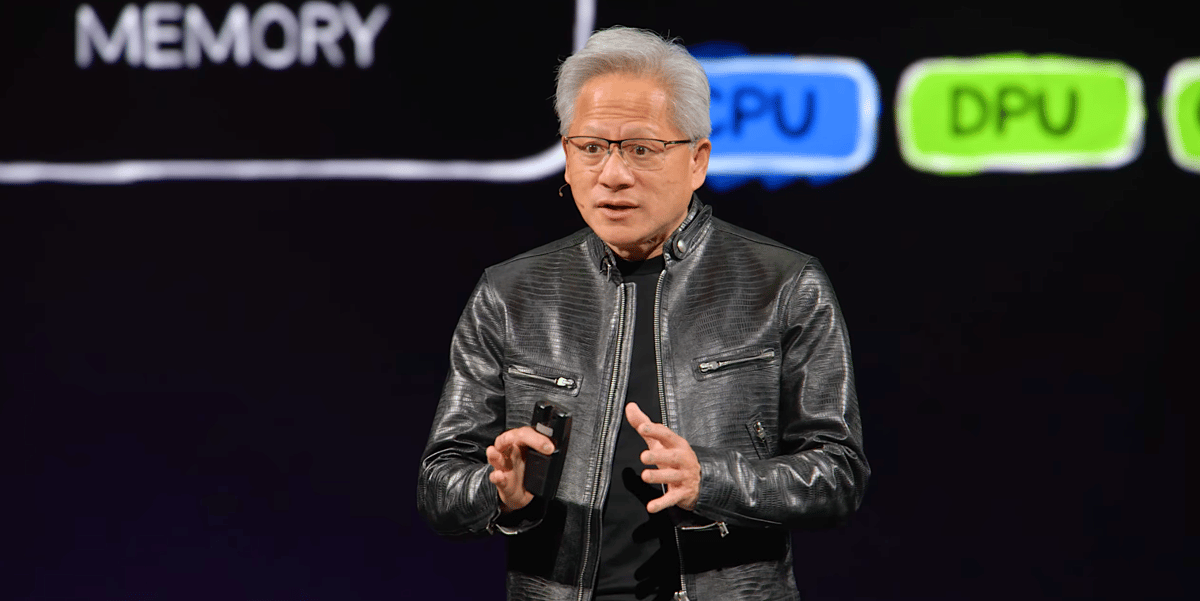
The rise of agentic AI marks a transition from isolated large‑language‑model APIs to autonomous systems that can observe, reason, and act across an enterprise’s entire IT stack. This evolution forces CIOs to rethink traditional application architectures, moving toward a distributed "agent" model where GPUs handle inference, CPUs orchestrate tool calls, DPUs secure data paths, and high‑speed fabric stitches the workflow together. Companies that re‑engineer their data‑center topology to maximize tokens per watt will capture a new margin stream, as each token now translates directly into revenue.
Nvidia’s announcement of AI factories underscores the capital intensity of this new paradigm. A single‑gigawatt site—costing roughly $80‑$100 billion—requires co‑design of chips, racks, power, and cooling, all validated in a digital twin via the DSX platform. This approach reduces time‑to‑deployment and mitigates the financial risk of idle capacity, positioning Nvidia not just as a GPU vendor but as a full‑stack AI infrastructure partner for hyperscalers, telcos, and regional clouds. The DSX ecosystem also promises standardized metrics for token throughput, enabling enterprises to benchmark and optimize spend across heterogeneous hardware.
Hardware innovations like the Vera Rubin pod and Vera CPU further cement the agentic loop’s performance demands. By integrating 88‑core CPUs, next‑gen GPUs, and high‑bandwidth interconnects into a cable‑free rack, Nvidia aims to cut assembly time dramatically while delivering nanosecond‑scale latency for tool calls. For businesses, this translates into tighter SLAs for AI‑driven processes—from real‑time analytics to autonomous decision‑making—making the difference between a competitive edge and obsolescence. As AI moves from proof‑of‑concept to core revenue engine, firms that align their compute strategy with token economics and agent‑centric design will secure the most durable advantage.
Five thoughts from Nvidia CEO Jensen Huang’s GTC Taipei 2026 keynote
Comments
Want to join the conversation?
Loading comments...