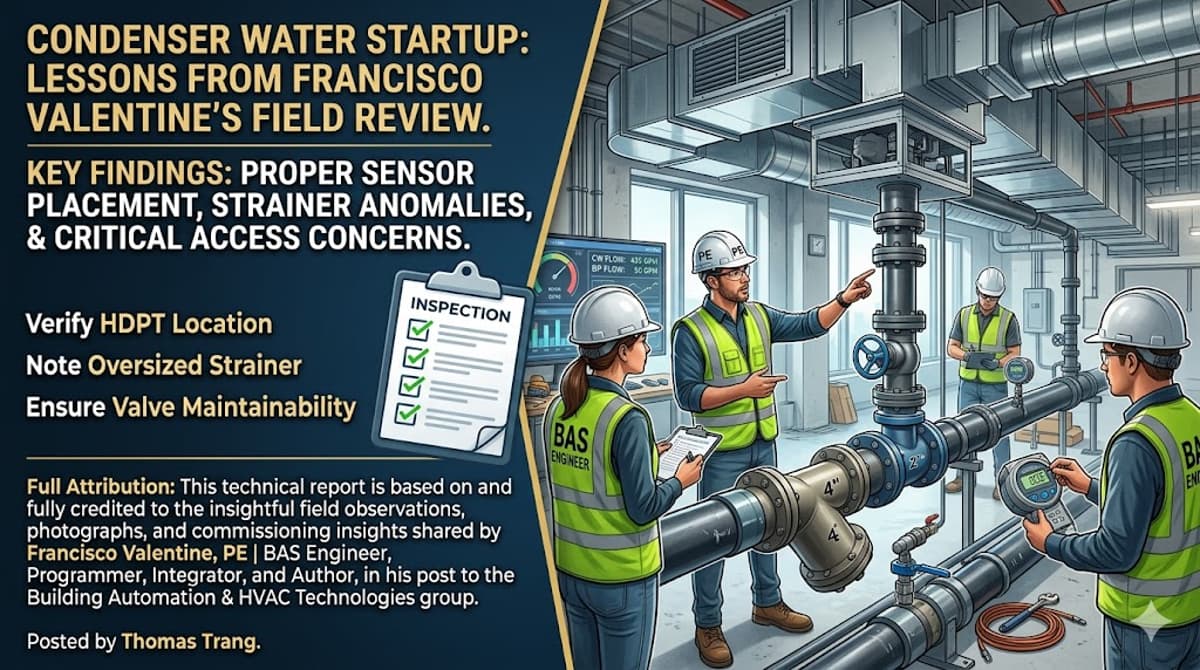
Condenser Water Startup Lessons From Francisco Valentine’s Field Review
Key Takeaways
- •DP transmitter should sit where it gives a representative demand signal
- •Critical circuit identified during TAB drives final differential pressure setpoint
- •Bypass-line strainer often unnecessary and can waste space and cost
- •Ensure all components remain accessible after ductwork installation
Pulse Analysis
In modern high‑rise buildings, condenser‑water loops are the heart of HVAC performance, yet their reliability hinges on nuanced control strategies. The placement of the hydronic differential‑pressure (DP) transmitter is a prime example: rather than anchoring it to the so‑called “critical circuit,” engineers should locate the sensor where it captures a true system‑wide demand signal. This approach aligns with the industry’s two‑thirds‑down‑run rule while ensuring the transmitter reflects the aggregate flow needs of the largest grouping of two‑way coil valves, delivering stable pump control without over‑reacting to localized anomalies.
The distinction between sensor location and the critical circuit becomes especially important during testing, adjusting, and balancing (TAB). The critical circuit—identified only after the balancing process—drives the final DP setpoint, not the transmitter’s physical spot. When pump speed is tied too closely to a single problematic branch, facilities can suffer chronic over‑pumping, inflating energy bills and accelerating wear. By using the TAB‑derived setpoint and addressing root causes such as dirty strainers or restricted piping, operators can achieve optimal pressure levels, reduce electricity consumption, and extend equipment life.
A second, often‑overlooked issue is the temptation to add a strainer on the bypass‑line control valve. While strainers protect valve trim, placing one on a bypass valve rarely adds value and can introduce unnecessary pressure drop, extra fittings, and, crucially, access constraints. In tight ceiling spaces, a Y‑strainer can become a maintenance nightmare once ductwork is installed, forcing costly retrofits. Best practice dictates confirming the necessity of each strainer during design, prioritizing accessibility, and documenting clear service procedures before the building envelope closes. This disciplined approach safeguards both operational efficiency and long‑term serviceability.
Condenser Water Startup Lessons from Francisco Valentine’s Field Review
Comments
Want to join the conversation?