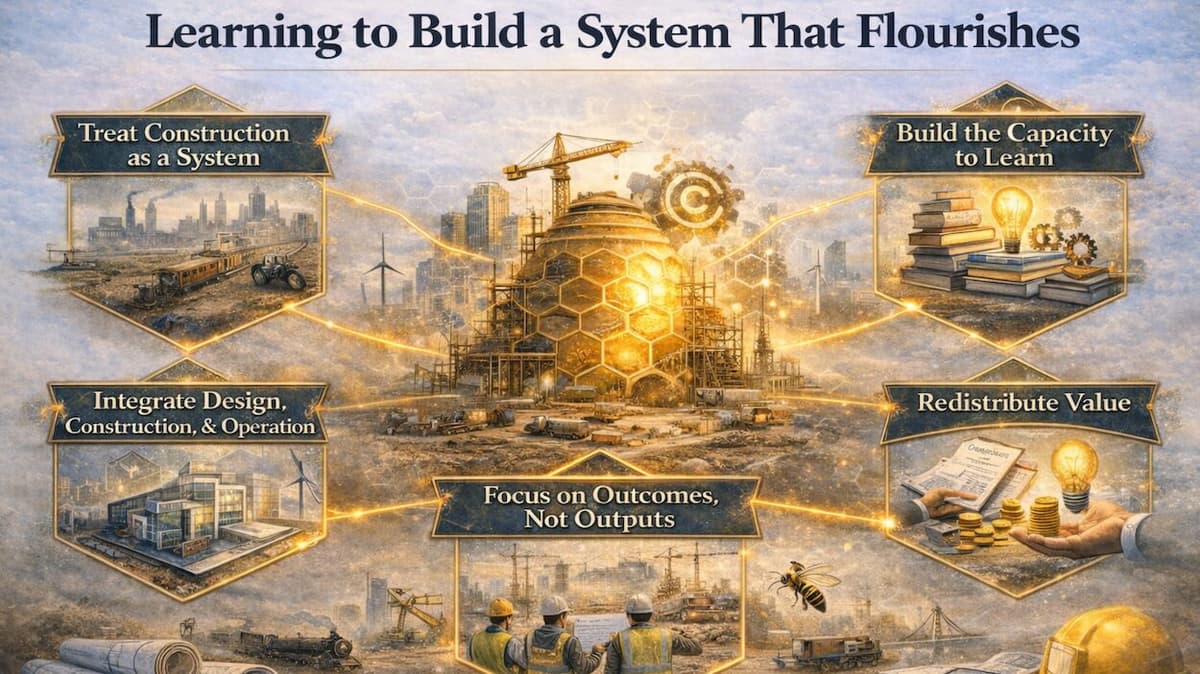
Five Lessons Construction Must Learn to Build a System that Flourishes
Key Takeaways
- •Treat construction as a continuous system, not isolated projects
- •Embed feedback, memory, and coordination to enable collective learning
- •Integrate design, build, and operation for lifecycle performance
- •Shift metrics from cost‑time outputs to long‑term outcomes
- •Align commercial models so value follows performance over time
Pulse Analysis
Recent energy shocks have exposed a deeper fragility in the built environment: a sector organized around discrete, short‑lived projects that discard lessons once a job ends. Unlike manufacturing, which operates as a continuous learning system, construction repeats the same inefficiencies project after project. Stacey’s five‑lesson framework reframes this weakness as an opportunity, urging industry leaders to adopt a system‑level perspective that captures data, retains knowledge, and coordinates decisions across the entire value chain. This shift is essential for delivering lower‑energy buildings, fewer defects, and faster housing delivery.
The Transforming Construction Challenge (TCC) provided the first real‑world testbed for these ideas, proving that digital twins, performance feedback loops, and collaborative ecosystems can generate measurable gains. Building on that success, the Industrialising and Digitalising Construction Challenge (IDCC) is scaling standardised digital marketplaces and industrialised construction methods. By integrating design, construction, and operation through shared data platforms, firms can feed operational performance back into design models, creating a virtuous cycle of improvement. The result is not just higher productivity but a more resilient supply chain capable of responding to geopolitical volatility.
For policymakers and investors, the final lesson—redistributing value—addresses the chronic misalignment where upfront investors reap few benefits from long‑term performance gains. New commercial contracts that reward whole‑life outcomes, along with procurement frameworks that prioritize durability and energy efficiency, can align incentives across owners, contractors, and operators. As the construction sector embraces these systemic changes, it will become a strategic asset for national resilience, supporting faster infrastructure roll‑outs, affordable housing, and sustainable urban growth.
Five lessons construction must learn to build a system that flourishes
Comments
Want to join the conversation?