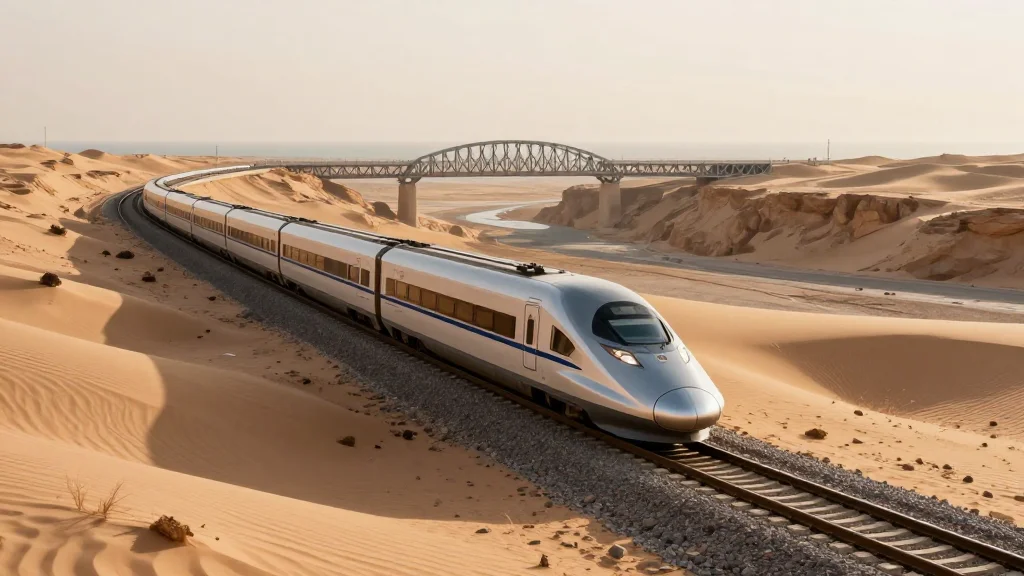
$26.6B Saudi Landbridge Project: Spanish Firm Wins the Design Role in Major Rail Construction Push
Why It Matters
The contract accelerates the Landbridge’s timeline, enhancing Saudi Arabia’s trade corridor and advancing Vision 2030’s diversification away from oil. It also signals confidence from international engineering firms in the Kingdom’s large‑scale infrastructure agenda.
Key Takeaways
- •Sener wins Saudi Landbridge design contract, boosting Spanish engineering presence
- •Project shifts to phased design‑and‑build model for faster delivery
- •Rail line will cut freight transit time between Red Sea and Gulf
- •Completion by 2034 supports Vision 2030 logistics and diversification goals
Pulse Analysis
The Saudi Landbridge, now entering an advanced planning phase, marks one of the most ambitious rail undertakings in the Middle East. By appointing Spain’s Sener to lead concept and detailed engineering, Saudi Arabia signals a commitment to world‑class technical standards and to diversifying its pool of international partners. The corridor, stretching roughly 1,500 km from Jeddah through Riyadh to Dammam and Jubail, will accommodate freight trains traveling up to 160 km/h and passenger services reaching 250 km/h, dramatically reducing cargo movement times across the kingdom’s industrial heartland.
A key shift in the delivery strategy moves away from a monolithic public‑private partnership toward a phased design‑and‑build approach. This model allows the government to tender discrete sections, such as the critical Riyadh‑Jeddah link, to multiple contractors, thereby spreading risk and expediting construction. The management consortium—Hill International, Italferr and Sener—brings together program oversight, rail engineering expertise, and localized technical advisory, ensuring that design updates align with evolving system integration and ETCS Level 2 signaling requirements. The phased rollout promises early operational benefits, even as the full network aims for a 2034 completion.
Beyond transportation, the Landbridge is a linchpin of Vision 2030’s economic diversification agenda. By creating a high‑capacity inland freight corridor, the project reduces reliance on maritime routes around the Arabian Peninsula, cuts logistics costs, and positions Saudi Arabia as a trans‑Eurasian hub linking Asia, Europe and Africa. The anticipated job creation, foreign investment inflows, and infrastructure resilience are expected to stimulate ancillary sectors such as logistics parks, manufacturing, and tourism. As regional rail integration efforts, like the Gulf Railway, progress, the Landbridge will serve as a critical node in a broader GCC network, amplifying trade flows across the Gulf and cementing the kingdom’s role in global supply chains.
$26.6B Saudi Landbridge Project: Spanish Firm Wins the Design Role in Major Rail Construction Push
Comments
Want to join the conversation?
Loading comments...