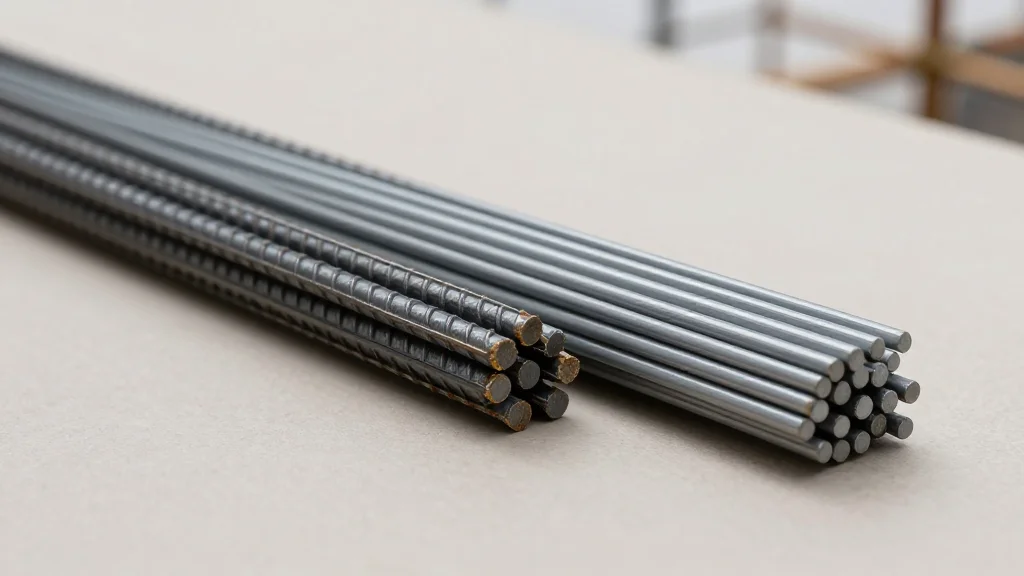
Brazil’s Composite Rebar Market Moves From Euphoria to Validation
Why It Matters
Higher certification barriers and price premiums are forcing the market to prove economic and performance value, shaping the future of corrosion‑resistant construction in Brazil’s massive steel‑rebar market.
Key Takeaways
- •Brazil now has ~10 qualified composite rebar manufacturers after market consolidation.
- •New 2025 technical standard raises qualification costs, limiting smaller players.
- •Composite rebar price $4‑5/kg versus steel $1.40‑1.60/kg hampers adoption.
- •Industry targets 0.5% of Brazil’s 3.6 M‑ton steel rebar market within five years.
- •Designer knowledge gap and qualification timelines slow large‑scale project uptake.
Pulse Analysis
The Brazilian composite rebar market exploded in the early 2020s, driven by a surge of new entrants eager to capitalize on the material’s corrosion‑resistant properties. The 2025 technical standard, however, introduced rigorous testing and documentation requirements that dramatically increased qualification expenses. As a result, the sector has consolidated, leaving roughly ten manufacturers capable of meeting the new criteria. This shift mirrors a broader industry pattern where early‑stage hype gives way to disciplined validation, forcing companies to demonstrate not just technical superiority but also cost‑effectiveness.
Economic realities present the biggest hurdle for widespread adoption. Composite rebar commands a price of $4‑5 per kilogram, roughly three times the $1.40‑1.60 per kilogram cost of conventional steel. Coupled with limited production capacity—an estimated 70,000 tons of composite rebar could not meet a single 270,000‑ton steel project—price and supply constraints dampen enthusiasm. Moreover, designers often lack the expertise to integrate composites without redesign, and qualification timelines clash with fast‑track construction schedules. These factors collectively slow market penetration beyond niche applications like floor reinforcement and automated mesh systems.
Despite the challenges, the market’s future hinges on targeted niches and industry collaboration. Companies such as Korthfiber are positioning themselves as equipment providers, having delivered dozens of rebar and mesh machines to support scaling efforts. The sector’s goal of capturing 0.5% of Brazil’s $3.6 million‑ton steel rebar market within five years reflects a realistic, incremental strategy focused on high‑value projects where corrosion resistance justifies the premium. As standards mature and a quality seal emerges, the emphasis will shift from proving the material exists to identifying projects where technical and economic benefits align, potentially unlocking broader acceptance across Brazil’s construction landscape.
Brazil’s composite rebar market moves from euphoria to validation
Comments
Want to join the conversation?
Loading comments...