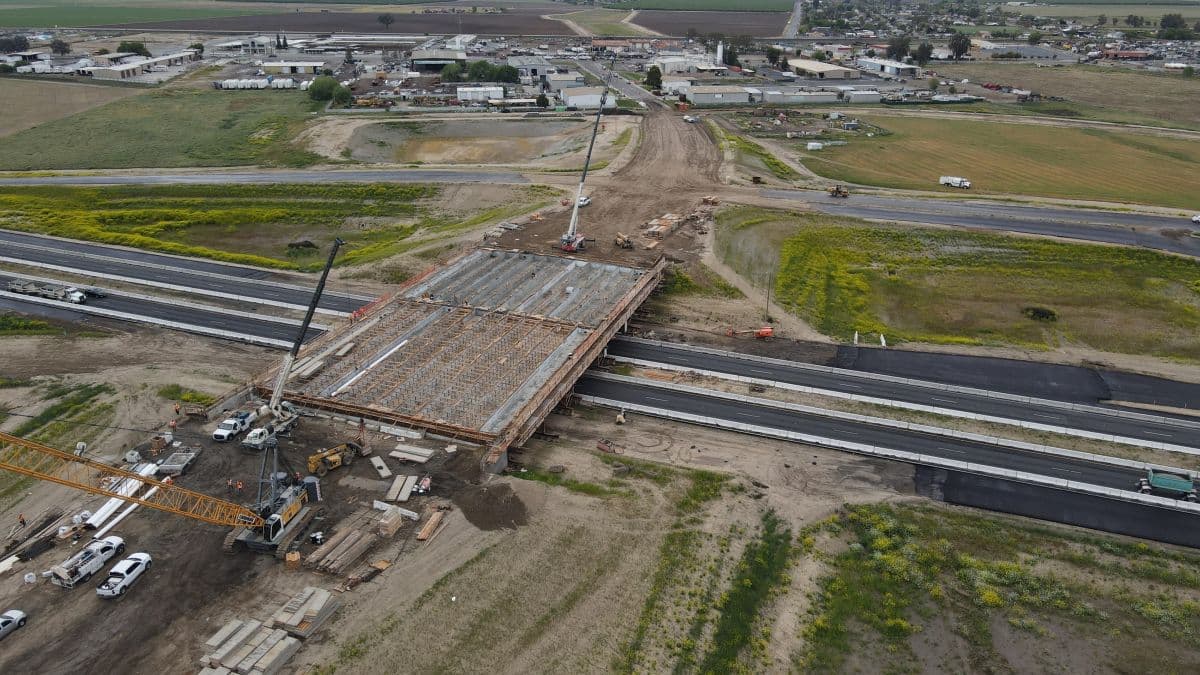
Caltrans, Security Paving Reduce Congestion, Enhance Safety On SR 99 Interchange
Why It Matters
By enhancing a critical freight corridor, the interchange boosts Tulare’s agricultural economy and reduces emissions, setting a benchmark for multimodal, technology‑driven highway upgrades in California.
Key Takeaways
- •$80 million SR 99 interchange project slated for fall 2026 completion.
- •New lanes, bike paths, sidewalks aim to cut congestion and emissions.
- •Smart‑traffic system will provide real‑time monitoring and ramp‑metering.
- •Construction kept Paige Avenue ramps open, preserving local access.
- •Project supports Tulare’s freight movement and tourism for Ag Expo.
Pulse Analysis
State Route 99 is the backbone of California’s Central Valley, linking major agricultural hubs and serving as a conduit for tourists heading to Sequoia and Kings Canyon. Tulare’s new International Agri‑Center/Commercial Avenue interchange addresses chronic bottlenecks that have long plagued commuters and truckers alike. By widening the roadway to four lanes, adding median shoulders, and installing modern traffic‑management tools, the project promises smoother flow for both local traffic and long‑haul freight, directly supporting the region’s $30 billion agricultural output.
Beyond raw capacity, the $80 million investment embeds multimodal elements that reflect evolving transportation priorities. Two miles of bike lanes and 1.4 miles of sidewalks encourage greener commutes, while real‑time traffic monitoring and ramp‑metering reduce idle time, cutting greenhouse‑gas emissions. The design also preserves the Paige Avenue ramps, a concession to community input that maintains neighborhood connectivity. For Tulare’s economy, the upgrade means faster delivery of crops, lower logistics costs, and a more attractive venue for the World Ag Expo, which draws roughly 100,000 visitors each year.
The project exemplifies California’s broader push toward resilient, technology‑enabled infrastructure. By integrating smart‑traffic systems and post‑tensioned concrete bridges, Caltrans sets a template for future highway enhancements that balance capacity, safety, and environmental stewardship. Although the timeline slipped due to the World Ag Expo and an FAA permit, the anticipated 2026 completion aligns with state goals to modernize key freight corridors ahead of rising demand. Stakeholders—from farmers to commuters—stand to benefit from reduced travel times, lower emissions, and a more adaptable transportation network.
Caltrans, Security Paving Reduce Congestion, Enhance Safety On SR 99 Interchange
Comments
Want to join the conversation?
Loading comments...