Companies Mentioned
Why It Matters
By linking education facilities with public amenities, the school fosters social cohesion and urban regeneration, setting a model for future public‑sector projects. Its design showcases how schools can serve as community hubs while meeting modern performance standards.
Key Takeaways
- •New Camarate Elementary integrates public library for community access
- •Courtyard design buffers noise from nearby Humberto Delgado Airport
- •South-facing classrooms use GRC canopies for solar control and comfort
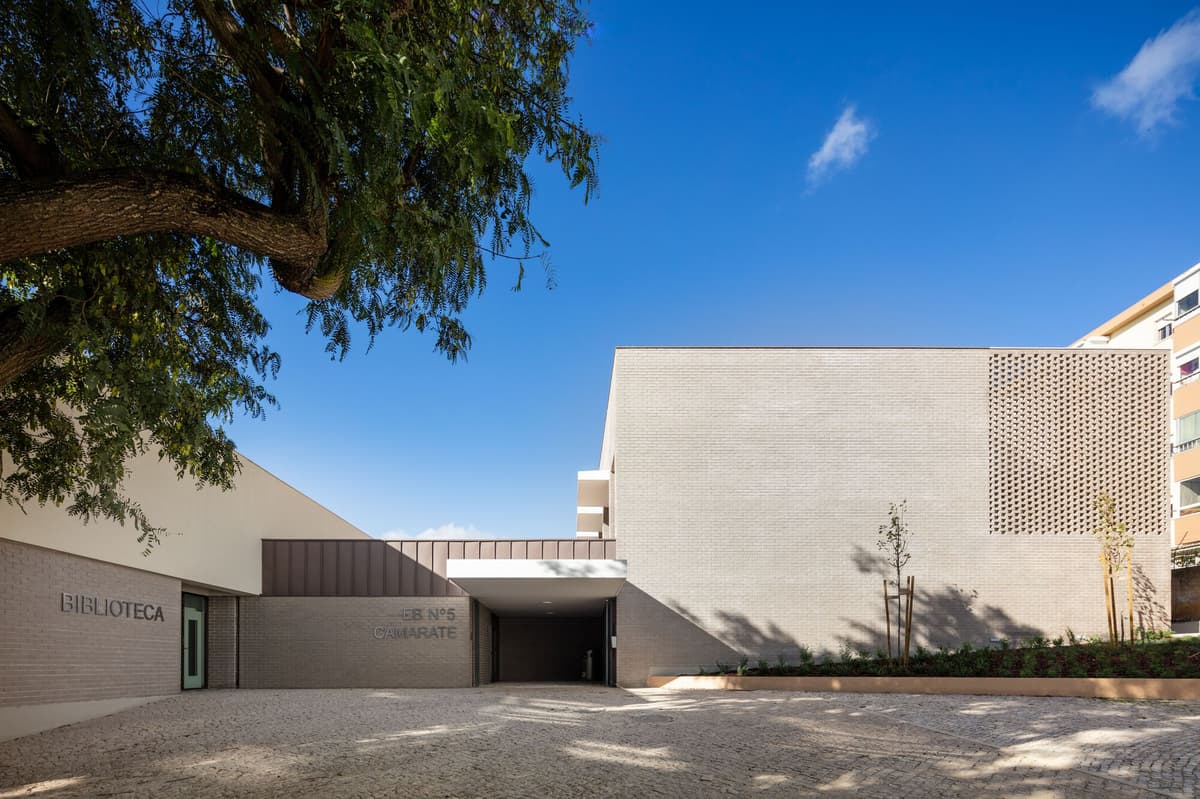
- •Exposed brick façade and grey‑brick lattice enhance durability and aesthetics
- •Covered playground and landscape blend enable year‑round outdoor use
Pulse Analysis
The opening of Camarate Elementary School No. 5 reflects Portugal’s renewed investment in 21st‑century educational infrastructure. Situated in the densely populated São Francisco district of Loures, the 1,731 m² campus replaces an aging facility and serves as a catalyst for neighbourhood revitalisation. By embedding a publicly accessible library within the school, the project blurs the line between civic and academic spaces, a strategy increasingly adopted by municipalities seeking to maximise public assets. This approach aligns with broader European trends that view schools as community hubs capable of driving social and economic uplift.
Architect Rui Cruz’s design tackles two perennial challenges: noise from the adjacent Humberto Delgado Airport and the need for natural illumination. A central courtyard acts as an acoustic shield, while the building’s four volumetric blocks channel daylight through skylights and solar tubes, creating bright, thermally comfortable classrooms. South‑facing rooms are protected by precast white‑concrete (GRC) canopies that regulate solar gain without sacrificing views. The choice of exposed brick façades, grey‑brick lattice, and durable white concrete not only reinforces a sober aesthetic but also ensures low‑maintenance performance in a high‑traffic public setting.
The school’s mixed‑use program delivers measurable community benefits. The library invites residents of all ages, fostering lifelong learning and strengthening neighbourhood ties. A covered playground, linked to interior spaces by GRC walkways, guarantees year‑round outdoor activity, supporting child development and public health goals. Landscape architecture integrates seamless transitions between built and green areas, enhancing biodiversity and visual appeal. As municipalities worldwide grapple with aging school stock, Camarate’s model demonstrates how thoughtful architecture, material durability, and community‑centric programming can jointly elevate educational outcomes and urban vitality.
Camarate Elementary School No. 5 / UMA Collective
Comments
Want to join the conversation?
Loading comments...