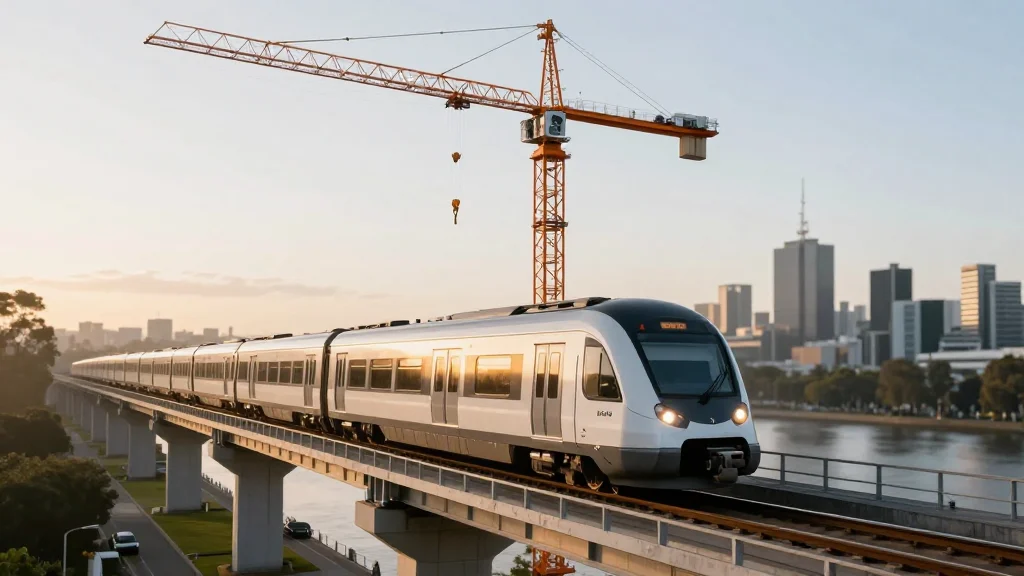
Commonwealth Pumps Billions More Into Melbourne’s Biggest Railway Project
Companies Mentioned
Why It Matters
Federal backing reduces financing uncertainty, accelerating a transformative transport corridor that will reshape Melbourne’s suburbs and stimulate long‑term economic growth. The funding model showcases how value‑capture can leverage private development to fund public infrastructure.
Key Takeaways
- •Commonwealth adds $2.5 bn USD to Melbourne rail loop.
- •Total federal contribution reaches $4.0 bn USD for $22.8 bn project.
- •Project aims to open 2035, linking southeast to east suburbs.
- •Construction to create 3,000 jobs now, 8,000 long‑term.
- •Value‑capture expected to fund half of state’s $7.6 bn share.
Pulse Analysis
Australia’s decision to inject an extra $2.5 bn USD into the Suburban Rail Loop East reflects a broader shift toward strategic, government‑led infrastructure that tackles urban sprawl. By financing a third of the $22.8 bn USD orbital rail, the Commonwealth not only eases the fiscal burden on Victoria but also signals confidence in the project’s long‑term viability. This infusion aligns with the federal agenda to improve inter‑suburban connectivity, reducing reliance on central‑city corridors and cutting commuter travel times, which in turn can lower road congestion and emissions.
The funding structure hinges on a mixed‑revenue model: one‑third state funds, one‑third federal, and the remaining third sourced through value‑capture. This mechanism taxes the uplift in land values and development potential that new stations generate, effectively turning future private gains into present‑day public capital. Analysts view this as a pragmatic way to bridge the $11.5 bn USD funding gap the state faces, especially after earlier criticisms of the business case’s assumptions. If successful, the model could become a template for other megaprojects across Australia and beyond, demonstrating how infrastructure can be financed without over‑leveraging public debt.
Beyond the balance sheet, the Loop promises tangible socioeconomic benefits. Immediate construction activity will employ 3,000 workers, while the completed network is projected to sustain up to 8,000 permanent jobs and enable the construction of roughly 70,000 new homes. By linking key growth corridors, the rail line is expected to stimulate commercial activity, expand labor market reach, and enhance property values in surrounding precincts. For investors and developers, the project offers a clear signal that Melbourne’s eastern and southeastern suburbs are poised for accelerated growth, making the Suburban Rail Loop East a pivotal catalyst for the city’s next phase of development.
Commonwealth pumps billions more into Melbourne’s biggest railway project
Comments
Want to join the conversation?
Loading comments...