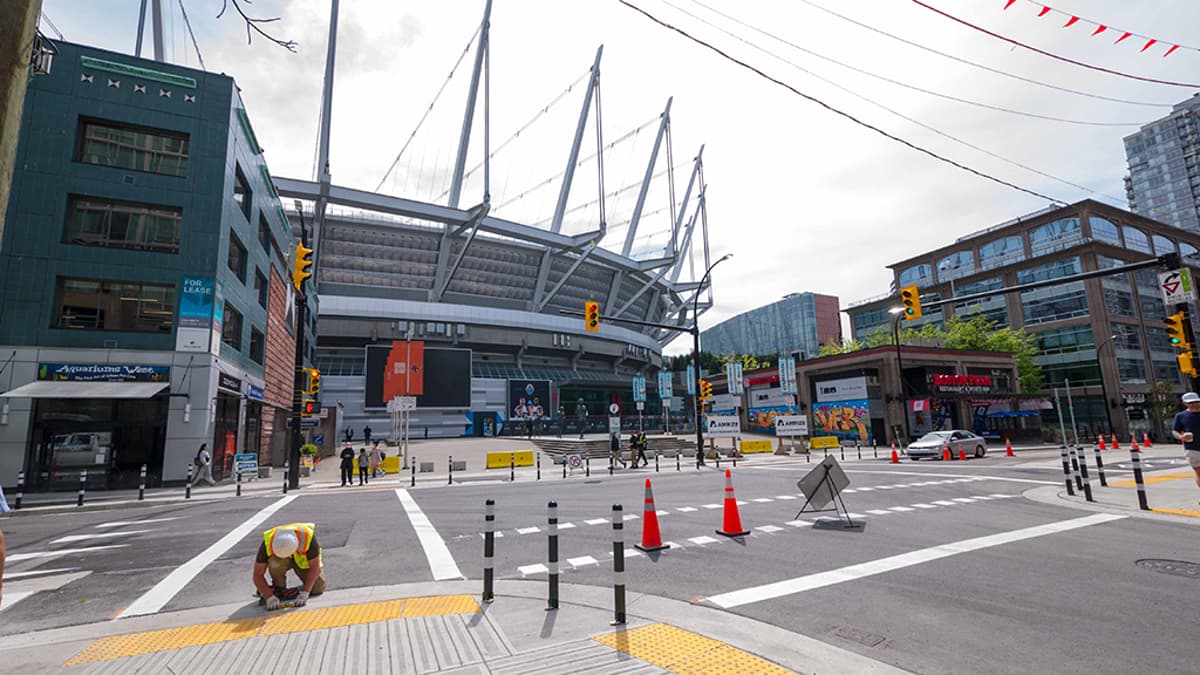
‘Final Touches’ Underway at FIFA World Cup Venues in Vancouver, Toronto
Why It Matters
The upgrades ensure Canada meets FIFA’s strict venue standards, safeguarding revenue, tourism, and the country’s reputation as a world‑class sports host.
Key Takeaways
- •B.C. Place renovation totals $146 million CAD (~$108 million USD).
- •BMO Field added 17,000 seats to meet FIFA’s 40,000 minimum.
- •Provincial hosting cost estimated $532‑$624 million CAD (~$394‑$462 million USD).
- •Grass surface uses 84% Kentucky bluegrass, 16% perennial ryegrass.
- •Final touches on B.C. Place on schedule, on budget.
Pulse Analysis
Canada’s stadium upgrades are more than cosmetic; they represent a strategic investment to meet FIFA’s rigorous standards while delivering long‑term community benefits. B.C. Place’s $146 million CAD overhaul, funded largely by the province, replaces artificial turf with a temporary natural grass system, a move that aligns the venue with elite soccer requirements and showcases Canadian engineering prowess. In Toronto, the $146 million CAD revamp of BMO Field—supported by a $123 million CAD city contribution and $23 million CAD from MLSE—added 17,000 seats, pushing capacity beyond the 40,000‑seat threshold and positioning the venue for future high‑profile events.
The grass‑installation effort highlights cutting‑edge agronomy. A research team led by Michigan State and the University of Tennessee engineered an 84/16 blend of Kentucky bluegrass and perennial ryegrass, seeded on trays and installed in a 14‑inch‑deep substrate at B.C. Place. Grow‑lights maintain vitality throughout the summer, reflecting advances since the 1994 World Cup’s temporary sod solutions. This scientific approach not only guarantees a consistent playing surface for athletes but also creates a replicable model for indoor stadiums worldwide, potentially opening new markets for turf technology providers.
Beyond the pitch, the World Cup’s economic ripple will be significant. Provincial estimates of $532‑$624 million CAD (~$394‑$462 million USD) cover infrastructure, security, and marketing, with expectations of heightened tourism, job creation, and global exposure for Canadian cities. Successful delivery of these upgrades reinforces Canada’s credibility for future mega‑events, while the legacy of upgraded venues promises sustained revenue streams for local sports franchises and community programs. The convergence of sport, technology, and economic ambition positions the 2026 World Cup as a catalyst for lasting growth in North America’s sports landscape.
‘Final touches’ underway at FIFA World Cup venues in Vancouver, Toronto
Comments
Want to join the conversation?
Loading comments...