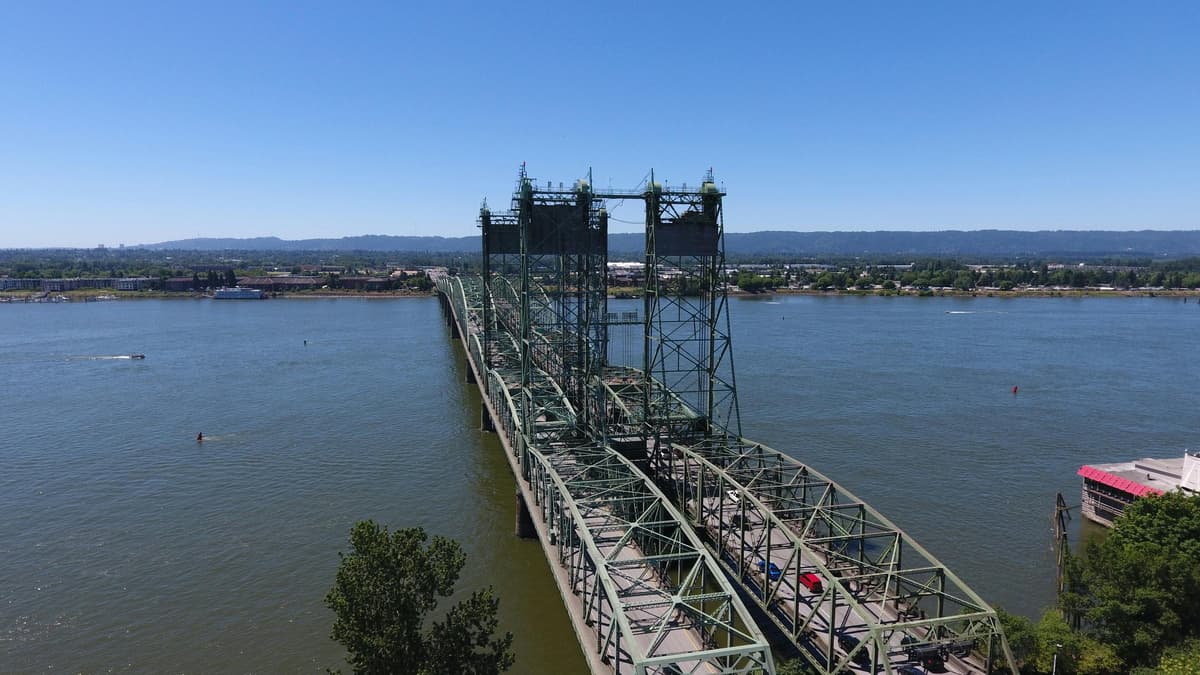
I-5 Bridge Replacement Between Washington and Oregon Climbs to $14.4 Billion
Why It Matters
The aging lift bridge is the only traffic‑stoplight on I‑5, creating chronic congestion and posing seismic risk; its replacement will restore reliable interstate flow and enable expanded transit. Securing funding and a fixed‑span design signals a decisive move toward modernizing a critical freight and commuter corridor in the Pacific Northwest.
Key Takeaways
- •Project cost rises to $14.4 billion, four times 2014 estimate
- •Fixed‑span design saves $1.7 billion and eliminates bridge lifts
- •Core phase budget $7.7 billion, with $5.5 billion funding secured
- •Construction could start 2028; opening projected for mid‑2030s
Pulse Analysis
The I‑5 bridge over the Columbia River is a linchpin for coast‑to‑coast commerce, yet its century‑old lift spans have become a bottleneck for both vehicles and freight trains. Each time the bridge raises for maritime traffic, traffic backs up for miles, creating the only traffic‑stoplight on the 2,700‑mile interstate corridor. Added to the congestion is the bridge’s vulnerability to a major earthquake, a risk that has loomed over regional planners for decades. Inflation, soaring steel prices, and updated seismic standards have driven the project’s cost from a modest estimate in 2014 to $14.4 billion today, underscoring the financial pressure on state budgets and the need for a pragmatic approach.
A key breakthrough came with the decision to build a fixed‑span bridge, a move that eliminates the lift mechanism and saves roughly $1.7 billion. This design not only cuts construction costs but also promises uninterrupted traffic flow, a boon for commuters and long‑haul trucking firms that rely on I‑5 for timely deliveries. The core phase, budgeted at $7.7 billion, couples the new bridge with an extension of light‑rail service to Vancouver’s waterfront, aligning with broader multimodal goals. With $5.5 billion already secured from federal and state sources, the financing picture looks more stable, though the project still hinges on final environmental clearance.
If construction kicks off in 2028 as projected, the region can expect a multi‑year stimulus to the local economy, from engineering contracts to labor jobs. The mid‑2030s opening will deliver a resilient, high‑capacity crossing that supports projected population growth and freight demand in the Pacific Northwest. Moreover, the project serves as a template for other aging infrastructure across the United States, illustrating how design innovation, strategic funding, and bipartisan political will can converge to modernize critical transportation links.
I-5 Bridge Replacement Between Washington and Oregon Climbs to $14.4 Billion
Comments
Want to join the conversation?
Loading comments...