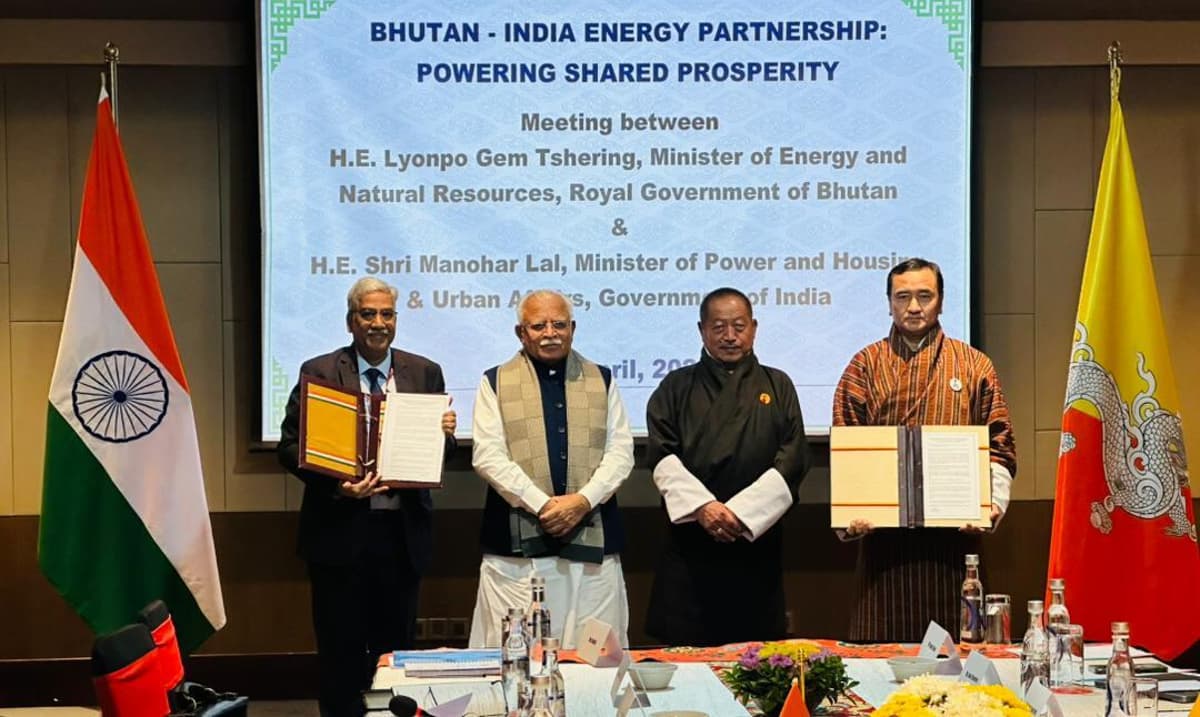
India-Bhutan Hydropower Push: Minister Manohar Lal’s 4-Day Visit to Drive Projects, Trade
Why It Matters
Accelerating these mega‑hydro projects strengthens India’s renewable supply, boosts Bhutan’s revenue, and deepens strategic energy interdependence in South Asia.
Key Takeaways
- •Punatsangchhu‑I and II together exceed 2 GW of planned capacity
- •FY2024‑25 cross‑border trade reached ~9,500 MUs, up 6% YoY
- •Tata Power‑Druk Green partnership drives 1,125 MW Dorjilung project
- •Minister Lal’s visit aims to accelerate project milestones and trade frameworks
Pulse Analysis
India and Bhutan have built a decades‑long partnership around hydropower, with India financing and importing the majority of Bhutan’s electricity. The two nations view water‑rich Bhutan as a natural battery for India’s growing renewable mix, allowing the grid to balance solar and wind fluctuations. Recent policy shifts, including streamlined licensing and joint‑venture incentives, have positioned the Punatsangchhu cascade—totaling over 2 GW—as the flagship of this cooperation, promising to add roughly 2.2 TWh of clean energy to the regional pool once fully operational.
The current portfolio extends beyond state‑run projects. Tata Power, in partnership with Druk Green Power Corp., is constructing the 1,125 MW Dorjilung and 600 MW Khorlochhu hydroelectric plants, marking the largest private‑sector PPP in Bhutan. These projects are slated to come online between 2027 and 2029, feeding into the existing 9,500 MUs of cross‑border trade that grew 6% in FY2024‑25. While financing and environmental clearances have progressed, challenges remain in transmission upgrades and land acquisition, prompting the minister’s on‑site reviews to keep timelines on track.
Strategically, the accelerated rollout of Bhutanese hydropower aligns with India’s climate commitments and its goal of achieving 450 GW of renewable capacity by 2030. Reliable imports from Bhutan can offset seasonal shortfalls, reduce coal dependence, and lower emissions across the subcontinent. Moreover, deepening energy ties reinforces geopolitical stability, offering a counterbalance to competing regional influences. Continued investment, coupled with robust trade mechanisms, could see bilateral electricity exchanges double within the next decade, cementing Bhutan’s role as a clean‑energy hub for South Asia.
India-Bhutan Hydropower Push: Minister Manohar Lal’s 4-Day Visit to Drive Projects, Trade
Comments
Want to join the conversation?
Loading comments...