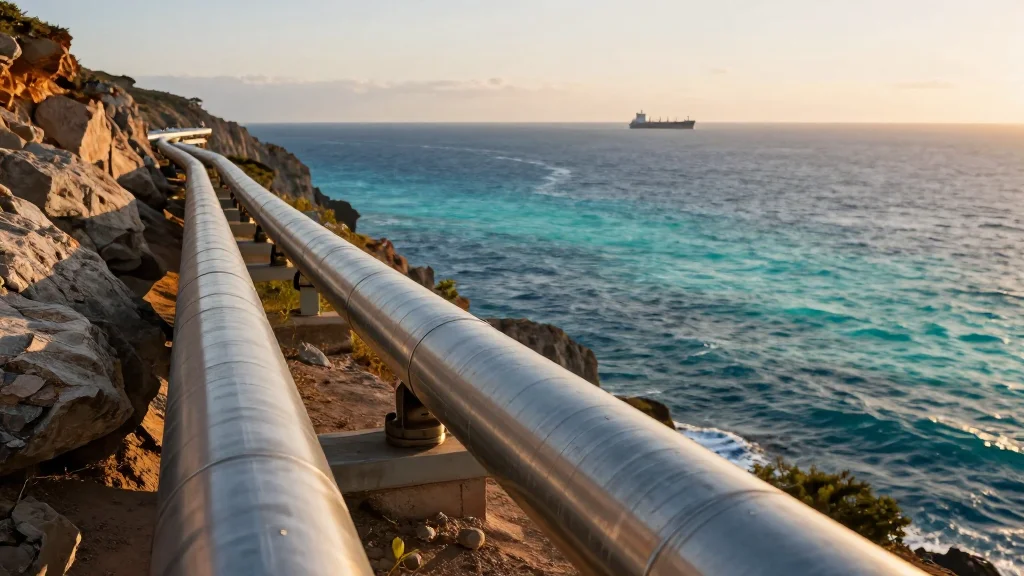
Morocco Seeks Financing for $25bn Gas Pipeline
Why It Matters
The project could reshape Euro‑African energy security by diversifying Europe’s gas supply and unlocking untapped West African reserves, while providing Morocco a strategic transit hub and new revenue stream.
Key Takeaways
- •Onhym launches $25 bn fundraising for 6,900 km gas pipeline.
- •Pipeline will connect Nigeria, Senegal, Mauritania to Morocco and Europe.
- •Phase‑1 FID expected by year‑end; project built in stages.
- •Capacity 30 bcm annually, half for Morocco, half for European export.
- •Joint venture with Nigerian National Petroleum Company will manage construction.
Pulse Analysis
Europe’s push to diversify its gas supply after the Ukraine war has turned attention to untapped reserves in West Africa. Morocco, perched at the southern edge of the Mediterranean, is uniquely positioned to become a transit corridor linking Nigerian, Senegalese and Mauritanian fields to the continent. The proposed 6,900‑km Nigeria‑Morocco Gas Pipeline would feed the existing Maghreb‑Europe line, offering a direct route for up to 30 billion cubic metres of gas each year. By channeling half of that volume to domestic Moroccan demand and the rest to Europe, the project promises to bolster energy security on both sides of the Mediterranean.
Financing a $25 bn infrastructure venture across multiple jurisdictions is a formidable task, prompting Onhym’s recent conversion into a joint‑stock company to attract diversified capital. The agency plans a staged fundraising approach, leveraging a joint‑venture with the Nigerian National Petroleum Company to share construction risk and streamline regulatory approval. International engineering firms such as Penspen and Worley have already been engaged for front‑end design, signaling technical credibility that could entice sovereign wealth funds, export‑credit agencies and private investors. By breaking the project into incremental phases, Onhym hopes to secure early cash flow while mitigating exposure to global financing volatility.
If realized, the pipeline could generate billions in transit fees, create thousands of construction and operations jobs, and cement Morocco’s role as an energy hub linking Africa to Europe. Regional integration would be deepened as participating countries gain access to reliable gas supplies, potentially lowering electricity costs and spurring industrial growth. However, the venture faces geopolitical risks, including regulatory alignment and security of offshore segments. Successful execution will depend on sustained political commitment, transparent governance, and the ability to attract long‑term financing amid a competitive global energy market.
Morocco seeks financing for $25bn gas pipeline
Comments
Want to join the conversation?
Loading comments...