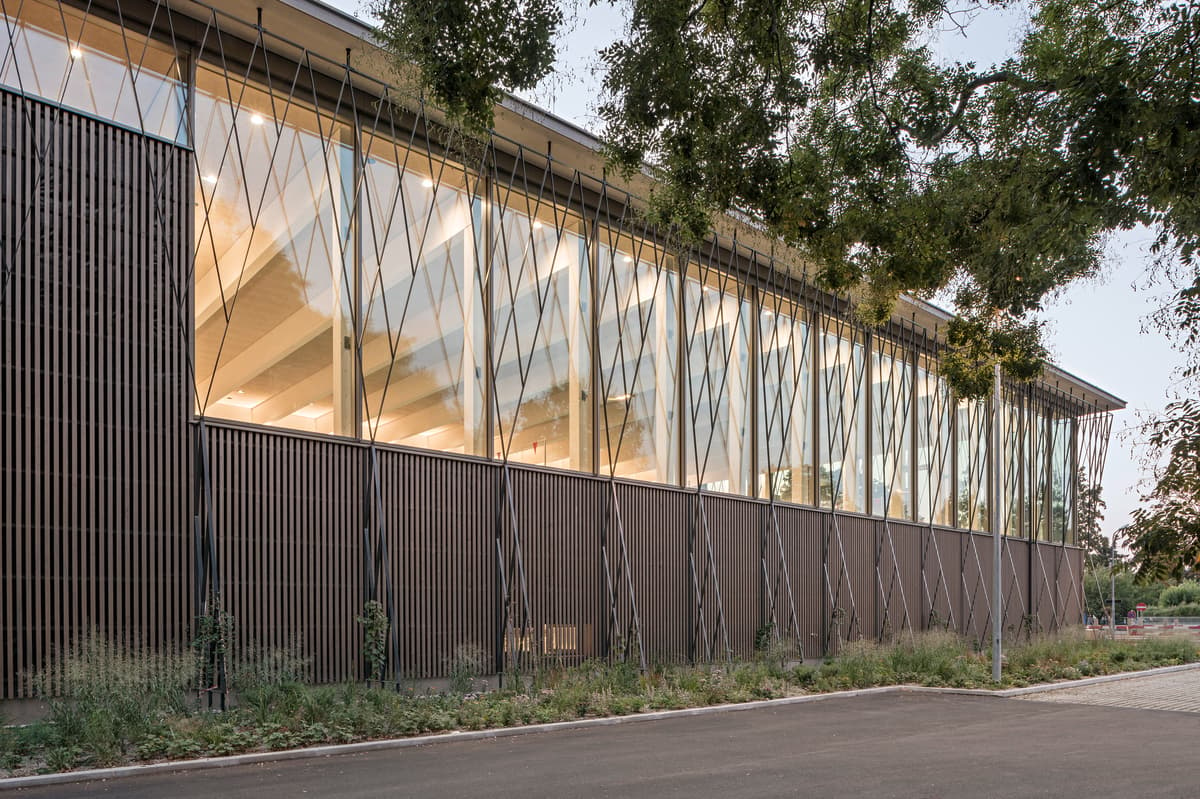
Public Swimming Pool Großfeldsiedlung / Illiz Architektur
Why It Matters
The project offers a scalable, low‑impact model for modernizing aging public sports facilities, aligning municipal upgrades with sustainability goals and budget constraints.
Key Takeaways
- •Elevated pool sits on first floor, creating barrier‑free bathing level
- •Two cantilevered bridges link new hall to 1980s complex
- •Timber glulam frame and roof slab enable long‑span, open space
- •Vegetated steel façade provides passive shading and urban biodiversity
- •Design replicates across two sites, offering a scalable extension model
Pulse Analysis
The public swimming complex in Großfeldsiedlung, originally built in the 1980s, faced the common dilemma of aging infrastructure that no longer meets modern training standards. Municipalities across Europe are increasingly looking for cost‑effective ways to upgrade facilities without extensive demolition. In response, Illiz Architektur entered an invited competition that demanded a single, repeatable solution for two identical sites. The brief emphasized a minimal footprint, climate‑responsive features, and a clear architectural identity that could be deployed quickly across the city’s pool network.
Illiz Architektur delivered a freestanding hall perched on the former parking area, accessed solely via two cantilevered bridges. By lifting the 25‑meter training pool to the first floor, the architects created a continuous, barrier‑free bathing level that aligns with the existing pool hall while offering swimmers a treetop perspective. The six‑meter‑high volume is framed by a timber glulam skeleton and a cross‑laminated timber roof slab, flooded with full‑height glazing that blurs the line between interior and surrounding greenery. A vegetated steel screen wraps the façade, delivering evaporative cooling, seasonal shading, and a habitat for urban flora.
The project demonstrates how cities can modernize legacy sports facilities while preserving historic fabric and minimizing construction waste. The use of timber, passive shading and a modular bridge system aligns with Europe’s push toward carbon‑neutral public buildings, and the replicable typology offers a template for other municipalities seeking scalable upgrades. Moreover, the living green veil not only improves energy performance but also contributes to urban biodiversity, a growing priority in climate‑responsive design. As budget constraints tighten, such climate‑smart, low‑impact interventions are likely to shape the next wave of public‑sector architecture.
Public Swimming Pool Großfeldsiedlung / Illiz Architektur
Comments
Want to join the conversation?
Loading comments...