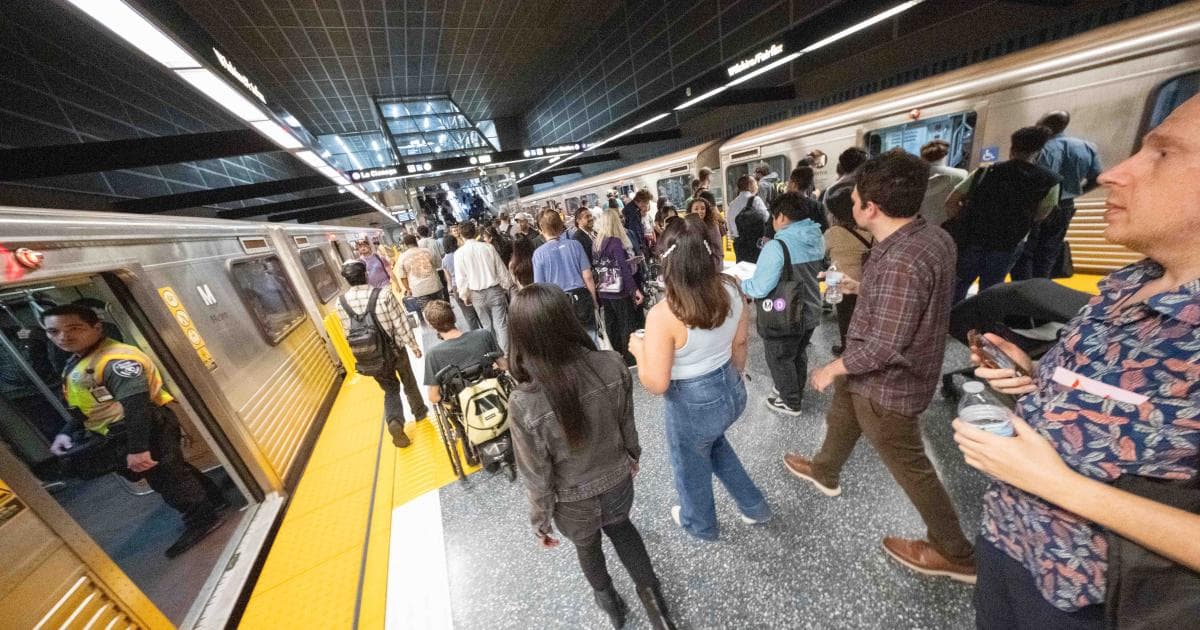
Scenes From the D Line Extension's Opening Day
Companies Mentioned

Why It Matters
The extension provides the fastest transit corridor between downtown and Beverly Hills, reshaping commuting patterns and spurring economic activity along Wilshire. It also marks a critical step toward a fully grade‑separated rail network in a car‑centric region.
Key Takeaways
- •Phase 1 adds three stations across Koreatown, Miracle Mile, Beverly Hills
- •Project cost totals $9.5 billion for a nine‑mile underground line
- •Metro expects 53,000 new daily riders upon full completion
- •Future phases will reach Rodeo Drive, Century City, and Westwood by 2027
Pulse Analysis
Los Angeles’ long‑awaited Wilshire subway finally moved from blueprint to reality as Metro launched the D Line’s first phase. The 3.9‑mile stretch, funded by a $9.5 billion public‑private partnership, introduces three strategically placed stations that connect cultural hubs like Museum Row with affluent neighborhoods such as Beverly Hills. By delivering a fully grade‑separated heavy‑rail option, the line cuts travel time between Downtown and the Westside to about 30 minutes, positioning rail as the fastest mode on Google Maps for that corridor.
Beyond speed, the extension is poised to reshape the city’s mobility landscape. Metro’s projection of 53,000 new daily riders translates into reduced vehicle miles traveled, lower congestion, and measurable emissions cuts. Early evidence from similar projects shows that proximity to new stations can lift nearby property values by 5‑10 percent and attract mixed‑use development. Retail corridors along Wilshire are already seeing increased foot traffic, suggesting that the D Line will act as a catalyst for both commercial revitalization and higher‑density housing, addressing the region’s chronic affordability challenges.
Looking ahead, phases two and three will push the line further west to Rodeo Drive, Century City, Westwood and the VA campus, with a target opening in 2027. Financing these extensions will rely on a blend of federal grants, local sales‑tax measures and bond issuances, while navigating the political hurdles that have historically delayed Los Angeles rail projects. If successful, the completed D Line will not only close a critical gap in the Metro network but also set a precedent for future transit investments across Southern California’s sprawling metropolitan area.
Scenes from the D Line extension's opening day
Comments
Want to join the conversation?
Loading comments...