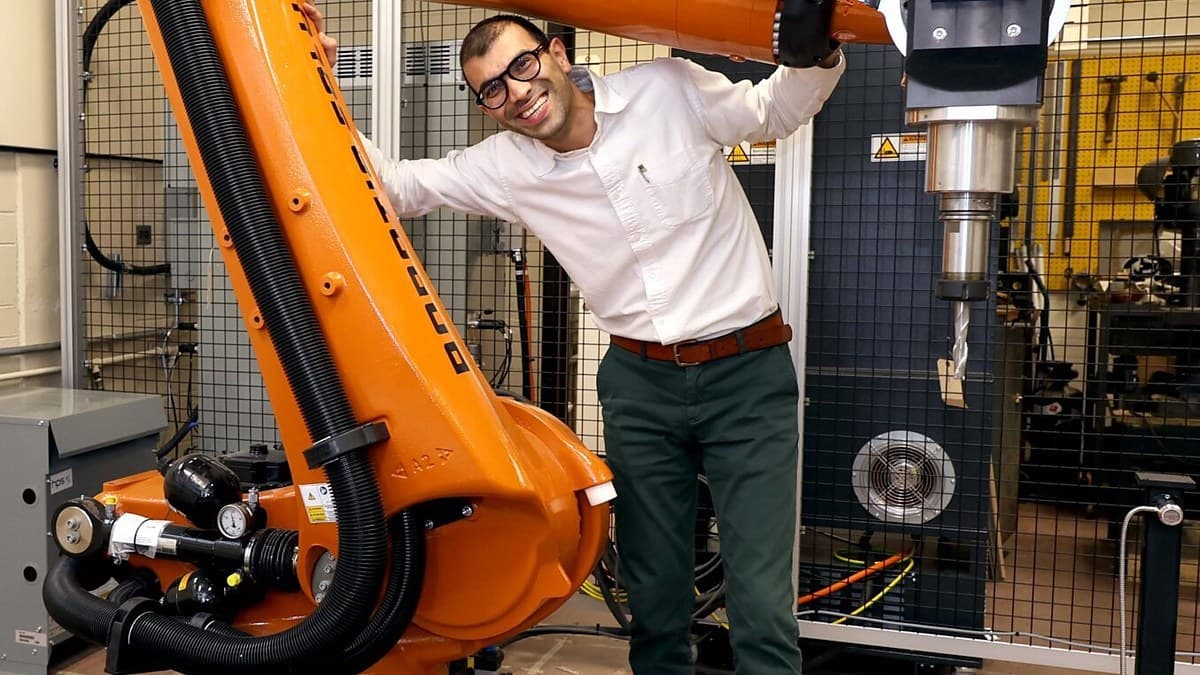
Toronto Robot Mills Mass Timber to Within 0.06-Millimetre Precision
Companies Mentioned
Why It Matters
The precision robotic platform dramatically speeds up automated timber construction, cutting labor costs while boosting structural performance and sustainability. It positions Canada at the forefront of high‑tech, low‑carbon building methods.
Key Takeaways
- •KUKA KR210 arm offers 0.06 mm repeatability for timber milling
- •Largest robotic arm installed at a Canadian university
- •Enables fastener‑free, full‑scale mass timber components
- •Supports digital‑to‑fabricated workflow for sustainable building
- •Funded by Canada Foundation for Innovation and Ontario Research Fund
Pulse Analysis
The introduction of the KUKA Quantec KR210 at the University of Toronto marks a watershed moment for North American timber engineering. With a 3.5‑metre reach, 210‑kilogram payload and 0.06‑millimetre pose repeatability, the arm rivals industrial systems traditionally confined to aerospace or automotive sectors. Its 15‑kilowatt milling spindle and integrated work‑holding table allow precise three‑dimensional carving of both solid blocks and sheet stock, delivering tolerances previously achievable only in specialized factories. This level of accuracy opens the door to complex, interlocking geometries that eliminate the need for mechanical fasteners, a key advantage for mass‑timber structures seeking both speed and durability.
Beyond the hardware, the real value lies in the digital‑to‑fabricated workflow now embedded in the Sustainable Structural Systems lab. Students translate parametric models directly into CNC‑ready code, feeding the robot a continuous stream of design iterations. This seamless integration reduces design‑to‑construction lead times, lowers material waste, and supports the growing demand for prefabricated, carbon‑negative building components. As municipalities tighten emissions standards, such precision manufacturing aligns with broader sustainability goals, offering a scalable path to high‑performance timber that can compete with steel and concrete on both cost and environmental metrics.
Canada’s investment through the Canada Foundation for Innovation and the Ontario Research Fund signals confidence in the nation’s capacity to lead in green construction technology. Coupled with collaborations like the Robot Made dome and international benchmarks such as Norway’s Oslotre studio, the Toronto cell showcases a model for academic‑industry partnerships that accelerate adoption of robotic timber fabrication. Looking ahead, the platform could serve as a testbed for advanced robotics, AI‑driven optimization, and modular construction methods, positioning Canadian universities as incubators for the next generation of sustainable building practices.
Toronto Robot Mills Mass Timber to within 0.06-Millimetre Precision
Comments
Want to join the conversation?
Loading comments...