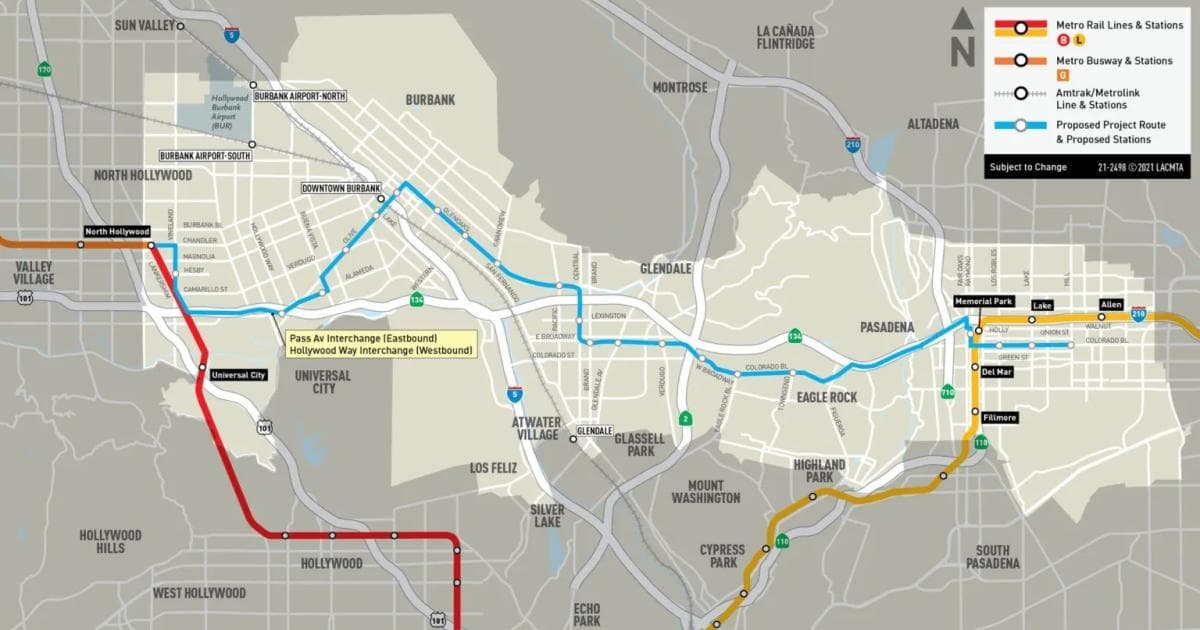
Work Getting Underway for NoHo-Pasadena BRT Line
Companies Mentioned

Why It Matters
The BRT will dramatically cut commute times and expand high‑capacity transit options across a densely populated corridor, supporting regional growth and the upcoming Olympic demand. Its early completion positions the corridor as a model for fast‑track, funded infrastructure projects.
Key Takeaways
- •317M Measure M funds 19‑mile North Hollywood‑Pasadena BRT.
- •Construction starts 2024; corridor work begins summer 2026.
- •Dedicated bus lanes aim to cut travel time 30‑40%.
- •Projected 30,000 daily riders before pandemic.
- •Line connects LA, Burbank, Glendale, Pasadena; ready for 2028 Olympics.
Pulse Analysis
The North Hollywood‑to‑Pasadena BRT represents one of the most ambitious bus‑only projects in Southern California, leveraging the $317 million Measure M allocation and state SB1 funds. By carving out dedicated lanes along Vineland, Olive, Glenoaks, Central, Broadway and Colorado, the line sidesteps typical traffic snarls that plague the SR‑134 corridor. This infrastructure investment not only modernizes a key east‑west axis but also aligns with Los Angeles’ broader goal of shifting commuters from cars to high‑frequency transit, a critical step toward meeting climate and congestion targets.
Operationally, the BRT’s design promises a 30‑40% reduction in travel time, translating to a faster, more reliable alternative to existing bus routes. The projected ridership of 30,000 daily passengers—based on pre‑pandemic forecasts—suggests strong demand for rapid, curb‑side service that integrates seamlessly with the A Line, G Line, B Line, and Metrolink. By offering frequent, off‑board fare collection and signal priority, the system aims to deliver subway‑like performance at a fraction of the cost, enhancing connectivity across Los Angeles, Burbank, Glendale and Pasadena.
Strategically, the line’s completion before the 2028 Olympics positions the region to handle a surge in visitor traffic while showcasing sustainable mobility solutions. The BRT will alleviate pressure on congested freeways, reduce emissions, and stimulate economic activity along its corridor through improved access to jobs and retail. Its success could spur additional BRT projects statewide, reinforcing the role of bus rapid transit as a scalable, cost‑effective complement to rail expansion in the United States.
Work getting underway for NoHo-Pasadena BRT Line
Comments
Want to join the conversation?
Loading comments...