AI Neckband Lets You Talk without Saying a Word
Why It Matters
The neckband could restore vocal communication for speech‑disordered patients and enable silent, reliable messaging in noisy or hazardous workplaces, expanding the market for wearable AI interfaces.
Key Takeaways
- •POSTECH neckband achieves 85.8% accuracy on 26-word set
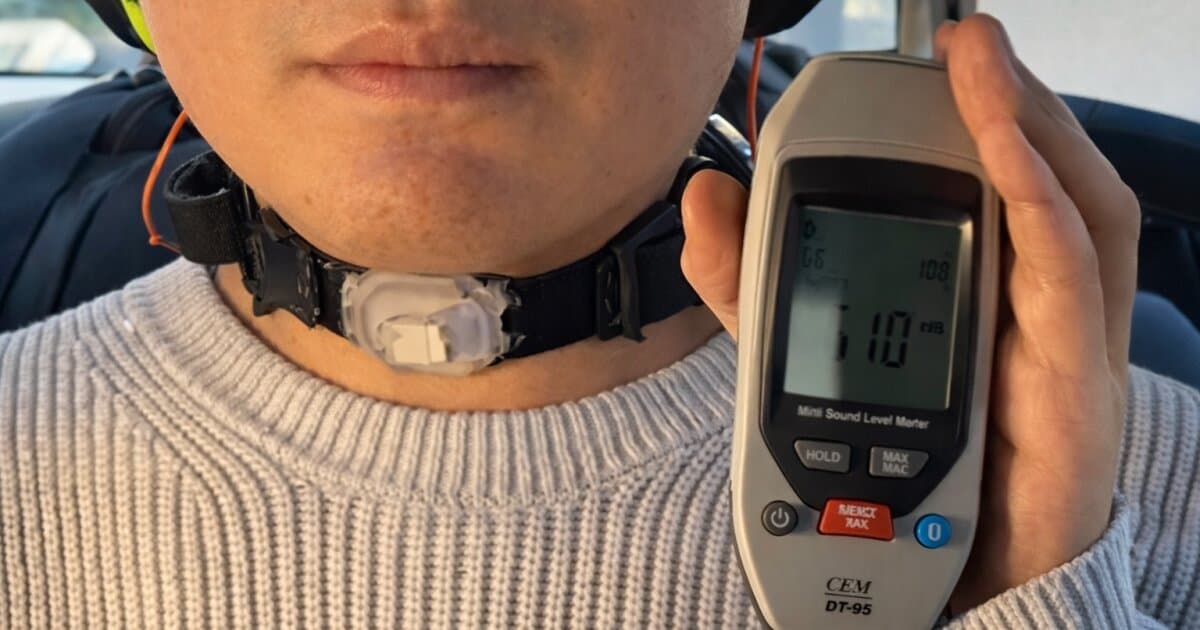
- •Operates in 90 dB noise, maintaining 33.75 dB signal‑to‑noise ratio
- •Personalized voice synthesis requires under 10 minutes of recordings
- •Accuracy falls to 39.7% with walking or head movement
- •Targets speech‑disordered patients and noisy industrial communications
Pulse Analysis
The POSTECH neckband represents a shift from traditional electromyography and EEG rigs toward a soft, wearable platform that reads mechanical deformation of the throat. By embedding a miniature camera and multiaxial strain sensors in silicone, the device captures a high‑resolution map of skin movement, feeding it to a deep‑learning model tuned to the wearer’s voice. This approach sidesteps bulky electrodes and offers a more comfortable, on‑the‑go solution, positioning it alongside emerging silent‑speech wearables that aim to translate intent without audible sound.
Performance metrics set the prototype apart from earlier lab‑only systems. In controlled tests it decoded 26 NATO phonetic words with 85.8% accuracy and sustained a 33.75 dB signal‑to‑noise ratio even under 90 dB white‑noise—conditions that would cripple most commercial EMG devices. Compared with a Cambridge choker that reported 95.25% accuracy on unrestricted vocabularies, POSTECH’s strength lies in its personalized text‑to‑speech output, which can be trained in under ten minutes and reproduces the user’s intonation. However, the system’s accuracy drops sharply to 39.7% when the wearer walks or makes pronounced head movements, highlighting the need for robust motion compensation.
If the team expands the vocabulary and refines movement correction, the neckband could disrupt several markets. For healthcare, it offers a non‑invasive voice restoration tool for laryngectomy patients and those with neuro‑degenerative speech impairments. In industrial settings—construction sites, factories, or military operations—silent communication could improve safety where conventional microphones fail. Investors and OEMs should watch the next development phase, as scaling the technology will require larger user trials, regulatory clearance for medical use, and integration with existing communication ecosystems. The convergence of soft‑sensor hardware and AI‑driven speech synthesis signals a broader trend toward discreet, AI‑augmented wearables that bridge the gap between intention and audible output.
AI neckband lets you talk without saying a word
Comments
Want to join the conversation?
Loading comments...