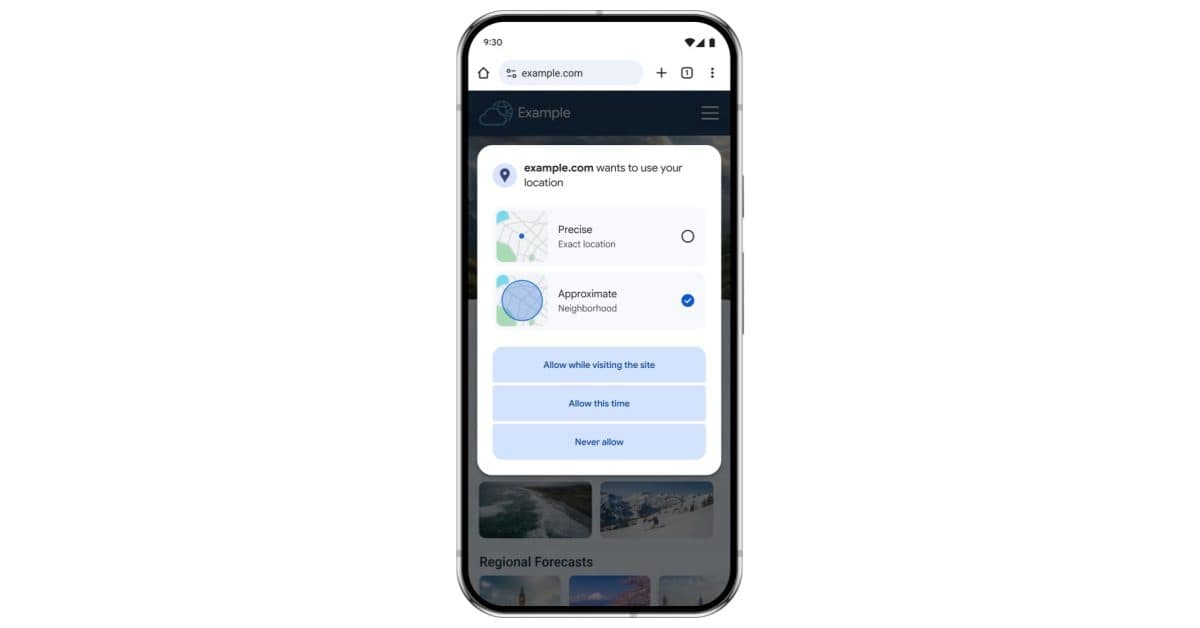
Chrome for Android Will Let You Just Share Approximate Location
Companies Mentioned
Why It Matters
By limiting location granularity, Chrome enhances user privacy while maintaining functionality for services that need only regional data, setting a new standard for mobile browsers.
Key Takeaways
- •Chrome adds Approximate location option for Android users
- •Users can choose neighborhood‑level data instead of exact coordinates
- •New APIs let developers request coarse location only
- •Feature aligns with recent Android privacy upgrades
- •Precise location still available for essential services
Pulse Analysis
Google’s decision to expose an approximate‑location toggle in Chrome for Android reflects a broader shift toward granular privacy controls on mobile platforms. By letting users share only a neighborhood‑level coordinate, the browser reduces the risk of unwanted tracking while still enabling location‑based services such as weather updates or local news. The move dovetails with recent Android privacy updates that introduced a one‑time location button and a refined permission UI, signaling that major tech firms are responding to both regulator scrutiny and growing consumer demand for data minimisation.
For web developers, the rollout introduces new Geolocation APIs that can explicitly request coarse location or declare a precise‑only requirement. This forces a reassessment of existing code that previously assumed high‑accuracy coordinates were always available. Sites that rely on exact positioning for non‑essential features—such as targeted advertising or detailed mapping—will need to downgrade their requests to preserve user trust and avoid permission fatigue. Early adopters who audit their location needs stand to benefit from smoother user experiences and lower compliance risk under emerging privacy regulations.
Chrome’s approximate‑location feature also puts pressure on competing browsers to adopt similar privacy‑first options, potentially establishing a new industry baseline. As users become accustomed to choosing between precise and coarse data, advertisers and data brokers may need to adjust targeting models that historically depended on pinpoint accuracy. Meanwhile, enterprises that embed location services into internal apps can leverage the coarse‑location API to comply with corporate data‑handling policies without sacrificing functional relevance. Overall, the change underscores a market‑wide pivot toward data minimisation while preserving the utility of location‑based experiences.
Chrome for Android will let you just share approximate location
Comments
Want to join the conversation?
Loading comments...