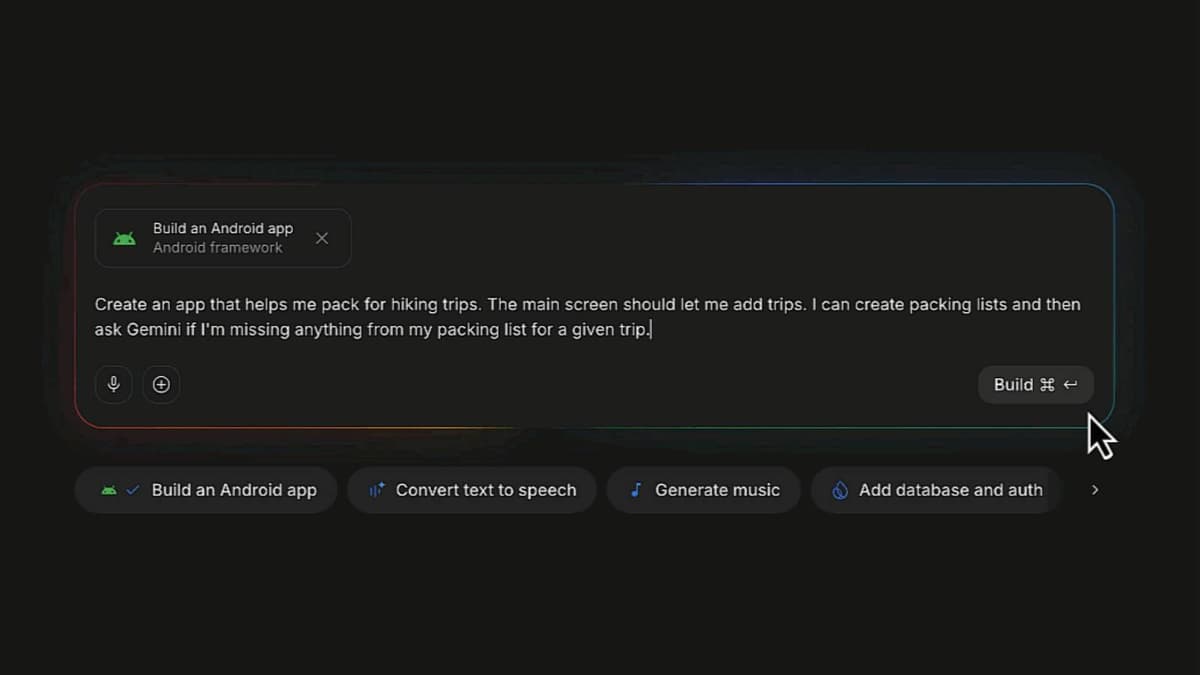
Google Just Made It Possible to Build Android Apps with only a Text Prompt
Why It Matters
By turning natural language into functional apps, Google accelerates development cycles and expands the pool of potential creators, reshaping the Android ecosystem’s productivity and discoverability.
Key Takeaways
- •Google AI Studio generates full Android apps from text prompts
- •Android Studio Canary supports multiple AI models, including Claude and GPT
- •Agent Skills let AI understand custom workflows and dependencies
- •Gemini will surface Play Store apps in search within weeks
- •Developers can refine AI‑generated code in Android Studio
Pulse Analysis
Google’s AI Studio marks a significant shift in mobile development, allowing users to describe an app’s functionality in plain language and receive a complete, native Android project in return. This democratizes app creation, letting entrepreneurs, designers, and even hobbyists prototype ideas without mastering Java or Kotlin. The technology leverages Google’s Gemini models, which have been fine‑tuned on extensive Android APIs, ensuring the generated code adheres to platform standards while reducing the time‑to‑market for new applications.
For professional developers, the integration of multi‑model support into Android Studio’s Canary build opens new collaborative possibilities. Teams can choose from Anthropic Claude, OpenAI’s GPT, or Google’s own models, and even run local instances like Gemma 4 for privacy‑sensitive projects. The introduction of "Agent Skills" lets developers embed domain‑specific knowledge, automating dependency management, error correction, and UI layout generation for emerging form factors such as foldable devices. This flexibility not only streamlines complex workflows but also positions Android Studio as a hub for AI‑augmented software engineering.
Beyond development, Google is enhancing app discovery through Gemini‑powered search. By indexing Play Store listings directly into conversational queries, users can locate relevant apps without traditional keyword hunting, a move that could boost install rates and diversify traffic sources. The upcoming rollout, slated for the coming weeks, signals a broader strategy to intertwine AI assistance across both creation and consumption phases of the Android ecosystem, reinforcing Google’s leadership in intelligent, user‑centric mobile experiences.
Google just made it possible to build Android apps with only a text prompt
Comments
Want to join the conversation?
Loading comments...