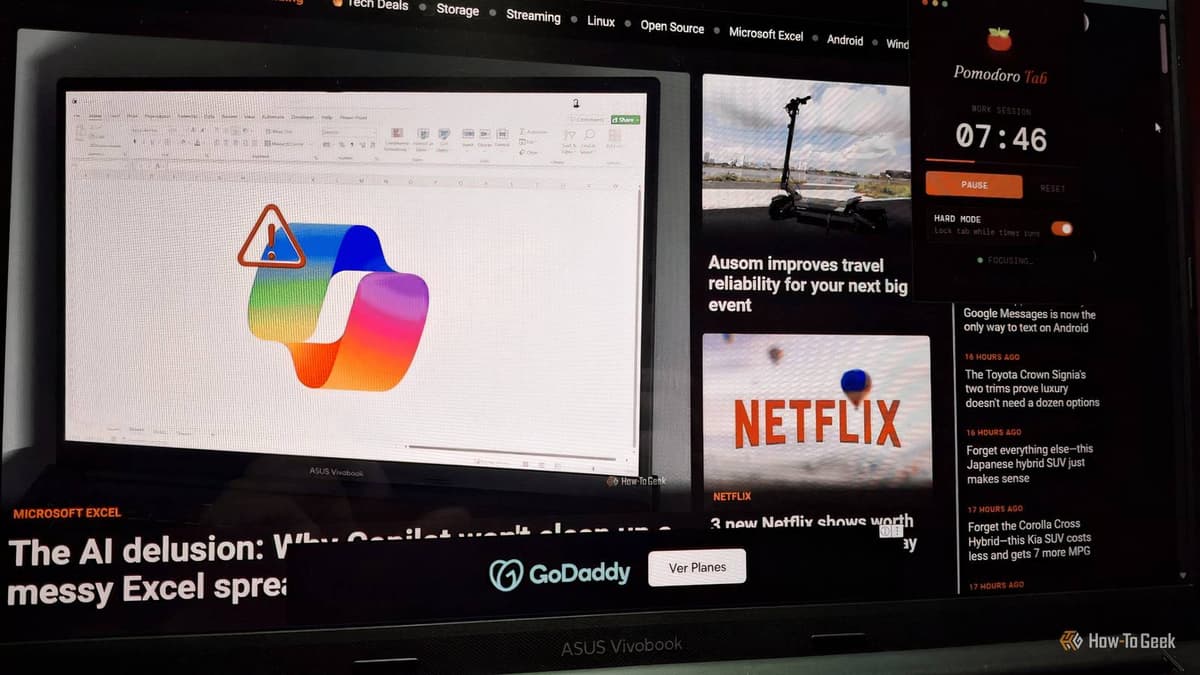
My Dream Google Chrome Extension Didn't Exist, so I Vibe Coded It with Claude
Companies Mentioned
Why It Matters
The tool shows AI‑assisted development can quickly deliver novel productivity features, potentially reshaping how developers build focus‑enhancing software and how users manage digital distraction.
Key Takeaways
- •Claude generated full Manifest V3 extension with styled UI.
- •Extension adds Pomodoro timer with selectable focus levels.
- •Hard Mode locks active tab, preventing navigation during sessions.
- •AI‑assisted coding reduced development time and iteration cycles.
- •Open‑source code available on GitHub for community use.
Pulse Analysis
Productivity apps have long relied on passive cues—timers, blockers, and reminders—to keep users on task, but they rarely intervene when attention drifts. The Pomodoro Tab extension flips that model by embedding enforcement directly into the browser. By offering multiple focus levels, from relaxed to strict, and a Hard Mode that automatically returns users to the designated tab, the extension tackles the “just one more” temptation that plagues traditional tools. This approach aligns with emerging research suggesting that proactive friction can improve sustained concentration in high‑distraction environments.
The development story underscores the growing role of generative AI in software engineering. Using Claude, the creator broke the project into discrete prompts—first generating a minimal Manifest V3 skeleton, then layering timer logic, and finally adding background scripts for tab‑locking. Each iteration produced complete code files, which were tested and refined locally. This “vibe‑coding” workflow cut down manual coding effort, accelerated debugging, and demonstrated how clear, task‑specific prompts can guide AI to produce production‑ready extensions without external libraries. The result is a clean, lightweight codebase that adheres to Chrome’s security policies while delivering sophisticated behavior.
For the broader market, the Pomodoro Tab illustrates a template for AI‑driven, niche productivity solutions. Its open‑source release invites developers to extend functionality—adding analytics, cross‑device sync, or adaptive focus algorithms—while the underlying enforcement concept could inspire new categories of browser extensions and SaaS tools. As AI coding assistants become more capable, we can expect faster prototyping of features that directly modify user behavior, potentially shifting the competitive landscape toward tools that not only remind but also compel focus. Organizations seeking to boost employee productivity may adopt similar AI‑crafted extensions to enforce digital discipline at scale.
My dream Google Chrome extension didn't exist, so I vibe coded it with Claude
Comments
Want to join the conversation?
Loading comments...