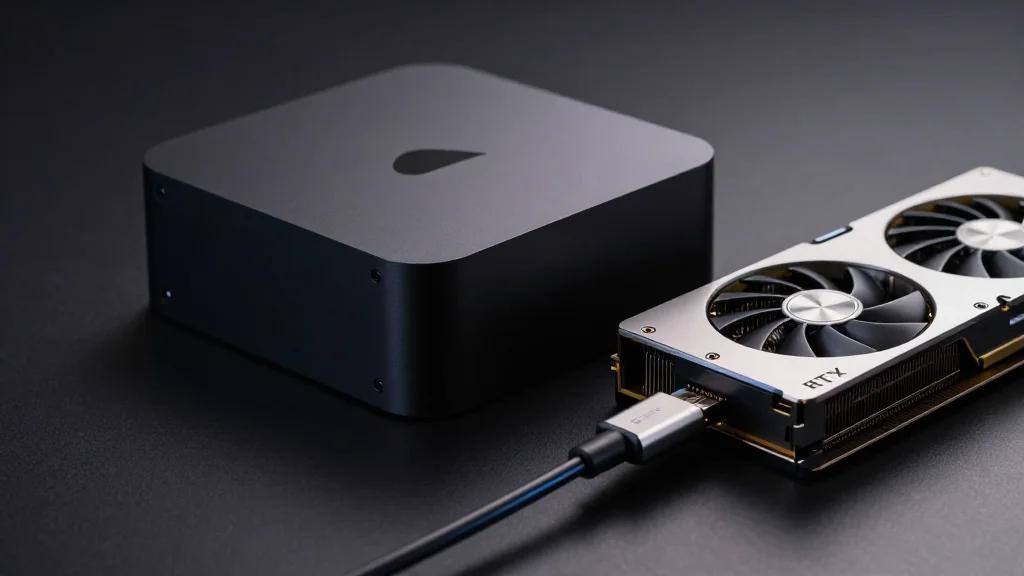
Someone Finally Got an RTX 5090 Running on a Mac – No Hacks Required
Companies Mentioned
Why It Matters
The driver proves that high‑end Nvidia GPUs can be integrated into macOS without hackery, opening new AI compute pathways for developers and potentially expanding the Mac ecosystem’s hardware options.
Key Takeaways
- •TinyGPU driver enables native Nvidia GPU on macOS without hacks
- •RTX 5090 runs via Thunderbolt on Mac Mini M4 Pro
- •Token generation hits 7.48 tokens/sec, lagging behind Metal
- •First-token latency three to four times faster than Metal
- •Driver delivers only 33 GB/s, far below GPU's 1.8 TB/s limit
Pulse Analysis
Apple’s decision in 2018 to drop Nvidia drivers left macOS users without native CUDA support, pushing AI developers toward AMD or cloud solutions. Tiny Corp’s TinyGPU changes that narrative by delivering a clean, Apple‑signed kernel extension that treats an external RTX 5090 like any other eGPU. The driver’s simplicity—plug‑and‑play over Thunderbolt or USB4—eliminates the need for virtual machines, kernel patches, or System Integrity Protection tweaks, making high‑end GPU compute accessible to a broader range of Mac professionals.
Performance testing reveals a mixed picture. While the RTX 5090’s raw compute power translates to 7.48 tokens per second on the Llama 3.1 8B model—modest compared with AMD‑based Metal implementations—the driver shines in latency‑sensitive scenarios. First‑token response times were three to four times quicker than native Metal, delivering a noticeably snappier chat experience. Yet overall inference remains roughly ten times slower than llama.cpp on Metal, primarily because TinyGPU currently moves data at only 33 GB/s versus the GPU’s 1.8 TB/s memory bandwidth. This bottleneck points to kernel‑level inefficiencies rather than Thunderbolt bandwidth constraints.
For the Mac AI community, TinyGPU is a proof‑of‑concept that could reshape hardware choices. Developers now have a pathway to leverage Nvidia’s cutting‑edge architectures, such as Blackwell, without abandoning Apple’s ecosystem. As Tiny Corp refines the driver—optimizing memory management, compiler pipelines, and kernel interactions—the performance gap may narrow, potentially making Macs a competitive platform for on‑device AI inference. The move also signals to hardware vendors that Apple is willing to certify third‑party GPU drivers, a development that could spur further innovation and broaden the market for high‑performance Mac workstations.
Someone finally got an RTX 5090 running on a Mac – no hacks required
Comments
Want to join the conversation?
Loading comments...