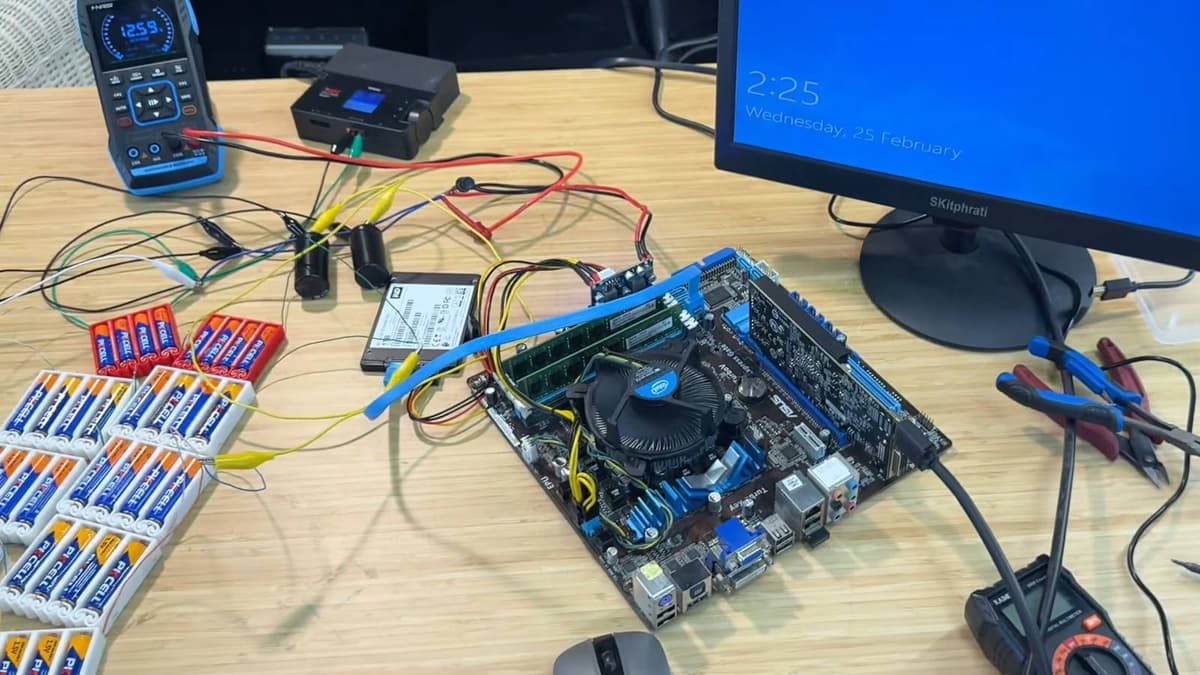
Someone Ran Their PC Off AA Alkaline Batteries, and It Lasted Longer than I Expected
•March 1, 2026
0
Why It Matters
It highlights the limits of conventional batteries for desktop power and reinforces why efficient, mains‑connected PSUs remain essential for cost, reliability, and sustainability.
Key Takeaways
- •56 AA batteries powered PC for two minutes
- •Capacitors smoothed voltage spikes during operation
- •GPU usage drained batteries within seconds
- •Traditional PSU cheaper and more eco‑friendly
- •Battery experiments highlight power efficiency challenges
Pulse Analysis
The XDA experiment stitched together 56 AA alkaline cells, each delivering roughly 1.5 V and 2 Ah, to reach the 12‑volt rail a typical desktop needs. At an estimated 150 W draw, the battery bank’s theoretical capacity translates to just over two minutes of runtime, which matches the observed 2 m 15 s before the system stalled. Adding electrolytic capacitors helped absorb the sudden current demands of the CPU and motherboard, preventing voltage collapse that would otherwise shut the machine down instantly.
Beyond novelty, the test offers insight into emergency power strategies. While a UPS normally relies on sealed lead‑acid or lithium‑ion packs for longer endurance, the AA setup demonstrates how voltage stability and spike mitigation are critical when using low‑capacity sources. GPUs, with their high transient loads, quickly exhaust such batteries, reinforcing the need for low‑power graphics or integrated solutions in battery‑critical scenarios. Engineers designing field‑deployable rigs must balance component selection with realistic power budgets to avoid premature shutdowns.
Environmentally, draining dozens of disposable alkaline cells for a brief gaming session is wasteful. Alkaline batteries contribute to landfill mass and contain chemicals that can leach over time. Modern desktops benefit from highly efficient switching PSUs that convert mains electricity with 80‑plus percent efficiency, reducing both cost and carbon footprint. As the industry pushes toward ARM‑based low‑power CPUs and more energy‑aware software, the relevance of such battery experiments shifts from practical use to educational proof‑of‑concept, reminding us that true sustainability lies in smarter hardware design rather than ad‑hoc power hacks.
Someone ran their PC off AA alkaline batteries, and it lasted longer than I expected
0
Comments
Want to join the conversation?
Loading comments...