Consumer Tech News and Headlines
  • All Technology
  • AI
  • Autonomy
  • B2B Growth
  • Big Data
  • BioTech
  • ClimateTech
  • Consumer Tech
  • Crypto
  • Cybersecurity
  • DevOps
  • Digital Marketing
  • Ecommerce
  • EdTech
  • Enterprise
  • FinTech
  • GovTech
  • Hardware
  • HealthTech
  • HRTech
  • LegalTech
  • Nanotech
  • PropTech
  • Quantum
  • Robotics
  • SaaS
  • SpaceTech
AllNewsDealsSocialBlogsVideosPodcastsDigests

Consumer Tech Pulse

EMAIL DIGESTS

Daily

Every morning

Weekly

Sunday recap

NewsDealsSocialBlogsVideosPodcasts
Consumer TechNewsWe’re Not the only Ones Saying It: Windows 11 Desperately Needs a Single Privacy Toggle
We’re Not the only Ones Saying It: Windows 11 Desperately Needs a Single Privacy Toggle
Consumer TechCybersecurity

We’re Not the only Ones Saying It: Windows 11 Desperately Needs a Single Privacy Toggle

•February 19, 2026
0
Windows Central
Windows Central•Feb 19, 2026

Companies Mentioned

Microsoft

Microsoft

MSFT

Cisco

Cisco

CSCO

VMware

VMware

VMW

Why It Matters

Fragmented privacy settings erode user confidence and could hinder Windows 11 adoption, while a unified toggle would reinforce trust and regulatory compliance.

Key Takeaways

  • •Privacy toggles scattered across Windows 11 settings menus.
  • •Telemetry remains enabled by default despite user adjustments.
  • •Users demand a single master privacy switch.
  • •Fragmented controls increase complexity and reduce trust.
  • •Centralizing privacy could strengthen Windows 11’s market position.

Pulse Analysis

Windows 11’s privacy architecture reflects a legacy of incremental feature integration rather than a cohesive data‑governance strategy. Settings for telemetry, cloud sync, search personalization, and backup are tucked into separate panels—Start, Search, Device usage, and OneDrive—making it difficult for even seasoned administrators to verify what data leaves the device. This fragmentation not only burdens users with a lengthy checklist of toggles but also creates blind spots where Microsoft can continue to harvest usage metrics, a practice that runs counter to the transparency expectations set by modern privacy regulations.

Across the broader operating‑system market, competitors are consolidating privacy controls to meet GDPR, CCPA, and emerging data‑sovereignty laws. Apple’s iOS offers a clear “Share iPhone Analytics” toggle, while Google’s Android provides a centralized “Usage & diagnostics” switch, both of which are prominently displayed during device setup. These streamlined approaches signal to consumers that privacy is a core product value rather than an afterthought. Windows 11’s scattered settings therefore place it at a competitive disadvantage, especially among privacy‑conscious enterprises and developers who must document compliance for audits.

Introducing a master privacy switch in Windows 11 would address these gaps by disabling non‑essential telemetry and data collection with a single action. Such a feature could be integrated into the existing Settings hub, alongside account and update controls, preserving the OS’s modular design while enhancing user agency. The move would likely boost consumer confidence, reduce support overhead, and align Microsoft with industry best practices, ultimately strengthening Windows 11’s position in a market where data stewardship is increasingly a differentiator.

We’re not the only ones saying it: Windows 11 desperately needs a single privacy toggle

The illusion of privacy controls

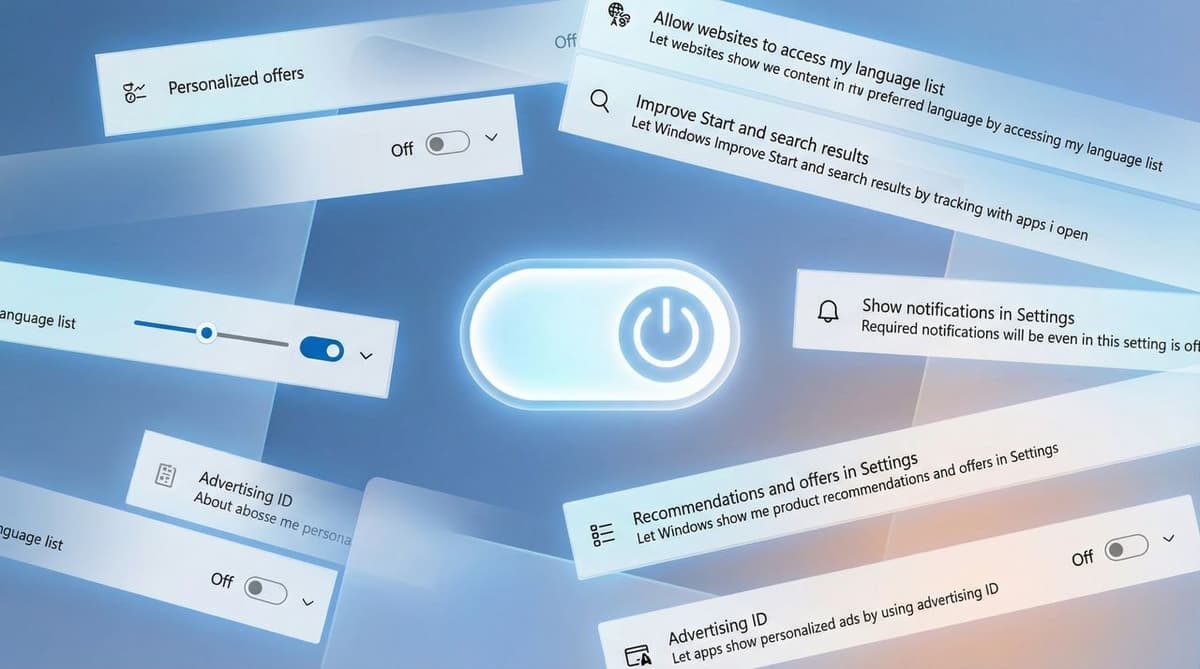
The settings for privacy in Windows 11 are scattered all over the place and can be difficult to find.

(Image credit: Windows Central | Edited with Gemini)

While writing my most recent comprehensive guide to improve privacy on Windows 11, I started noticing just how many settings you have to manage to reduce the amount of data Microsoft collects from devices and users.

At one point, I genuinely thought I would never finish that set of instructions. Every time I believed I had found the last toggle, another appeared somewhere else. And even after turning off and reconfiguring dozens of default options, it's still unclear how much data the company continues to collect in the background.


Privacy settings are not completely centralized

The Start settings include recommendations, suggestions, and account‑linked experiences. The Search settings integrate cloud content and web results, and the Device usage page influences personalized tips and content.

If you use a Microsoft account to set up Windows 11, it also serves as another source of data mining, as it connects settings, preferences, and usage data across devices, and the data has to traverse the Microsoft network. (So, who really knows what happens in transit?)

The Windows Backup system and OneDrive also rely on Microsoft’s infrastructure.

Windows backup settings

(Image credit: Mauro Huculak)

Windows Update gathers telemetry to determine compatibility and deliver updates, and diagnostic data settings allow reducing, but not eliminating, telemetry on most editions.

This fragmentation makes privacy management overwhelming and opaque. You are not managing one privacy system. You are navigating a network of interconnected services, cloud integrations, personalization engines, and telemetry pipelines. Many of them cannot be fully disabled, but can only be minimized. Others are tied directly to core functionality.


Managed collection is the real default

If I didn’t know better, I would think this level of complexity is intentional.

Windows 11 makes it feel like you’re in control, but behind the scenes data collection is still deeply built into the system. The default isn’t minimal data gathering; it’s controlled data gathering. And that’s the real problem.

The operating system should include a single, system‑wide master switch that disables all non‑essential telemetry and data collection. It shouldn’t be buried in submenus, split across different sections, or scattered throughout dozens of settings pages. In addition, every app should explicitly request users whether they want to send telemetry. The default should be “off,” not “on.”


Users are noticing and pushing back

I’m not the only one noticing this. In my previous set of instructions on controlling Microsoft’s data collection, readers were blunt. For example, Harold56 wrote:

“Something is seriously wrong that there are so many tracking features that have to be individually turned off. There should be one button to stop all tracking and telemetry.”

Another reader, IDont Know, added:

“It’s insane and a clear deterrent from me ever using Windows 11 on my personal devices.”

That frustration is growing. Not because people are against updates or security, not because they don’t understand telemetry, but because all the responsibility falls on them.


Windows 11 needs a real privacy master switch

Privacy should not require a checklist of dozens of toggles across half the operating system. It should not require a 5,000‑word guide to manage privacy carefully.

Microsoft has the engineering capability to centralize these controls. It already centralizes updates, accounts, and cloud services. So, centralizing privacy shouldn’t be that complicated.

A master privacy switch would not weaken Windows 11. It would strengthen trust. It would send a clear message that user choice matters more than passive data collection.

Until that happens (if ever), privacy on Windows 11 remains a maze. No modern operating system should require users to solve a maze just to feel in control of their own data.


Do you think Windows 11 privacy settings are out of control?

Windows 11’s privacy settings are scattered across so many menus that even power users are getting fed up — and a lot of you told us you feel the same way. A single master switch could solve half the confusion overnight, but until Microsoft gives us one, we’re stuck hunting through toggles like it’s a scavenger hunt.

How are you dealing with Windows 11’s privacy maze?

Do you have a go‑to workflow, a setting you always change first, or a pain point we didn’t mention?


Author

Mauro Huculak has been a Windows How‑To Expert contributor for WindowsCentral.com for nearly a decade and has over 22 years of combined experience in IT and technical writing. He holds various professional certifications from Microsoft, Cisco, VMware, and CompTIA and has been recognized as a Microsoft MVP for many years.

Read Original Article
0

Comments

Want to join the conversation?

Loading comments...