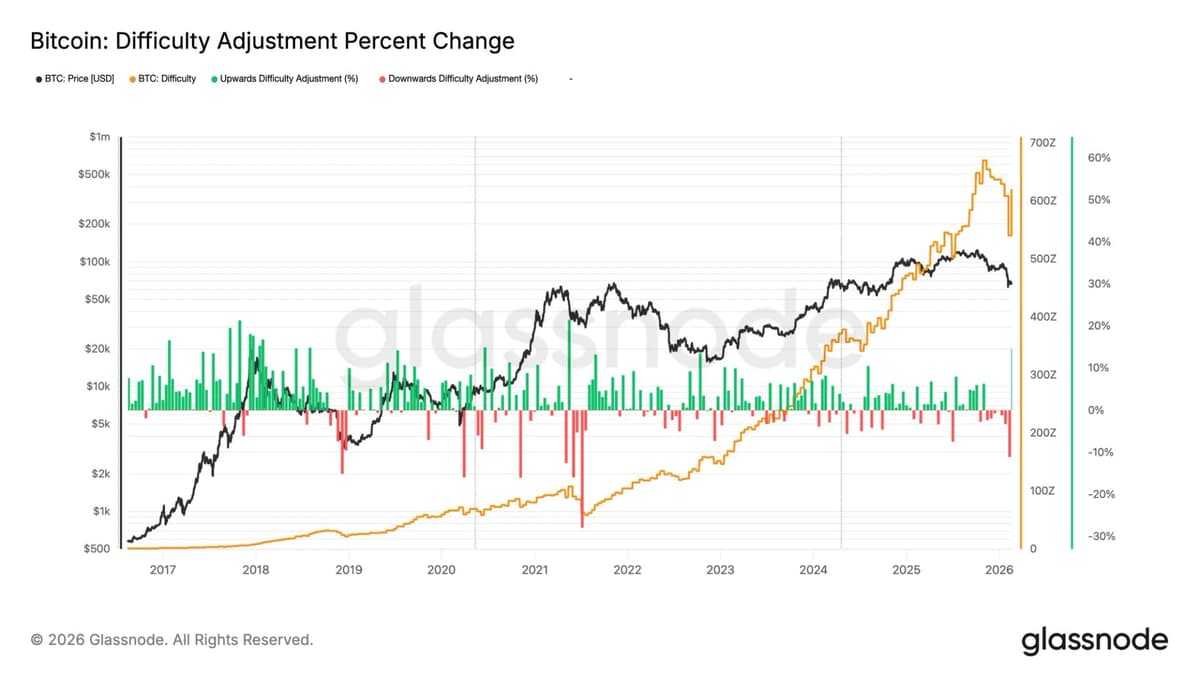
Bitcoin Difficulty Jumps 15% Largest Increase Since 2021, Despite Price Slump
•February 20, 2026
0
Why It Matters
Higher difficulty signals a resilient hashpower base that secures the blockchain, even as miner margins tighten, influencing Bitcoin’s long‑term stability and investment appeal.
Key Takeaways
- •Difficulty rose 15% to 144.4 T, biggest since 2021.
- •Hashrate rebounded to 1 ZH/s despite price slump.
- •Hashprice fell to $23.9 per PH/s, multi‑year low.
- •UAE mining profit $344 M shows advantage of cheap energy.
- •Miners reallocate to AI data centers, reducing network hashpower.
Pulse Analysis
The 15% difficulty increase underscores the self‑correcting nature of Bitcoin’s proof‑of‑work protocol. Every 2,016 blocks the network recalibrates to maintain a ten‑minute block interval, and a surge in difficulty typically reflects a surge in total computational power. By pushing difficulty to 144.4 trillion, the system is absorbing a higher hashrate, which bolsters security against attacks and reinforces confidence among institutional participants who monitor network robustness as a risk metric.
From an economic perspective, the hashprice—miners’ revenue per unit of hashrate—has slumped to roughly $23.9 per petahash‑second, compressing profit margins across the sector. Yet well‑capitalized operators with access to subsidized electricity, exemplified by the United Arab Emirates’ estimated $344 million in unrealized profit, can continue mining aggressively. This disparity highlights a growing bifurcation: small‑scale miners face sustainability challenges, while large entities leverage economies of scale to maintain network hashrate despite subdued Bitcoin prices.
Concurrently, a strategic pivot toward artificial‑intelligence and high‑performance‑computing workloads is reshaping the mining landscape. Companies such as Bitfarms and Riot Platforms are reallocating hardware to AI data centers, a trend that temporarily depresses hashpower but may diversify revenue streams. As AI demand accelerates, the industry could see a gradual rebalancing of resources, potentially moderating future difficulty adjustments. Stakeholders should monitor these shifts, as they will affect both the security dynamics of the Bitcoin network and the broader profitability calculus for miners.
Bitcoin difficulty jumps 15% largest increase since 2021, despite price slump
0
Comments
Want to join the conversation?
Loading comments...