Bitcoin in a Deep Bear Market Against Gold, History Suggests Downside May Persist
•January 22, 2026
0
Why It Matters
The widening gap challenges Bitcoin’s digital‑gold narrative and signals prolonged underperformance for crypto‑focused investors, affecting asset‑allocation decisions across the market.
Key Takeaways
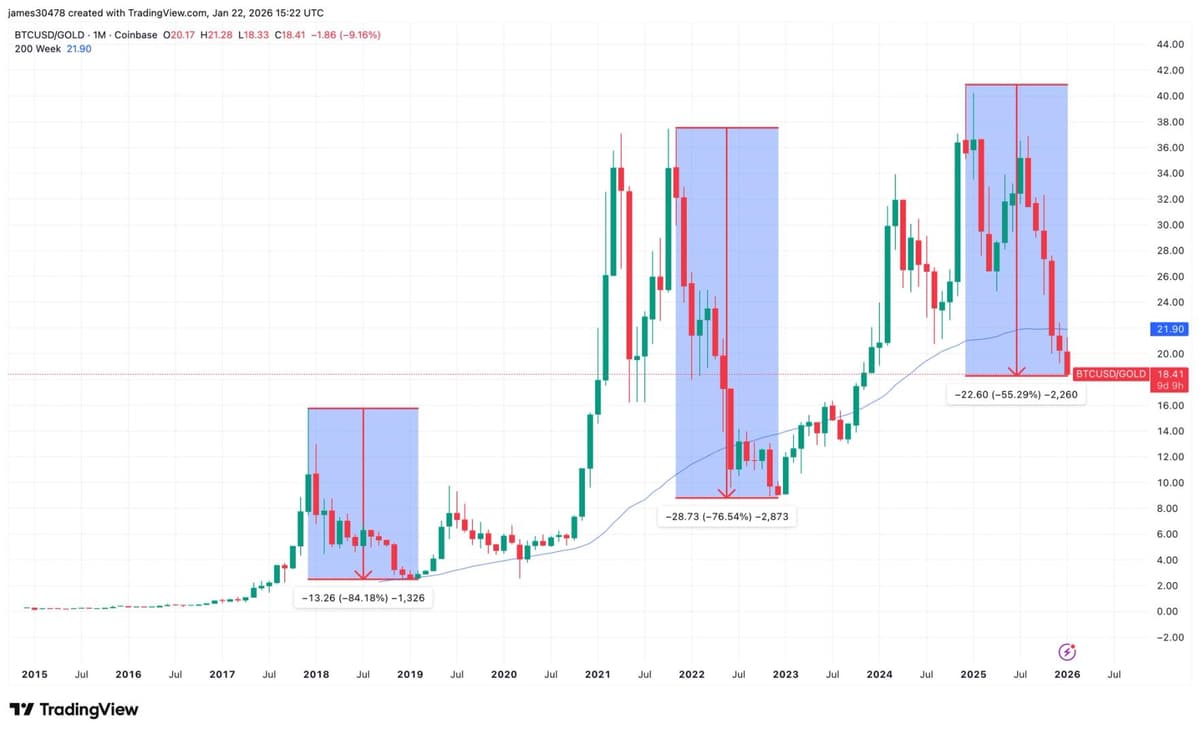
- •Bitcoin down 55% vs gold since Dec 2024 peak
- •BTC‑gold ratio at 18.46, 17% below 200‑WMA
- •Gold up ~12% YTD, Bitcoin barely positive
- •Past bear markets saw deeper ratio declines
- •Ratio could stay below 200‑WMA through late 2026
Pulse Analysis
The recent divergence between Bitcoin and gold highlights a shifting risk‑on/risk‑off dynamic in the broader investment landscape. While gold rallies toward a $4,900 per‑ounce record, buoyed by inflation concerns and safe‑haven demand, Bitcoin’s modest year‑to‑date gains mask a steep 55% slide against the precious metal. The BTC‑to‑gold ratio, now at 18.46, trails its 200‑week moving average by 17%, a technical signal that historically precedes extended periods of relative weakness for the cryptocurrency.
Historical precedent offers a cautionary lens. In the 2022 bear market, the ratio plunged more than 30% below its long‑term average and lingered there for over twelve months, while earlier cycles in 2017‑2018 saw even sharper declines. Those episodes coincided with heightened regulatory scrutiny, macro‑economic tightening, and a retreat from speculative assets. Investors who treated Bitcoin as a digital counterpart to gold found portfolio volatility spike, prompting a reallocation toward traditional safe havens. The current trajectory suggests a similar environment may be re‑emerging, with the ratio potentially staying subdued until at least late 2026.
For portfolio managers and institutional players, the implications are clear: diversification strategies must account for Bitcoin’s diminishing correlation with gold and its heightened sensitivity to broader market sentiment. Monitoring the 200‑week moving average of the BTC‑gold ratio can serve as an early warning indicator for timing exposure adjustments. Moreover, the prolonged underperformance may accelerate the search for alternative crypto assets or stablecoin yields, reshaping the digital‑asset allocation framework. Understanding these dynamics equips investors to navigate the evolving narrative of Bitcoin as either a speculative play or a true store of value.
Bitcoin in a deep bear market against gold, history suggests downside may persist
0
Comments
Want to join the conversation?
Loading comments...