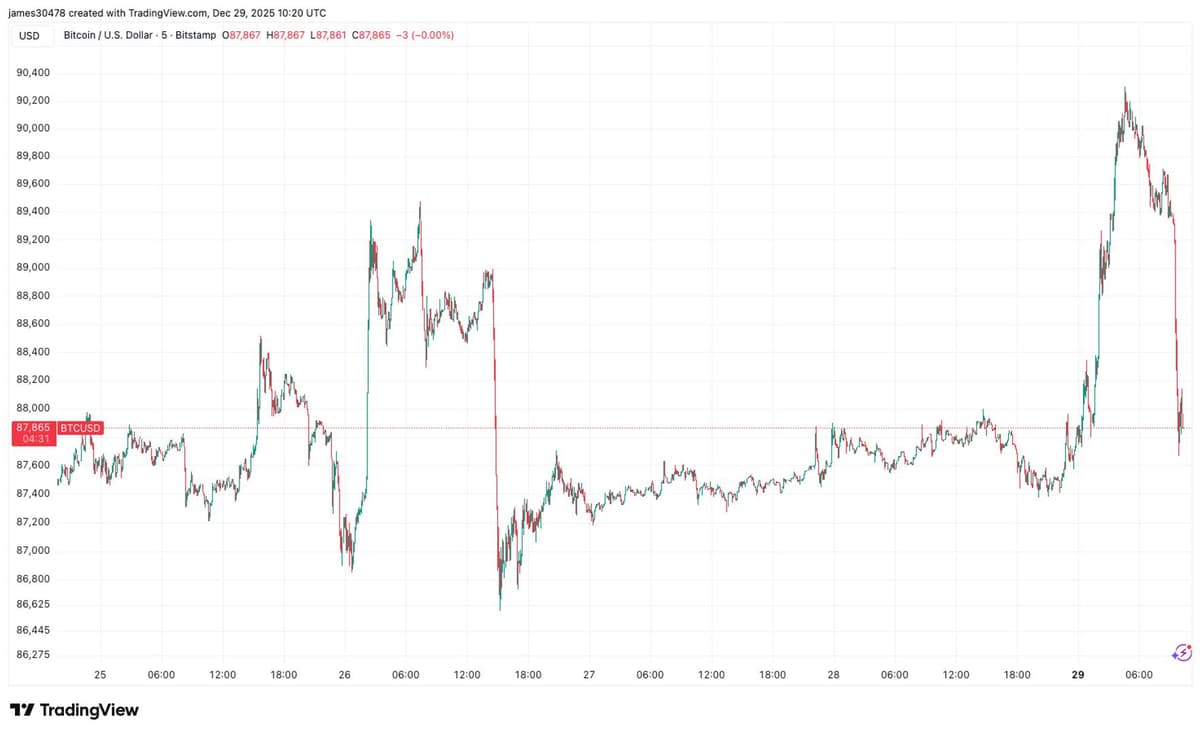
Bitcoin Reverses Early Gains, Drops Below $88,000 as Nasdaq Futures Wilt
•December 29, 2025
0
Companies Mentioned


Why It Matters
The move highlights crypto’s sensitivity to equity market swings, influencing risk‑on/off flows and positioning strategies across both asset classes.
Key Takeaways
- •Bitcoin slipped below $88k, losing $2k gains.
- •Nasdaq futures down 0.5%, reinforcing crypto‑stock correlation.
- •Global BTC futures open interest fell to 533k BTC.
- •Altcoins (ETH, SOL, DOGE) retreated alongside Bitcoin.
- •Analysts expect sideways trade, buying dips $71‑84k.
Pulse Analysis
Bitcoin’s recent price swing illustrates the growing interdependence between digital assets and traditional equities. When Nasdaq 100 futures slipped, Bitcoin mirrored the decline, reinforcing a correlation that traders monitor for cross‑market signals. This relationship is especially pronounced during equity pullbacks, as algorithmic and macro‑funds adjust exposure across correlated risk assets. Understanding this dynamic helps investors anticipate crypto volatility in response to broader market sentiment, rather than treating Bitcoin as an isolated market.
Futures open interest provides a window into trader confidence and leverage usage. The contraction to about 533,000 BTC signals that participants are trimming positions after the brief rally to $90,000, a reaction amplified by year‑end tax‑loss harvesting that has pressured crypto assets during U.S. trading hours. Lower open interest often precedes reduced liquidity, which can exacerbate price swings when large orders hit the market. Monitoring these metrics offers insight into the health of the derivatives ecosystem and potential spill‑over effects on spot prices.
Looking ahead, market sentiment remains mixed. While Elliott‑wave analyst John Glover sees a promising longer‑term chart, he advises a sideways to slightly lower trajectory in the near term, targeting entry zones between $71,000 and $84,000. This cautious stance reflects the uncertainty introduced by macroeconomic data releases and equity market volatility. Investors seeking exposure should balance the allure of lower‑priced entry points with the risk of continued underperformance during U.S. hours, employing diversified strategies and prudent risk management to navigate the evolving landscape.
Bitcoin reverses early gains, drops below $88,000 as Nasdaq futures wilt
0
Comments
Want to join the conversation?
Loading comments...