Bitcoin Slides Toward $91,000 with Two CME Pricing Gaps Coming Into Focus
•January 7, 2026
0
Companies Mentioned


Why It Matters
If the gaps fill, Bitcoin could experience a short‑term correction, influencing both futures and ETF markets and shaping trader sentiment across the crypto ecosystem.
Key Takeaways
- •Bitcoin trades just above $91,000.
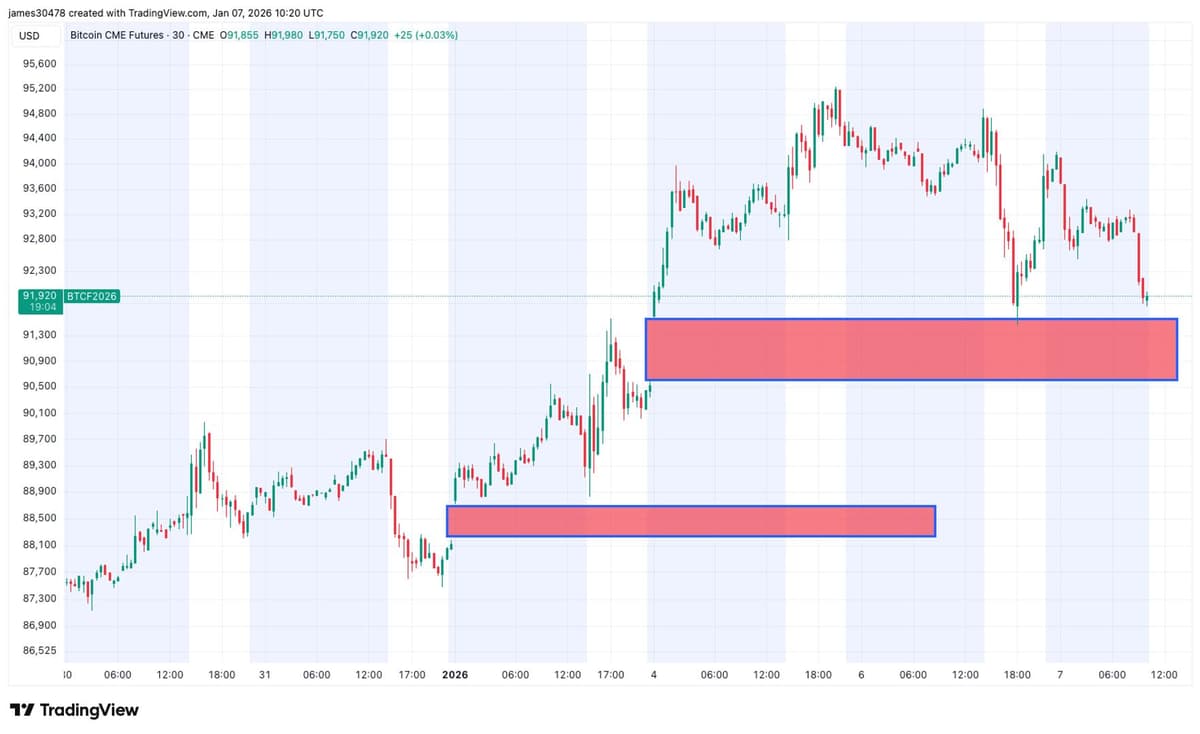
- •CME futures gap sits near $90,600.
- •Gap fill historically triggers short-term retracements.
- •IBIT ETF shows parallel $48‑$50 gaps.
- •Filling gaps could push price down 1.6%‑4%.
Pulse Analysis
CME Bitcoin futures, unlike spot markets, pause each day and over weekends, creating price discontinuities known as gaps. When Bitcoin’s price moves sharply during these closures, a gap forms between the last settlement price and the reopening level. Traders monitor these gaps because historical data shows a propensity for the market to "fill" them—revisiting the gap area within days or weeks. The current weekend gap, spanning roughly $90,600 to $91,600, sits just below today’s price, making it a focal point for short‑term technical strategies.
The gap‑fill phenomenon mirrors the max‑pain theory in options, where collective trader expectations create self‑fulfilling price targets. Market participants often place orders anticipating a retracement toward the gap, amplifying momentum as the price approaches the level. Empirical evidence suggests many gaps close within the first week, though outliers persist. For Bitcoin, a 1.6% decline would erase the weekend gap, while a deeper 4% move would also close the New Year’s Day gap near $88,000, potentially resetting short‑term support and resistance zones.
The emergence of similar gaps in BlackRock’s iShares Bitcoin Trust (IBIT) adds a new layer to the narrative. IBIT’s price recently settled at $52.45, leaving open gaps around $48 and $50—levels that could act as analogues to CME gaps for ETF investors. As institutional products like IBIT gain liquidity, their trading patterns may increasingly influence Bitcoin’s broader price dynamics, aligning spot, futures, and ETF markets around shared technical reference points. This convergence could heighten volatility during gap‑fill events, offering both risk and opportunity for sophisticated traders.
Bitcoin slides toward $91,000 with two CME pricing gaps coming into focus
0
Comments
Want to join the conversation?
Loading comments...