Bitcoin’s Negative Correlation With Nasdaq Persists, and History Suggests a Bottom May Be Forming
•December 4, 2025
0
Companies Mentioned

Why It Matters
The divergence highlights Bitcoin’s decoupling from traditional risk assets, offering potential entry points for investors. It also underscores the importance of correlation metrics in forecasting crypto market cycles.
Key Takeaways
- •Bitcoin down 27% while Nasdaq near record highs.
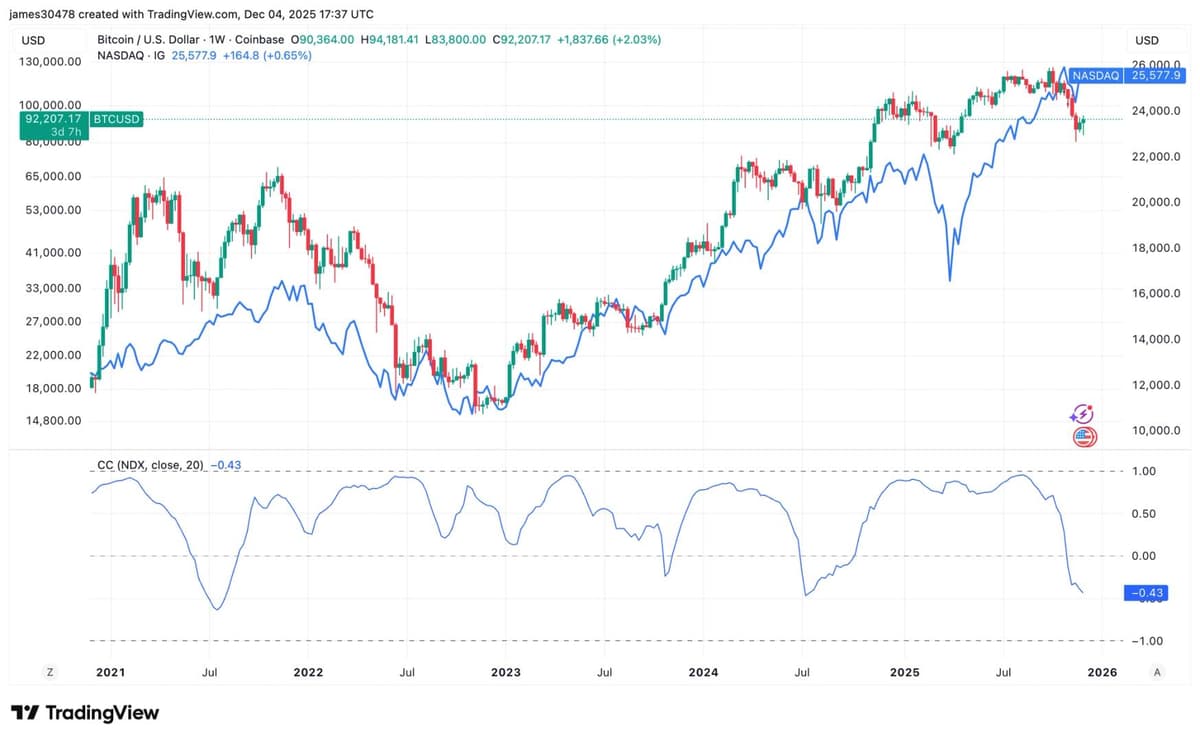
- •Correlation coefficient now -0.43, indicating divergence.
- •Past negative correlation periods preceded Bitcoin bottoms.
- •Current setup may signal a new Bitcoin bottom.
Pulse Analysis
Negative correlation between Bitcoin and the Nasdaq 100 has become a valuable barometer for crypto analysts. When the 20‑day correlation coefficient dips below zero, it signals that Bitcoin is moving independently of the broader tech‑heavy equity market. Historical data from July 2021, September 2023 and August 2024 reveal that each negative swing preceded a pronounced Bitcoin trough, suggesting that investors can use this metric to anticipate market turning points.
The current landscape amplifies that signal. Bitcoin has retreated roughly 27% from its October all‑time high, whereas the Nasdaq 100 remains within 2% of its record, reflecting a stark risk‑on/risk‑off split. Macro factors such as tightening monetary policy and shifting capital flows have pressured risk assets, yet the equity index’s resilience contrasts sharply with crypto’s slump. This divergence is captured by a –0.43 correlation reading, echoing past periods when Bitcoin’s price bottomed before rallying.
For market participants, the implication is twofold. First, a sustained negative correlation may present a strategic entry point for long‑term Bitcoin investors seeking value after a deep correction. Second, reliance on correlation alone is insufficient; traders should combine it with on‑chain metrics, macroeconomic cues, and liquidity analysis to gauge the timing of any rebound. While the pattern hints at a potential bottom, uncertainty remains, and prudent risk management remains essential as the crypto market navigates the next cycle.
Bitcoin’s Negative Correlation With Nasdaq Persists, and History Suggests a Bottom May Be Forming
0
Comments
Want to join the conversation?
Loading comments...