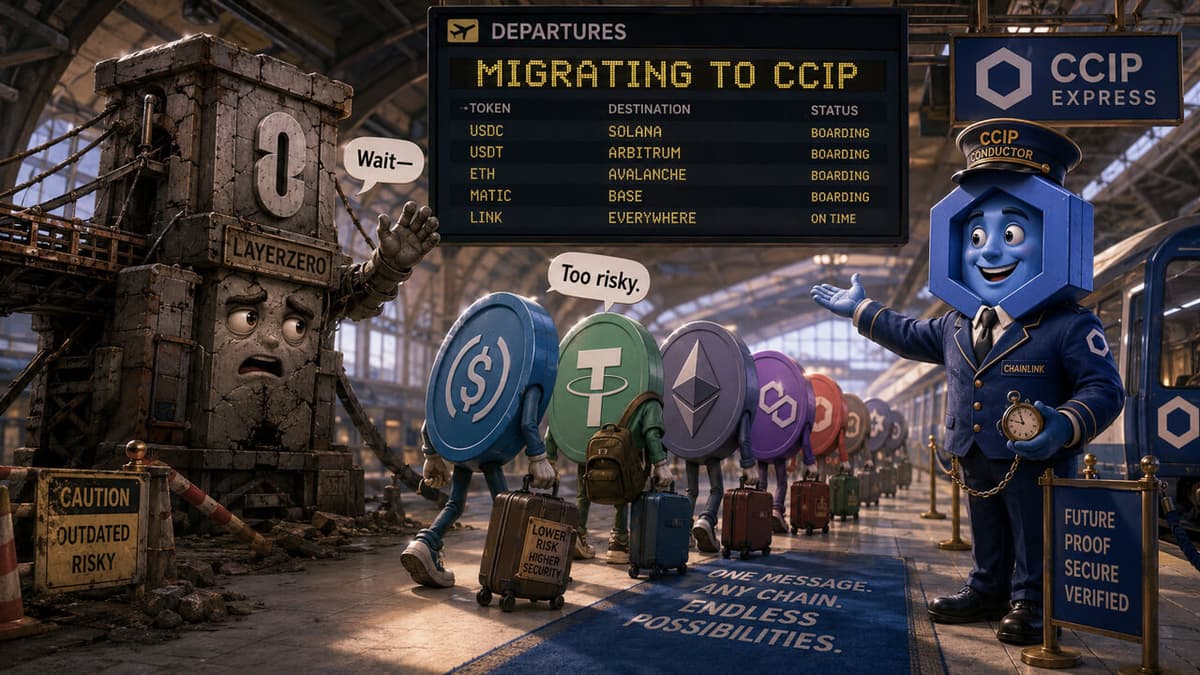
Chainlink Emerges as the Unlikely $3B Winner of KelpDAO Exploit as DeFi Projects Dump LayerZero
Companies Mentioned
Why It Matters
The shift validates Chainlink’s CCIP as a trusted cross‑chain standard, reshaping infrastructure choices and potentially reallocating billions of dollars in DeFi capital.
Key Takeaways
- •DeFi protocols shifted $3 B TVL to Chainlink CCIP after KelpDAO hack
- •LINK token rose 15% to $10.52, its highest since January
- •Exchange reserves of LINK fell 13.5 M tokens, a 10.5% drop
- •LayerZero admitted oversight lapse, citing single verifier risk
- •Over $9 B continued to flow through LayerZero despite the exploit
Pulse Analysis
The $292 million breach of KelpDAO has reignited scrutiny of cross‑chain bridges, long regarded as the weakest link in DeFi security. In the wake of the attack, protocols controlling more than $3 billion in total value locked announced migrations to Chainlink’s Cross‑Chain Interoperability Protocol (CCIP). By decommissioning legacy oracles and bridge stacks, projects such as Solv Protocol, Re and Tydro are betting on Chainlink’s decentralized oracle network to provide a standardized, auditable security layer. The shift underscores a growing preference for proven, on‑chain verification over bespoke bridge designs.
The migration wave translated into immediate market momentum for LINK. The token jumped 15 % to $10.52, its strongest level since January, while on‑chain analytics show exchange‑held LINK falling by 13.5 million units—a 10.5 % contraction of available supply. Investors appear to be pricing in the expectation that Chainlink will capture a larger share of the cross‑chain infrastructure market, expanding its revenue beyond price‑feed services. The price action also signals confidence that CCIP can safeguard the $3 billion of assets now earmarked for its use.
LayerZero, the former bridge of choice for KelpDAO, has tried to stem the outflow by acknowledging a mis‑configuration that allowed a single Decentralized Verifier Network to secure high‑value transactions without sufficient guardrails. Despite the apology, the protocol still processes more than $9 billion of cross‑chain traffic and hosts assets like USDe and WBTC. The episode highlights a broader industry debate: whether flexibility and custom security models can coexist with the institutional demand for default, hardened safeguards. As DeFi matures, the balance between modularity and risk mitigation will likely dictate the next generation of cross‑chain standards.
Chainlink emerges as the unlikely $3B winner of KelpDAO exploit as DeFi projects dump LayerZero
Comments
Want to join the conversation?
Loading comments...